
Private label manufacturers in Germany
German manufacturing is defined by precision engineering, process efficiency, and a focus on high-quality outputs, particularly in dietary supplements, complex skincare, and certified organic foods. The country's strength is rooted in its "Mittelstand" - a vast network of family-owned, highly specialized small and medium-sized enterprises. These suppliers leverage advanced automation and a skilled workforce, supported by a dense infrastructure of raw material providers and research institutes, especially in regions like North Rhine-Westphalia and Baden-Württemberg. Sourcing from Germany means engaging with a market that prioritizes quality and reliability over the lowest price. Minimum order quantities (MOQs) are typically higher than in Eastern Europe, often starting at 5,000-10,000 units, as production is geared towards automated, large-scale runs. English proficiency is high in commercial roles, but communication is formal and direct. Expect detailed contracts and a strong emphasis on written specifications and documentation. Lead times are predictable, usually between 8 and 14 weeks.
- Featured suppliers
- 41
- Featured categories
- 52
- Region
- Western Europe
- Nearby countries
- 6
Sourcing from Germany
German manufacturing is defined by precision engineering, process efficiency, and a focus on high-quality outputs, particularly in dietary supplements, complex skincare, and certified organic foods. The country's strength is rooted in its "Mittelstand" - a vast network of family-owned, highly specialized small and medium-sized enterprises. These suppliers leverage advanced automation and a skilled workforce, supported by a dense infrastructure of raw material providers and research institutes, especially in regions like North Rhine-Westphalia and Baden-Württemberg.
Sourcing from Germany means engaging with a market that prioritizes quality and reliability over the lowest price. Minimum order quantities (MOQs) are typically higher than in Eastern Europe, often starting at 5,000-10,000 units, as production is geared towards automated, large-scale runs. English proficiency is high in commercial roles, but communication is formal and direct. Expect detailed contracts and a strong emphasis on written specifications and documentation. Lead times are predictable, usually between 8 and 14 weeks.
Where Germany is genuinely competitive
- Dietary Supplements
Strong clusters of highly automated contract manufacturers, especially for capsules, tablets, and powders. Deep expertise in GMP and regulatory documentation for EU markets.
BLL industry data 2023
- Scientific Skincare
Focus on derma-cosmetics and active ingredient efficacy, supported by research institutes. High adoption of ISO 22716 GMP and airless packaging.
IKW Sector Report
- Organic & Certified Foods
Mature market for organic products drives a large pool of EU 2018/848 certified suppliers. High standards for private label driven by retailers like Edeka and Rewe.
Biofach Annual Report
- Household Chemicals
Leverages Germany's large chemical industry base (e.g. BASF, Henkel). Expertise in concentrated formulas and compliance with EU REACH and CLP regulations.
VCI Industry Data
- Confectionery
Global leader in producing gums, jellies, and chocolate. Highly automated production lines and deep experience with IFS Food a standard practice.
ISM Cologne Exhibitor Data
Featured manufacturers in Germany
 View profileBMP Production
Expert Contract Manufacturer
CapsulesIron supplementPowder supplements+1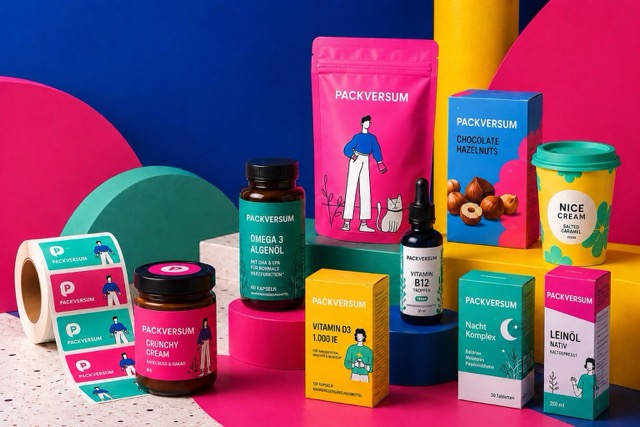 View profilePackversumHayderstr. 5, 88299 Leutkirch im Allgäu
Top German packaging supplier for primary packaging, secondary packagin, labels and flexible formats
Cosmetic PackagingPaper bagsSustainable Packaging+1 View profileArboretum NutraUrbanstrasse 71, 10967 Berlin, Germany
German contract manufacturer for supplements and functional food. Low MOQs, perfect for startups and brands.
CapsulesIron supplementPowder supplements View profileAzba CosmeticsJustus‑von‑Liebig‑Str. 4, 12489 Berlin, GermanyFace tonerShampooBeauty+1
 View profilePure Flavour
Supplements contract manufacturer from Munich
Liquid SupplementsVitamin D3Vitamin Spray+1- DPView profiledp DermaPerfect GmbHAm Sonnenrain 9, 79539 Lörrach, Germany
Family-owned German skincare manufacturer specializing in nature-based dermocosmetic formulations with production in Switzerland.
- COView profileCosmacon GmbHSchenefeld, Hamburg, Germany
German cosmetic formulation experts specializing in custom development and certified natural cosmetics since 2013.
 View profileHL Hamburger Leistungsfutter GmbH
Advancing Animal Nutrition with Innovative Feed Formulas
Pet ProductsBird food View profileAtinacosmetics GmbHWilhelmstraße 9, 33602 Bielefeld, Germany
Customized Solutions from a Premier Cosmetics Manufacturer
BeautyEye creamSkincare+1 View profileHK Koch Cosmetic Packaging
High-end Cosmetic packaging supplier from Germany
Cosmetic Packaging- FRView profileFreiburger Lebensmittel GmbH (Freiburger Pizza)
European Leader in Private Label Frozen Pizzas
Frozen PizzaFoodPizza Dough+1  View profileGiuliano’s Specialty Foods
European excellence in brioche burger buns for wholesale and private label.
Burger BunBrioche Burger Bun View profileDreiturm GmbH
Experts in Hygiene, Health, and Beauty Solutions
Beauty View profileWiegand-Glas
Comprehensive Services From a Single Source
Glass bottleGlass jars View profilePIOflex
Sustainable Paper Straw Manufacturer
Paper straws View profileAmazonas Products
Sustainable Private Label Packaging
Paper bags View profileUnopack
High-Quality Private Label Paper Bags
Paper bags View profilePackhelp
Sustainable Private Label Paper Bags
Paper bags View profileSeitz Heimtiernahrung
Trusted Private Label Partner for Premium Pet Food
Pet food View profileHeristo Group
Reliable Partner for High-Quality Private Label Pet Food
Pet food View profileMERA
Family-Owned Expertise in Premium Pet Food Manufacturing
Pet food View profileNava CandlesBerlin, Germany
Private label & white label candle manufacturer
Soy candlesCandlesScented candles- EIView profileEifrisch-Vermarktung GmbHLohne (Oldenburg), Lower Saxony, Germany
Leading European egg marketer and private label supplier with vertically integrated operations across Germany.
Eggs - GUView profileGutshof-Ei GmbHSchackendorf, Schleswig-Holstein, Germany
One of Germany's largest egg producers with 3 million laying hens across 60 partner farms.
Eggs - COView profileColumbus Frischei GmbHSchöppingen, NRW, Germany
Sixth-generation family business with modern packing and egg-coloring facilities in NRW.
Eggs - EIView profileEierhof Hennes GmbHEuskirchen, NRW, Germany
Third-generation egg producer in NRW supplying Aldi with organic and free-range eggs.
Eggs - BAView profileBaumeister Frischei GmbHBreckerfeld, NRW, Germany
Family-run egg producer near Ruhr area with 50+ years of experience in animal-friendly housing.
Eggs  View profileTBS-Pack
Packaging films, bags and trays for industrial packaging
 View profileBiologisch Verpacken
Your Partner for Sustainable Packaging Solutions
Sustainable Packaging View profileMinderleinsmühle
Premium Private Label Food Solutions
Granola View profileBeyond Jewelry
Crafting Exquisite Custom Jewelry for Private Label Brands
Earrings View profileKHK GmbH
Expert Manufacturer of Premium Private Label Lip Care Products
BeautyLip balmBody butter View profileHK Müller
Injection-molded plastic packaging manufacturer
Cosmetic Packaging View profileSK UV Gele
Private Label UV Gel Manufacturer
Nail CareNail Polish View profileStrubl
Packaging films, bags, and cleanroom packaging for industry
 View profileAmapharm GmbH
The leading gummy private label manufacturer located in Germany
Immunity GummiesVitamin GummiesBeauty Gummies+1 View profileNat Food GmbH
Private Label Healthy Bar Manufacturing
Protein barOat Bars View profileBizdrinks
Tailored Private Label Beverage Solutions
Energy drink View profileRebhan
German manufacturer and supplier for high-end cosmetics packaging
Cosmetic Packaging View profileBorggreve
Your Private Label Cookie Specialist
Cookie View profileDotti Love
Your Partner in Crafting Exquisite Private Label Earrings
NecklaceJewelryEarrings+1
What gets manufactured in Germany
A sample of categories covered by featured Germany suppliers. Click a category to see the full supplier shortlist.
- Eggs5+
- Cosmetic Packaging4+
- Paper bags4+
- Beauty4+
- Pet food3+
- Capsules2+
- Iron supplement2+
- Powder supplements2+
- Sustainable Packaging2+
- Earrings2+
- Collagen1+
- Coffee packaging manufacturers1+
- Face toner1+
- Shampoo1+
- Cosmetics1+
- Liquid Supplements1+
- Vitamin D31+
- Vitamin Spray1+
- Immunity Supplements1+
- Pet Products1+
- Bird food1+
- Eye cream1+
- Skincare1+
- Herbal cosmetics1+
- Frozen Pizza1+
- Food1+
- Pizza Dough1+
- Frozen food1+
- Burger Bun1+
- Brioche Burger Bun1+
- Glass bottle1+
- Glass jars1+
- Paper straws1+
- Soy candles1+
- Candles1+
- Scented candles1+
- Granola1+
- Lip balm1+
- Body butter1+
- Nail Care1+
- Nail Polish1+
- Immunity Gummies1+
- Vitamin Gummies1+
- Beauty Gummies1+
- Hair Supplements1+
- Protein bar1+
- Oat Bars1+
- Energy drink1+
- Cookie1+
- Necklace1+
- Jewelry1+
- Rings1+
Regulatory landscape in Germany
What governs the categories most often sourced from Germany, and which authority oversees them.
- BVL (Bundesamt für Verbraucherschutz und Lebensmittelsicherheit)Food ingredients & food supplement notification
Food supplements must be notified to the BVL under §5 NemV before market placement. Labels must be in German and comply with EU Regulation 1169/2011 (FIC).
Source - EU Cosmetics Regulation (EC) No 1223/2009Cosmetics safety, labeling, and claims
Mandates a Product Information File (PIF), safety assessment, and notification via CPNP for all cosmetic products. Enforced by German state-level authorities.
Source - BfArM (Bundesinstitut für Arzneimittel und Medizinprodukte)Borderline products (cosmetic vs. drug)
Assesses and classifies products at the borderline between cosmetics, medical devices, and medicinal products. A negative classification can block a cosmetic product.
Source - EU REACH Regulation (EC) 1907/2006Chemical substances (e.g. in household cleaners)
Governs the registration and use of chemical substances. Enforced by the BAuA and ECHA. Requires suppliers to provide Safety Data Sheets (SDS).
Source
Certifications to expect from credible Germany suppliers
- IFS Food v8International Featured Standards - FoodFood processing and packing sites, GFSI-recognized
A de facto requirement for selling private label food to German and French retailers (Edeka, Rewe, Carrefour). Lack of IFS is a major barrier to entry.
- BRCGS Food v9Brand Reputation through Compliance Global Standard - FoodFood manufacturing, GFSI-recognized
The primary alternative to IFS, often requested by UK, US, and other international retailers. Many German suppliers hold both IFS and BRCGS.
- ISO 22716:2007Cosmetics - Good Manufacturing Practices (GMP)Cosmetic product manufacturing, packing, storage
Provides the presumption of conformity with GMP as required by the EU Cosmetics Regulation 1223/2009. This is a legal requirement, not optional.
- EU 2018/848EU Organic Regulation ('Bio')Organic food and feed production
The legal basis for any food product to be labelled 'organic' in the EU. Suppliers display the German national 'Bio-Siegel' and the EU organic leaf logo.
- Ecocert COSMOSCOSMOS Standard for Organic and Natural CosmeticsCosmetic ingredients and finished products
The leading private standard for certifying natural and organic cosmetics in Europe. It provides consumer trust beyond the legal minimums of EU regulation.
- Sedex SMETA 4-PillarSedex Members Ethical Trade AuditSocial and ethical compliance audit
Demonstrates ethical trade practices covering labor, health & safety, environment, and business ethics. Increasingly requested by large international brands.
Typical sourcing benchmarks
- Typical MOQ
- 5,000-25,000 units depending on category and automation level
- Lead time
- 8-14 weeks from PO to ex-works delivery weeks
- Price posture
- Premium. Expect a 15-30% price premium over Eastern European suppliers, justified by automation, quality systems, and reliability.
- Deposit norm
- 30-50% on PO, 70-50% before shipment. Net terms are for established partners only.
- English proficiency
- Very high in commercial roles; good to mixed in technical/R&D roles.
German business communication is direct, formal, and focuses on facts. Expect written quotations within 5-10 business days. Contracts are detailed and strictly followed. Initial contact should be formal (using 'Sie' not 'du') and preferably via email. Phone calls are for clarification, not negotiation. A 30-50% deposit on purchase order is standard, with the balance due before shipment. August is not a common shutdown month, but business slows significantly from December 20th to January 6th.
Logistics and Incoterms
- Main hubs
- Port of Hamburg, Port of Bremerhaven, Frankfurt Airport (FRA) for air cargo, Duisburg for rail freight to Asia/Europe
- Typical Incoterms
- FCA (Free Carrier), EXW (Ex Works), DAP (Delivered At Place) intra-EU
- Lead time to EU
- 2-5 days by road/rail days
- Lead time to US
- 18-28 by sea (East Coast), 4-7 by air days
No customs for intra-EU shipments. For US, FDA Prior Notice for food/supplements is required. For UK, standard import/export declarations apply.
Red flags when sourcing from Germany
- Hesitation to provide GFSI/GMP certificates
Mitigation: A serious German manufacturer will provide their IFS, BRCGS, or ISO 22716 certificate without hesitation. If they delay or offer an expired one, it's a major red flag.
- "Made in Germany" claim for a mostly foreign product
Mitigation: Ask for the exact address of the production site and verify it against the certification. Clarify which specific production steps (e.g., blending, filling, final assembly) occur at the German site to justify the claim.
- Verbal agreements or promises
Mitigation: German business culture is contract-driven. If it's not in the written agreement (Angebot, contract), it doesn't exist. Follow up every phone call with a summary email to create a written record.
- Supplier is unwilling to accommodate a factory audit
Mitigation: Reputable Tier-1 suppliers are accustomed to audits. Unwillingness might indicate they are a broker or have something to hide. A virtual video audit should be a minimum acceptable alternative.
How to source from Germany
- 01
Write a one-page brief
Spec, MOQ, target landed cost, certifications, and timeline. Suppliers in Germany respond fastest when the brief is specific and the volume is realistic.
- 02
Shortlist 3 to 5 suppliers
Use the directory above. Filter by category, then by whether their MOQs and product types match yours. Don't shortlist more than five for the first round, you won't have time to evaluate them properly.
- 03
Request samples and a compliance pack
Ask for production samples (not prototypes), recent test reports, and any category-specific certifications. For food, supplements, and cosmetics this is non-negotiable before a PO.
- 04
Confirm logistics and Incoterms
From Germany, FCA or EXW with a freight forwarder you control usually beats DAP. Confirm packaging, palletization, and labeling requirements before the first run.
Frequently asked
What is the typical minimum order quantity (MOQ) for private label in Germany?
MOQs in Germany are generally higher than in Southern or Eastern Europe due to a high degree of automation. For cosmetics, expect MOQs from 5,000 to 10,000 units per SKU. For dietary supplements, it can range from 10,000 units for capsules to 25,000 for gummies. Food products vary widely, but a first run is rarely below 3,000-5,000 units. These figures reflect the production efficiencies of German factories, which are optimized for larger, consistent runs.
Are German manufacturers more expensive than those in other countries?
Yes, on a per-unit basis, German manufacturers often have a higher price point compared to producers in Poland or Spain. This is due to higher labor costs, energy prices, and the expense of maintaining extensive certifications and documentation. However, brands find that this 'quality premium' is often justified by lower defect rates, reliable delivery schedules, robust regulatory compliance, and overall process efficiency. The total cost of ownership can be competitive when factoring in reduced risk and fewer supply chain disruptions.
Do German contract manufacturers ship to the US and UK?
Yes, most established German contract manufacturers are experienced exporters and routinely ship to the US, UK, and other global markets. They are familiar with the required export documentation. For shipments to the US, they can typically support with FDA Prior Notice for food/supplements and accommodate US-specific labeling. For the UK, they can manage the necessary customs declarations post-Brexit. It's important to clarify Incoterms early on; many prefer FCA (Free Carrier), where the buyer handles international shipping, but some offer DAP (Delivered at Place).
Which certifications are most important for German suppliers?
For food and supplements, IFS Food or BRCGS Food Safety are critical. Without one of these GFSI-recognized certifications, a supplier cannot realistically serve major retailers. For cosmetics, compliance with ISO 22716 (Cosmetics GMP) is a legal requirement. For organic products, look for certification to EU 2018/848 for food (the 'Bio-Siegel') and either Ecocert COSMOS or NATRUE for cosmetics. A general ISO 9001 for quality management is a good baseline but insufficient on its own for FMCG.
How long does it take to receive a quote from a German manufacturer?
German suppliers prioritize detail over speed. A simple budgetary quote might take a few days, but a formal, binding quote can take 1-3 weeks. They will expect a detailed briefing from you, including formulation ideas, packaging specifications, and target quantities. The quote you receive will be comprehensive and well-considered. Rushing this process is often counterproductive. Providing a complete technical pack will significantly speed up the process.
Is English widely spoken in German manufacturing companies?
Yes, in commercial, sales, and project management roles, English proficiency is generally high to fluent. You can comfortably conduct all commercial negotiations and project management in English. However, on the factory floor or in some technical R&D roles, proficiency can be more limited. It is good practice to confirm all technical details in writing (via email) to avoid miscommunication.
What are the payment terms with German suppliers?
The standard for new business relationships is a deposit payment upon placement of the purchase order, typically 30% to 50% of the total value. The remaining balance (70% to 50%) is usually due before the goods are shipped from the factory. Net 30 or Net 60 terms are very rare for a first-time order and are typically only granted after a successful, long-term relationship has been established over several production runs.
How does food supplement regulation work in Germany?
Food supplements in Germany are regulated as foodstuffs. Before a product can be sold, the brand or manufacturer must notify it to the Federal Office of Consumer Protection and Food Safety (BVL) under §5 of the German Food Supplement Ordinance (NemV). The formulation must comply with German and EU purity standards, and any health claims made on the label must be authorized under the EU Health Claims Regulation (EC 1924/2006). German authorities are known for their strict enforcement of these rules.