
Best private label sun-dried tomatoes manufacturers
Shortlist private label sun-dried tomatoes suppliers on Wonnda. Consider whether your product will be offered as dry-packed halves, flakes, or powder, or if you prefer oil-marinated options in jars. Sourcing variables include tomato variety, residual moisture content, and the type of oil and herbs utilized for marinated products. Lead times can vary depending on drying processes and custom packaging requirements for jarred varieties.
- Vetted suppliers
- 20,000+
- Brands & buyers
- 25,000+
- EU-made
- 80%
5+ Top private label sun-dried tomatoes manufacturers
Wonnda works with the best private label sun-dried tomatoes manufacturers. Here is a list of trusted suppliers from our network.
 Private LabelContract Manufacturing
USA-based manufacturer producing imported cheeses, salumi and charcuterie, extra virgin olive oil, available to brands sourcing sun-dried tomatoes.
- Country
- USA
- MOQ
- Lead time
 Private LabelContract Manufacturing
Europe-based manufacturer producing nfc fruit juice, juice concentrates, fruit puree, available to brands sourcing sun-dried tomatoes.
- Country
- -
- MOQ
- Lead time
 Private LabelContract Manufacturing
Turkey-based manufacturer producing capers, caperberries, jalapeños, available to brands sourcing sun-dried tomatoes.
- Country
- Turkey
- MOQ
- Lead time
 Private LabelContract Manufacturing
Spain-based manufacturer producing fresh oranges, fresh lemons, extra virgin olive oil, available to brands sourcing sun-dried tomatoes.
- Country
- Spain
- MOQ
- Lead time
 Private LabelContract Manufacturing
Italy-based manufacturer producing peeled and cooked chestnuts, pitted olives, sun-dried tomatoes, available to brands sourcing sun-dried tomatoes.
- Country
- Italy
- MOQ
- Lead time
Compare MOQs and lead times
Quick side-by-side of the shortlist. Missing values shown as a dash.
| Supplier | Location | Types | MOQ | Lead time |
|---|---|---|---|---|
| Musco Food | USA | PL · CM | ||
| Ekoterra Food | - | PL · CM | ||
| Sibas Food | Turkey | PL · CM | ||
| Fet a Soller S.L. | Spain | PL · CM | ||
| Italcastagne | Italy | PL · CM |
Buyer criteria
- Dry-pack versus oil-pack capability
Confirm the manufacturer runs the exact format you want at scale. A dry-pack packer may subcontract oil filling, which adds a partner and a margin. For oil packs, verify they control acidification and have a validated process, because food-safety responsibility on garlic-in-oil products sits squarely on the packing recipe.
- Cultivar and provenance verification
Ask which tomato variety and which region the dried halves come from, and request documentation if you sell an Italian or sun-dried provenance story. Plum and roma cultivars dry best. A vague answer of just Mediterranean tomatoes usually means a blended, lowest-cost crop that will not support a premium origin claim.
- Packing oil specification
The oil is a major cost and quality lever. Extra virgin olive oil, refined olive, sunflower or a blend each change price, taste and shelf life. Pin down the exact oil grade and origin in the spec, since substitution to a cheaper oil after first order is a common and hard-to-spot cost-down on this product.
- Moisture and pH control
Request the target end moisture for dry product and the validated pH for oil packs. Consistent moisture controls texture and shelf life, and verified low pH is the safety barrier on oil-marinated jars. A packer that cannot state these numbers and show records is not controlling the two parameters that matter most here.
- Seasonality and contract timing
Because drying follows the harvest, lock volume and price before the season packs out. Ask how the packer secures crop and whether they hold buffer stock between harvests. Brands that brief late in the season face higher prices and substitution to lesser grades, so align your launch calendar with the crop cycle.
Red flags
- Oil packs without acidification records
Garlic and herbs in oil are a botulism risk unless the product is acidified to a validated pH or otherwise controlled. If a packer cannot produce pH records and a documented process for oil-marinated jars, do not place the order. This is the single most serious safety failure in this category and it is invisible in the finished jar.
- Unverifiable sun-dried claim
If a supplier markets traditional sun-dried but cannot evidence open-air or genuine sun drying, you are paying a provenance premium for tunnel-dried product. Most commercial supply is oven or tunnel dried, which is fine, but selling it as sun dried without proof is a labeling exposure that falls on your brand.
- Inconsistent moisture and color
Samples that vary from pliable to brittle, or from deep red to scorched brown across the same grade, signal poor drying control. That inconsistency will show up in customer complaints and returns. Reject a packer whose grade samples are not uniform, because color and texture are the whole shelf appeal of this product.
- Vague oil substitution clause
A quote priced on extra virgin olive oil but with a contract that allows oil substitution at the packer's discretion sets you up for a quiet downgrade. Insist the packing oil grade and origin are fixed in the specification and that any change requires your approval, since the oil drives both cost and taste.
Manufacturing process
- 01
Variety selection and harvest
Plum and roma tomatoes are chosen for low water and seed content so they dry to a firm, meaty half rather than a thin papery one. The crop is harvested ripe in summer and autumn, and the harvest year sets the color, sugar and price of the batch the brand will pack.
- 02
Washing, halving and salting
Tomatoes are washed, sorted and cut, usually halved, then lightly salted on the cut face. The salt draws moisture and supports preservation during drying. Salting level is a recipe choice that affects both safety and the finished flavor, and it should match the brand's positioning and any low-sodium claim.
- 03
Drying
Halves are dried in tunnel or oven driers under controlled heat, or traditionally sun dried for premium provenance lines. Drying continues until moisture reaches a target that concentrates the flavor and gives shelf stability. Consistent end moisture is what separates a chewy, pliable half from one that is brittle or, worse, still too wet.
- 04
Sorting and grading
Dried halves are graded by size, color and integrity, removing scorched, broken or off-color pieces. Grade drives price and shelf appeal, since a jar of uniform deep-red halves reads as premium while mixed sizes and dark edges read as commodity. Foreign-material and metal checks run at this stage.
- 05
Rehydration or oil packing
For oil-packed jars the dried tomatoes are partially rehydrated, then layered with packing oil, garlic, herbs and an acidulant to control pH for safety. For dry-pack the graded halves go straight to pouches. Acidity and oil coverage are validated because under-acidified oil-packed product carries botulism risk.
- 06
Filling, sealing and pasteurization
Jars are filled to weight, topped with oil, sealed, and where required pasteurized or hot-filled to a validated process. Dry pouches are nitrogen-flushed or vacuum sealed to protect color and texture. Lot codes and best-before dates are printed for traceability across the run.
- 07
Quality control and labeling
Finished product is checked for moisture, pH on oil packs, fill weight, vacuum or seal integrity and sensory quality against the standard. Allergen and origin labeling is verified, then jars or pouches are labeled, cased and palletized with the batch documentation that travels with the shipment.
Understanding sun-dried tomatoes private-label manufacturing
Product Formats: Dry-Pack vs. Oil-Marinated
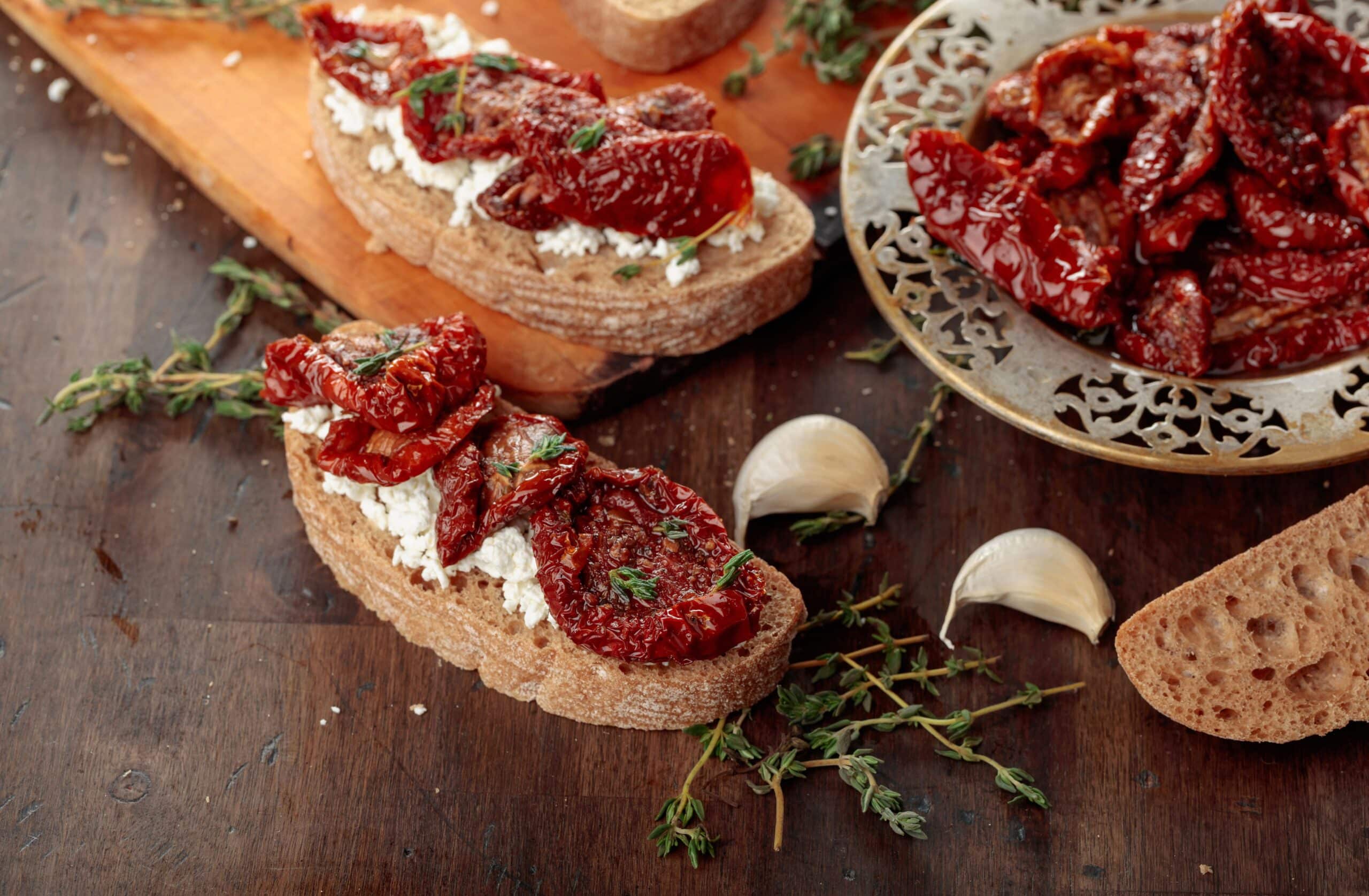
Sun-dried tomatoes are ripe tomatoes dehydrated to concentrate sugars and acids into a chewy, savory product. They are sold either dry in pouches or packed in oil in jars. For a private label brand, the initial sourcing decision involves choosing between dry-pack and oil-marinated.
- Dry halves are shelf-stable and lighter to ship. They allow the buyer to control the oil and herb details downstream.
- Oil-packed jars have a higher unit cost and require careful garlic, herb, and acidity control for safety. These typically command better margins on deli or specialty shelves.
Production Methods and Sourcing
Most commercial sun-dried tomatoes are dried in tunnels or ovens under controlled temperatures. This method ensures consistent moisture and color, avoiding contamination and weather risks associated with open-air drying. A smaller, premium segment still uses traditional sun drying methods in Southern Italy, Greece, and Turkey. Brands specifying this provenance should verify it.
Plum and roma tomato varieties are ideal for drying due to their low water and seed content. It is advisable to inquire about the cultivar used by the manufacturer.
Manufacturing Locations and MOQs
Production for the European market is concentrated in the Mediterranean growing belt. Italy (Puglia, Sicily, Campania), Greece, Turkey, and Spain handle most drying and oil packing. The raw tomato crop dictates strong seasonality, with drying occurring throughout the summer and autumn harvest.
MOQs for custom oil-packed jars typically range from 3,000 to 6,000 units, due to jar, label, and recipe setup. Dry-pack pouches can start with lower MOQs if re-labeling an existing grade. Lead times are generally 6 to 12 weeks outside of peak season, extending during harvest packing.
Cost Drivers and Target Markets
Cost is primarily influenced by the crop year and grade of the dried tomato. Other significant factors include the packing oil (extra virgin olive oil versus sunflower), the jar and lid, and the inclusion of herbs and garlic.
Buyers include specialty grocery, deli, and antipasti brands, as well as foodservice private label and D2C Mediterranean ranges. Products are sold through grocery, delicatessen, and online channels, where provenance and oil quality are key price determinants.
Frequently asked questions
Are commercial sun-dried tomatoes actually dried in the sun?+
Should I launch dry-pack pouches or oil-packed jars?+
Which packing oil is best for marinated sun-dried tomatoes?+
What MOQ and lead time should I expect?+
How long do sun-dried tomatoes keep?+
Can the manufacturer add garlic, herbs or chili to the jar?+
Explore adjacent product types
Get a vetted shortlist of sun-dried tomatoes suppliers in 48 hours.
Post a brief on Wonnda. Free, no commitment. We match you with vetted manufacturers that fit your MOQ, format and market.