
Best private label necklace manufacturers
Wonnda connects brands with private label necklace manufacturers. When sourcing necklaces, consider whether you need pre-made chains, custom pendants, or fully integrated sets. Material choices include 925 silver, various steel alloys, or plated brass, each offering distinct aesthetic and cost implications. Key sourcing variables encompass the specific metals and finishes required, ensuring compliance with relevant safety standards such as nickel-safe regulations. Production lead times can vary significantly based on the complexity of the design and the manufacturing processes for both the chain and pendant components.
- Vetted suppliers
- 20,000+
- Brands & buyers
- 25,000+
- EU-made
- 80%
5+ Top private label necklace manufacturers
Wonnda works with the best private label necklace manufacturers. Here is a list of trusted suppliers from our network.
 Private LabelContract Manufacturing
Europe-based manufacturer producing rings, bracelets, necklaces, available to brands sourcing necklace.
- Country
- -
- MOQ
- Lead time
 Private LabelContract Manufacturing
United Kingdom-based manufacturer producing hoop earrings with interchangeable charms, interchangeable necklaces with charms, gold/silver plated jewelry on base metals, available to brands sourcing necklace.
- Country
- United Kingdom
- MOQ
- Lead time
 Private LabelContract Manufacturing
Belgium-based manufacturer producing lost wax casting (bronze, silver, gold 14k/18k), vacuum casting for jewellery, rubber mould production for serial pieces, available to brands sourcing necklace.
- Country
- Belgium
- MOQ
- Lead time
 Private LabelContract Manufacturing
Poland-based manufacturer producing cardano chain, figaro chain, box chain, available to brands sourcing necklace.
- Country
- Poland
- MOQ
- Lead time
 Private LabelContract Manufacturing
Europe-based manufacturer producing 3d knitting software, stitch pattern generation tool, 3d knit fabric design software, available to brands sourcing necklace.
- Country
- -
- MOQ
- Lead time
Compare MOQs and lead times
Quick side-by-side of the shortlist. Missing values shown as a dash.
| Supplier | Location | Types | MOQ | Lead time |
|---|---|---|---|---|
| Dotti Love | - | PL · CM | ||
| Ashiana London | United Kingdom | PL · CM | ||
| Van Ranst | Belgium | PL · CM | ||
| Silvexcraft | Poland | PL · CM | ||
| Variation | - | PL · CM |
Buyer criteria
- Chain quality and kink resistance
Confirm the chain is well made with soldered, consistent links that do not kink, especially for snake and herringbone styles that crease permanently if poorly made. Flex a sample chain and check it lies flat without twisting. Chain is often the larger cost share on a pendant necklace, and a kinking or thin chain is a frequent failure that no attractive pendant can offset.
- Clasp security and smooth operation
Inspect the clasp, since a weak spring ring or flimsy lobster claw lets the necklace slip off and be lost. Test that it opens and closes securely and smoothly and is sized to the chain. The clasp is a common necklace failure point, so match a robust clasp to the value of the piece and verify its operation on production samples, not just the prototype.
- Jump-ring and bail strength
Check that the jump ring or bail connecting the pendant to the chain is soldered or closed tightly so the pendant cannot detach. An open or weak jump ring lets the pendant fall off and be lost, a frustrating failure customers blame on the brand. Tug-test the connection on samples, since this small joint carries the whole pendant and is easy to under-build.
- Plating durability and even coverage
Verify plating thickness in microns and that coverage reaches into the link crevices, since a chain bends constantly and thin or patchy plating exposes base metal where it flexes. Match chain and pendant tone so they do not differ. Ask for a wear result, because uneven or thin chain plating tarnishes and discolors against the neck, a visible failure on a piece worn openly.
- Nickel release tested to EN 1811
Require nickel-safe alloys and plating with an EN 1811 test report, since a necklace rests against the chest and neck for hours, where sweat accelerates nickel release. Non-compliance is a skin-reaction and EU REACH liability. A supplier that cannot certify nickel compliance exposes you to reactions and pulled listings, which is disqualifying for the EU market regardless of price.
- Metal weight, length and fineness
For 925 silver, confirm fineness and that chain gauge, length, and pendant weight match the agreed spec, since silver is sold by weight and a thin underweight chain is both a cost grab and weaker. Verify the base metal on plated pieces. Request an assay or material certificate, as an underweight chain or misrepresented metal undercuts both margin and the hypoallergenic claim.
Red flags
- Kinking or poorly soldered chain
A chain that kinks, twists, or has unsoldered links will crease permanently or open under tension, the most common necklace failure. Snake and herringbone chains are especially prone if poorly made. If a sample chain does not lie flat or links pull open, the chain quality is inadequate, and no pendant design compensates for a chain that fails in normal wear.
- Weak clasp or open jump ring
A flimsy clasp or a jump ring that is not soldered or tightly closed lets the necklace or pendant slip off and be lost, a frequent and frustrating failure. If the clasp feels loose or the jump ring pulls open under a gentle tug, the assembly is under-built. These small joints carry the whole piece, so reject samples whose clasp or jump ring fails a tug test.
- Thin or patchy chain plating
Chain plating that is thin or does not reach into the link crevices exposes base metal where the chain bends, tarnishing and discoloring against the neck. A factory that will not state chain plating microns is cutting cost on the largest visible component. Demand the micron figure and check crevice coverage, since chain plating wear is obvious on a piece worn openly.
- No nickel certification
A necklace without an EN 1811 nickel-release test is a skin-reaction and EU REACH compliance risk, made worse because it rests against the chest and neck for hours where sweat accelerates release. Reactions show as visible marks on the neck. Treat missing nickel testing as disqualifying for any necklace sold in the EU, regardless of how attractive the per-piece price looks.
Manufacturing process
- 01
Chain and pendant design
The brand decides the chain style and length and the pendant design, and whether the chain is a finished stock component or custom. The pendant is modeled by hand or CAD with any stone seats and the bail or jump-ring point. Chain gauge and length and pendant weight are fixed here, since they drive both metal cost and how the piece hangs.
- 02
Chain making or sourcing
Chain is either bought as a finished component made on specialist chain machines or produced to spec in the chosen style, cable, curb, rope, box, snake. Link soldering and consistency are checked, since unsoldered or weak links open under tension. For machine-made chain, gauge and plating are verified before assembly with the pendant.
- 03
Pendant casting or stamping
The pendant is lost-wax cast in silver or alloy or die-stamped for flat designs, then cut from the tree and cleaned. The bail or jump-ring loop must be solid, since it carries the pendant's weight on the chain. Casting porosity is watched, as a flawed pendant face shows through plating and a weak bail breaks in wear.
- 04
Stone setting and pendant finishing
Where the pendant carries stones, they are set by prong, bezel, or pave, and the pendant is filed and pre-polished. A necklace pendant sways and knocks against the chest less aggressively than a ring, but the setting still must hold. Surface defects are corrected here before plating, which would otherwise amplify a rough finish.
- 05
Plating
Chain and pendant are cleaned and electroplated to a specified micron thickness, gold over brass, rhodium over silver, or PVD on steel, with chain and pendant matched so they do not differ in tone. Plating chain evenly is exacting because of its many links, so coverage in the link crevices is checked to avoid base metal showing where the chain bends.
- 06
Assembly and clasp fitting
The pendant is attached to the chain with a jump ring or bail, and the clasp, lobster claw, spring ring, or toggle, is fitted to the chain ends. Jump rings are soldered or closed tight so the pendant cannot slip off, and the clasp is tested for secure, smooth operation. These joints are where necklaces most often fail in wear.
- 07
Quality control and packing
Necklaces are inspected for chain consistency, kinking, plating coverage, clasp security, jump-ring strength, and pendant finish, and a sample is tested for nickel release against EN 1811. Hallmarking is applied to silver where required. Pieces are polished, laid on cards or boxed to prevent tangling, and packed with care information and lot codes.
Understanding necklace private-label manufacturing
Components and Customization
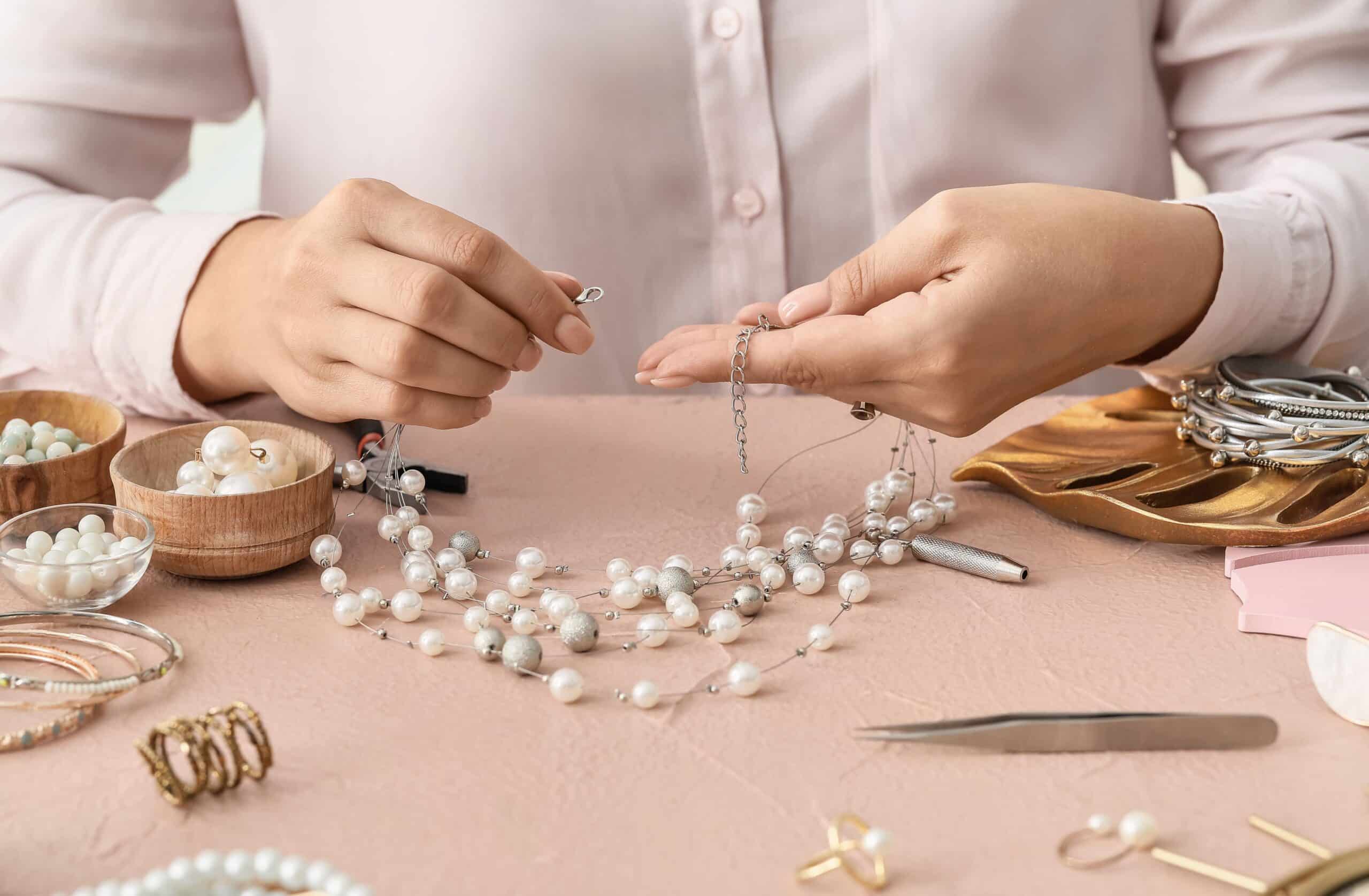
A necklace consists of two primary components: the chain and the pendant. These are often sourced individually. Chains are typically acquired as finished components from specialist manufacturers, while pendants are cast, stamped, or set separately.
The assembly involves joining the chain and pendant with jump rings and a clasp. Your sourcing approach, tooling costs, and minimum order quantities (MOQs) depend on whether you opt for a chain-only piece, a pendant on a stock chain, or a fully custom set.
Materials, Construction, and Durability
Material choices significantly impact durability and cost. Plated brass and alloy chains and pendants are more economical, with plating thickness being a key factor. 925 sterling silver and stainless steel offer enhanced durability and hypoallergenic properties.
Chain style is also important:
- Fine cable or box chains are delicate and lower cost.
- Rope or curb chains are heavier and more durable.
- Snake or herringbone chains are sleek but prone to kinking if poorly made.
Clasps are a common point of failure; a weak spring ring or flimsy lobster claw can lead to loss. Solder joints on links and the jump ring connecting the pendant are critical structural points that determine a necklace's resistance to wear.
Manufacturing Locations, MOQs, and Lead Times
Necklace manufacturing is globally distributed:
- India and Thailand specialize in silver and stone-set work.
- China and Vietnam focus on plated fashion volume and machine-made chains.
- Italy, Turkey, Portugal, and Germany are known for higher-end silver and gold chains, with Italy particularly noted for fine chain-making, offering shorter EU lead times.
MOQs generally range from 100 to 500 pieces per design. These minimums can be lower for stock chains with custom pendants but higher for fully custom cast pendants, which incur master and mold charges. A first custom production run typically requires 6 to 12 weeks.
Cost is primarily determined by metal weight (chain length and gauge, pendant weight - silver priced by gram, alloy by piece), followed by stone setting and plating thickness. For simple pendant necklaces, the chain often represents the larger share of the cost.
Quality and Compliance
Private label necklace buyers include D2C fashion and demi-fine brands, layering and personalization labels, retailer accessory ranges, gifting brands, and apparel brands expanding into jewelry.
Nickel compliance under EU REACH via EN 1811 is mandatory because necklaces are in prolonged contact with the skin. When selecting a partner, prioritize chain quality, clasp security, plating durability, solder-joint and jump-ring strength, and nickel certification over the headline price. Failures such as kinking, tarnishing, clasp malfunction, or pendant detachment are common and frustrating issues that drive product returns.
Frequently asked questions
Should I buy the chain and pendant separately or as a custom set?+
Which chain style should I choose?+
Why do necklace clasps and pendants fall off?+
What MOQ and lead time should I expect for necklaces?+
How do I stop my chains tarnishing or wearing on the neck?+
Are necklaces subject to the same nickel rules as earrings?+
Explore adjacent product types
Get a vetted shortlist of necklace suppliers in 48 hours.
Post a brief on Wonnda. Free, no commitment. We match you with vetted manufacturers that fit your MOQ, format and market.