
Best private label granola manufacturers
Wonnda is where brands find private label granola manufacturers. Sourcing considerations include the ability to accommodate various oat and grain-free recipes, alongside different sweeteners and oil glazes. Manufacturers should be able to produce diverse cluster sizes and incorporate specific inclusions like nuts, seeds, and dried fruits. Certifications for organic or other specialized dietary requirements are often key, with lead times varying depending on recipe complexity and ingredient availability.
- Vetted suppliers
- 20,000+
- Brands & buyers
- 25,000+
- EU-made
- 80%
5+ Top private label granola manufacturers
Wonnda works with the best private label granola manufacturers. Here is a list of trusted suppliers from our network.
 Private LabelContract Manufacturing
Poland-based manufacturer producing supplement powders, supplement capsules, konjac (shirataki) products: organic konjac noodles, rice, and spaghetti (low-calorie, gluten-free)., available to brands sourcing granola.
- Country
- Poland
- MOQ
- Lead time
 Private LabelContract Manufacturing
Poland-based manufacturer producing classic energy drinks, bcaa beverages, fruit juices, available to brands sourcing granola.
- Country
- Poland
- MOQ
- Lead time
 Private LabelContract Manufacturing
Europe-based manufacturer producing mueslis, cereals, granola, available to brands sourcing granola.
- Country
- -
- MOQ
- Lead time
 Private LabelContract Manufacturing
Europe-based manufacturer producing granola and crunchies, muesli, porridge, available to brands sourcing granola.
- Country
- -
- MOQ
- Lead time
 Private LabelContract Manufacturing
Europe-based manufacturer producing crunchy granola bars, cereal bars, granola bars, available to brands sourcing granola.
- Country
- -
- MOQ
- Lead time
Compare MOQs and lead times
Quick side-by-side of the shortlist. Missing values shown as a dash.
| Supplier | Location | Types | MOQ | Lead time |
|---|---|---|---|---|
| DIET-FOOD (Mipama) | Poland | PL · CM | ||
| Brandsparkle | Poland | PL · CM | ||
| Minderleinsmühle | - | PL · CM | ||
| Mulder Natural Foods | - | PL · CM | ||
| Ravensbergen Food | - | PL · CM |
Buyer criteria
- Cluster size and texture control
Cluster size is a core spec that varies by brand, from loose granola to large snackable clumps. Confirm the baker can hit and hold your target cluster size and crunch batch to batch, and ask for samples. A bake that arrives dusty or with broken-down clusters looks cheap and signals weak process control.
- Nut allergen control
Granola is nut-heavy, so allergen management is central. Confirm how the line is cleaned between recipes, how tree nuts and peanuts are segregated, whether allergen testing validates cleaning, and that labeling reflects cross-contact accurately. For a nut-free SKU, ask whether a genuinely segregated line exists rather than a precautionary statement.
- Oxidation-aware shelf life
Nuts and oils in granola go rancid over time, so shelf life is set by oxidation, not just moisture. Ask what best-before the baker supports in your chosen pack, whether they use barrier or nitrogen-flushed packaging, and whether they have stability data, because an over-stated shelf life leads to rancid product and returns late in distribution.
- Sweetener and sugar control
If you make a low-sugar or no-added-sugar claim, the binder system must support it while still clustering, which is a real formulation challenge. Verify the actual sugar content of the finished product against your claim with analysis, and confirm the baker can cluster with reduced syrup rather than just adding more to make it stick.
- Certification matching your claims
Require HACCP as a baseline and BRCGS or IFS for retail, plus organic certification if you sell organic granola, which is common in this category. Ask for batch traceability back to nut and fruit raw-material lots, since the nut supply chain carries both allergen and contaminant risk that needs a documented recall path.
Red flags
- Dusty granola with no clusters
If samples arrive as loose, broken crumbs rather than intact clusters, the baker has not controlled the binder ratio or the bake. Cluster integrity is what consumers pay for in premium granola, and a dusty product signals weak process control that will worsen with shipping vibration over a full production run.
- Casual nut allergen handling
Given how nut-heavy granola is, a baker who cannot explain segregation and line cleaning for tree nuts and peanuts is a serious risk. Undeclared nut cross-contact is one of the most dangerous allergen failures in food. Treat vague answers on nut allergen control as disqualifying for any retail-bound product.
- Shelf life set without oxidation data
A printed best-before that ignores nut and oil rancidity will leave you with off-tasting product before the date. If the baker assigns a long shelf life without stability data and without barrier packaging, they are guessing. Rancid granola is a frequent late-stage complaint that damages a breakfast brand built on freshness.
- Low-sugar claim with no analysis
If a baker promises a low-sugar granola but cannot show the finished sugar content tested against your claim, the number may not hold. Clustering normally relies on syrup, so genuine low-sugar formulation is hard. A claim unsupported by analysis exposes you to mislabeling and to a product that either fails to cluster or fails the claim.
Manufacturing process
- 01
Recipe and cluster design
The baker fixes the oat or grain-free base, the syrup-and-oil binder ratio, and the inclusion mix, then tunes for target cluster size and sugar content. Bench batches are baked and tasted. The binder ratio is critical because it controls both clustering and sweetness, the two things a granola is judged on.
- 02
Raw material intake and testing
Oats, nuts, seeds, dried and freeze-dried fruit, syrups and oils arrive against specification and are checked for moisture, microbiological limits and, for nuts, aflatoxin where required. Because nuts dominate cost and risk, intake control protects both margin and food safety before anything is mixed.
- 03
Mixing and coating
Dry base and inclusions are combined and coated with the warmed syrup-and-oil binder so every piece is glazed evenly. Even coating is what produces consistent clusters and color in the bake. Heat-sensitive inclusions such as chocolate or freeze-dried fruit are held back and added after baking.
- 04
Baking and clustering
The coated mix is baked on a continuous oven band at controlled temperature and time, which caramelizes the sugars, dries the product for shelf stability, and sets the clusters. Bake profile determines crunch, color and cluster integrity, so it is tightly controlled and adjusted for recipe and humidity.
- 05
Cooling, post-add and quality control
Baked granola is cooled, then heat-sensitive inclusions like chocolate, freeze-dried berries or post-roast nuts are folded in. The product is checked for moisture, crunch, cluster size and sensory match. Low residual moisture is essential, since any excess shortens shelf life and softens the texture buyers expect.
- 06
Filling and barrier packing
Granola is filled by weight into resealable barrier pouches, boxes or single-serve packs, sealed against moisture and oxygen, and lot-coded with a best-before date. Allergen runs are scheduled and the line cleaned between recipes, with each batch documented for traceability through the nut-heavy supply chain.
Understanding granola private-label manufacturing
Product Overview
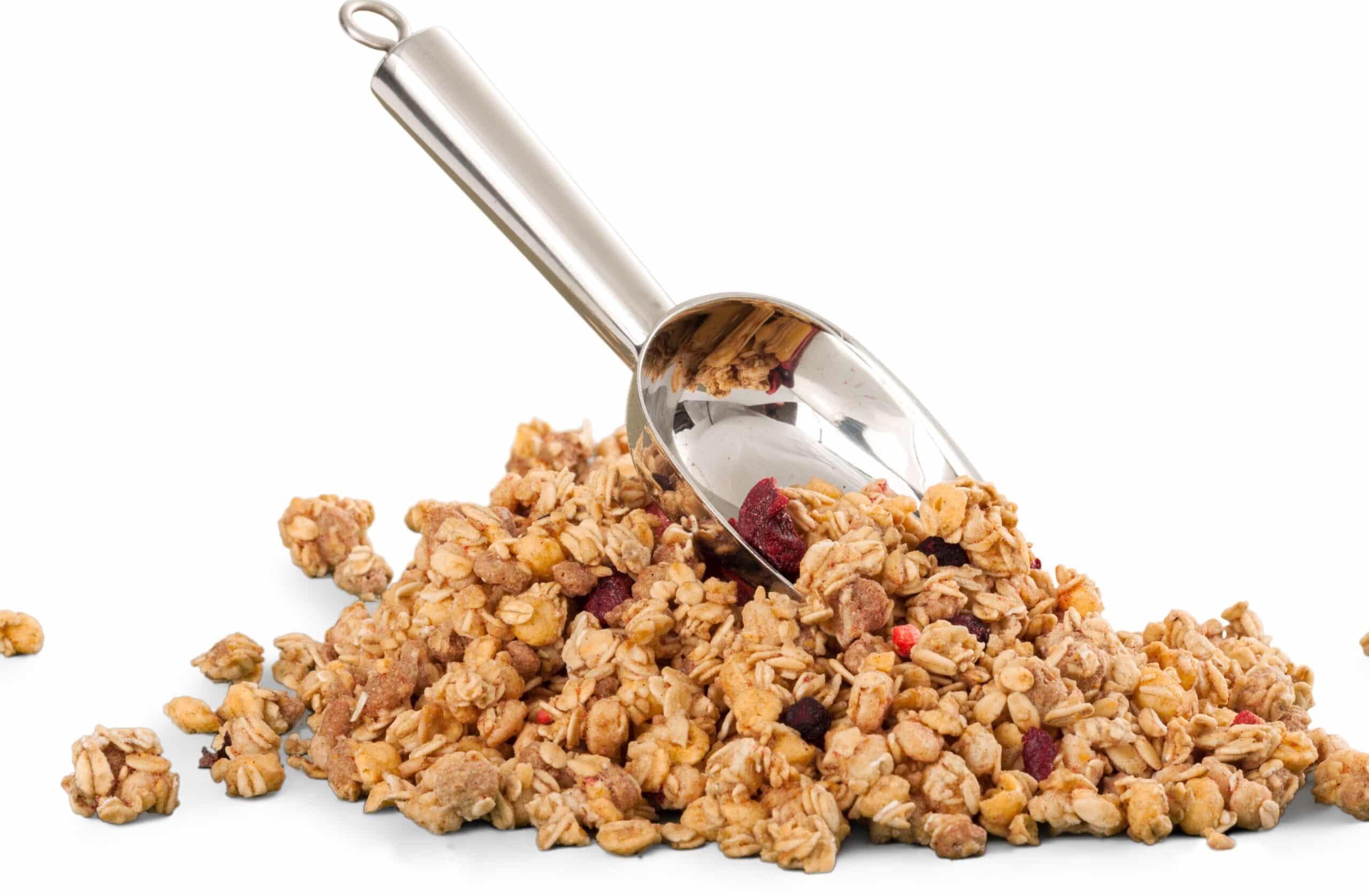
Granola consists of baked clusters of rolled oats, nuts, seeds, and dried fruit, bound with a syrup-and-oil glaze. It is sold as a breakfast cereal or snack. For a private label brand, granola offers an accessible entry into packaged food due to its forgiving base process and wide recipe space.
Differentiation can be achieved through inclusions, cluster size, sweetener choice, and positioning (e.g., high-protein, low-sugar, grain-free, organic) rather than through complex production lines. The chosen contract baker should offer recipe flexibility and reliable cluster formation.
Ingredients and Customization
The primary sourcing decision involves the base and the sweetener system. Oats serve as the commodity backbone. However, grain-free granola, made with nuts, seeds, and coconut, represents a growing premium niche with a higher cost per kilogram.
The binder, typically a blend of syrup (honey, maple, glucose, or date) and oil, controls both clustering and sugar content. Low-sugar positioning is achieved or lost at this stage. Inclusions such as almonds, pecans, freeze-dried berries, or chocolate influence cost and shelf appeal. Cluster size is a critical specification; some brands prefer loose granola, while others desire large, snackable clumps, which is controlled during baking.
Manufacturing and Logistics
European granola baking is concentrated in:
- Germany
- The Netherlands
- Poland
- The UK
Organic-certified lines are common in these regions due to strong demand. Lead times typically range from 6 to 12 weeks for a custom recipe once approved. This timeframe may extend if specialty inclusions or new pouch tooling are required.
Minimum Order Quantities (MOQs) for custom granola generally start at 500 to 1,500 kg of finished product, equivalent to several thousand bags depending on fill weight. Relabeling an existing baker's recipe may have a lower MOQ but limits product differentiation.
Cost, Quality, and Certifications
Cost is primarily driven by:
- Inclusions (nuts and freeze-dried fruit)
- Base type (grain-free is more expensive than oat-based)
- Sweetener and oil system
- Bake-and-pack run
Packaging is crucial for shelf life. Granola can go stale and rancid as nuts and oils oxidize. Therefore, a resealable barrier pouch and a sensible best-before date are integral to both cost and quality.
Buyers of private label granola include D2C breakfast and health brands, retailer private-label cereal ranges, hotel and foodservice lines requiring portion packs, and gym and protein brands seeking high-protein clusters. Retail formats typically demand resealable stand-up pouches and boxes, while hospitality requires single-serve portions.
Qualifying a baker based on cluster consistency, allergen control (given high nut content), organic or other certifications, and oxidation-aware shelf life is more critical than the headline price. Granola that arrives dusty, soft, or rancid will fail in a category where texture and freshness are paramount.
Frequently asked questions
Should I launch oat-based or grain-free granola?+
How is cluster size controlled in granola?+
How do I manage nut allergens in granola production?+
What shelf life can granola achieve and what limits it?+
Can I make a genuine low-sugar granola?+
What MOQ and lead time apply to private label granola?+
Explore adjacent product types
Get a vetted shortlist of granola suppliers in 48 hours.
Post a brief on Wonnda. Free, no commitment. We match you with vetted manufacturers that fit your MOQ, format and market.