
Best private label body scrub manufacturers
Source private label body scrub suppliers through Wonnda. Look for manufacturers adept at formulating stable suspensions, preventing ingredient separation over time. Key sourcing considerations include the choice of abrasive, such as sugar, salt, ground seeds, or crushed shells, and the base, which can be an oil, butter, or emulsified formula. Certifications like Cosmos Organic or NSF may be important, and typical lead times should account for both formulation stability testing and production scaling.
- Vetted suppliers
- 20,000+
- Brands & buyers
- 25,000+
- EU-made
- 80%
7+ Top private label body scrub manufacturers
Wonnda works with the best private label body scrub manufacturers. Here is a list of trusted suppliers from our network.
- Featured
 Contract ManufacturingPrivate Label
ISO 22716 cosmetics contract manufacturer with in-house R&D lab in Poland
- Country
- Poland
- MOQ
- From 1,000 units for most creams, lotions, shampoos and toners; 3,000 units for perfumes; about 10,000 units for lip balms.
- Lead time
- 3-6 months new formula; 4-8 weeks repeat
 Private LabelContract Manufacturing
Latvia-based manufacturer producing natural soaps, bath bombs, face moisturizers, available to brands sourcing body scrub.
- Country
- Latvia
- MOQ
- Lead time

Bio2you
4.7Private LabelContract ManufacturingLatvia-based manufacturer producing sea buckthorn facial serum, sea buckthorn mask, sea buckthorn cream, available to brands sourcing body scrub.
- Country
- Latvia
- MOQ
- Lead time
 Private LabelContract Manufacturing
Germany-based manufacturer producing dietary supplements, natural cosmetics, hybrid cosmetics, available to brands sourcing body scrub.
- Country
- Germany
- MOQ
- Lead time
 Private LabelContract Manufacturing
Greece-based manufacturer producing sunscreen cream, self-tanning lotion, hyaluronic acid serum, available to brands sourcing body scrub.
- Country
- Greece
- MOQ
- Lead time
 Private LabelContract Manufacturing
USA-based manufacturer producing dietary supplements, pet supplements, pet grooming products, available to brands sourcing body scrub.
- Country
- USA
- MOQ
- Lead time
 Private LabelContract Manufacturing
Poland-based manufacturer producing rainbow bath cloud bath bomb, crackling bath salt, foaming and coloured bath salt, available to brands sourcing body scrub.
- Country
- Poland
- MOQ
- Lead time
Compare MOQs and lead times
Quick side-by-side of the shortlist. Missing values shown as a dash.
| Supplier | Location | Types | MOQ | Lead time |
|---|---|---|---|---|
| Cosmetics Laboratories | Poland | CM · PL | From 1,000 units for most creams, lotions, shampoos and toners; 3,000 units for perfumes; about 10,000 units for lip balms. | 3-6 months new formula; 4-8 weeks repeat |
| Cita Lieta Ltd. | Latvia | PL · CM | ||
| Bio2you | Latvia | PL · CM | ||
| Azba Cosmetics | Germany | PL · CM | ||
| ALCHEMIST LABS LTD | Greece | PL · CM | ||
| GP Labs | USA | PL · CM | ||
| FormulaNova | Poland | PL · CM |
Buyer criteria
- Suspension stability
The central test for a body scrub is whether the abrasive stays evenly suspended rather than sinking into a hard layer under separated oil. Ask to see a sample held over time, not freshly mixed. A scrub that separates in the jar looks broken to the customer and is the most common and most visible failure of the format, so verify the suspension before anything else.
- Grit size and consistency
Confirm the abrasive grit matches the intended use, fine for a body scrub, coarser for feet, and that granule size is consistent without harsh oversized particles. Test the actual scrub on skin. A grit too harsh scratches and a grit too soft fails to exfoliate, so matching and controlling the grit is essential to the product working as promised.
- Base feel and rinse-off
Decide whether you want a rich oil base that leaves a conditioning film or an emulsified base that rinses cleaner, and confirm the blender delivers the feel you want. Test the rinse-off. A scrub that leaves an unpleasant greasy residue, or one marketed as nourishing that rinses away to nothing, disappoints buyers on the sensory promise.
- Preservation for emulsified scrubs
An emulsified or water-containing scrub needs a working preservative system, and even oil scrubs that meet water in the shower carry some microbiological consideration. Confirm preservative efficacy where relevant. A scrub used with wet hands in a humid bathroom is a contamination risk if the preservation is inadequate, which matters for safety and shelf life.
- Compliant exfoliants
Verify the abrasive is a compliant natural exfoliant and not a microplastic bead, which is effectively excluded under EU rules. Confirm the exact abrasive and its source. Using a non-compliant exfoliant is a regulatory exposure and a reputational risk in the natural-beauty segment that buys most body scrubs.
Red flags
- Separated sample in the jar
If a sample shows the abrasive sunk into a hard layer under a pool of oil, the suspension system is inadequate and the product looks broken on the shelf. A blender who ships a separating scrub has not solved the defining technical problem of the format, so this is reason to walk away.
- Harsh or inconsistent grit
If the scrub scratches skin or contains oversized particles, the grit is too harsh or poorly controlled, which can damage skin rather than exfoliate it. A blender who cannot deliver consistent, appropriately sized grit is failing at the one function the product exists for.
- Microplastic exfoliant
If the abrasive is a plastic microbead, it is effectively non-compliant under EU rules and unacceptable to the natural-beauty buyers who dominate this category. A blender still offering microplastic exfoliants is behind on regulation and a reputational risk to your brand.
- No preservation plan for wet use
If an emulsified scrub lacks a working preservative system, or the blender ignores that scrubs are used with wet hands in humid bathrooms, you face a contamination risk. A blender indifferent to in-use microbiological exposure is overlooking a real safety and shelf-life problem.
Manufacturing process
- 01
Abrasive and grit selection
The exfoliant, sugar, salt, ground coffee, seed, or shell powder, is chosen for hardness and grit size against the target use, from a gentle body scrub to a coarse foot polish. Microplastic beads are excluded under EU rules. Grit consistency is specified so the scrub exfoliates evenly without harsh oversized particles.
- 02
Base formulation
An oil and butter base or an emulsified base is built to carry the abrasive and condition the skin, with the choice driving whether the scrub leaves a rich film or rinses cleaner. Emulsified bases need a preservative system since they may contact water in use. The base sets the feel and a large share of the cost.
- 03
Suspension system setup
A thickener or structuring agent is built into the base so the abrasive stays dispersed rather than sinking into a hard layer under separated oil. This suspension problem is the central technical challenge of the format. The system is tuned to the density of the chosen abrasive so the scrub holds together in the jar.
- 04
Mixing and abrasive incorporation
The abrasive is folded into the base under controlled mixing that distributes it evenly without grinding the granules down or breaking the structure. Over-mixing can dissolve sugar or pulverize seeds, changing the exfoliation. The blend is checked for even granule distribution before filling.
- 05
Quality control and stability
The batch is tested for granule distribution, suspension stability over time, pH for emulsified bases, scent, and, where relevant, microbiological limits and preservative efficacy. Stability data confirms the scrub does not separate across shelf life. Results support the cosmetic product file.
- 06
Jar filling
The thick granular scrub is filled into jars by weight, which is slower than filling a liquid because the product does not flow freely. Fill accuracy and a clean jar rim are checked. Jar format dominates because a thick scrub cannot be pumped, and the wide opening lets users scoop the product.
- 07
Labelling and lot coding
Jars are labelled with the ingredient list, fragrance allergen declarations, any slip-hazard guidance for oil scrubs, and lot code with expiry or period-after-opening, consistent with the CPNP notification. Traceability links finished jars back to base and abrasive lots.
Understanding body scrub private-label manufacturing
Product Overview
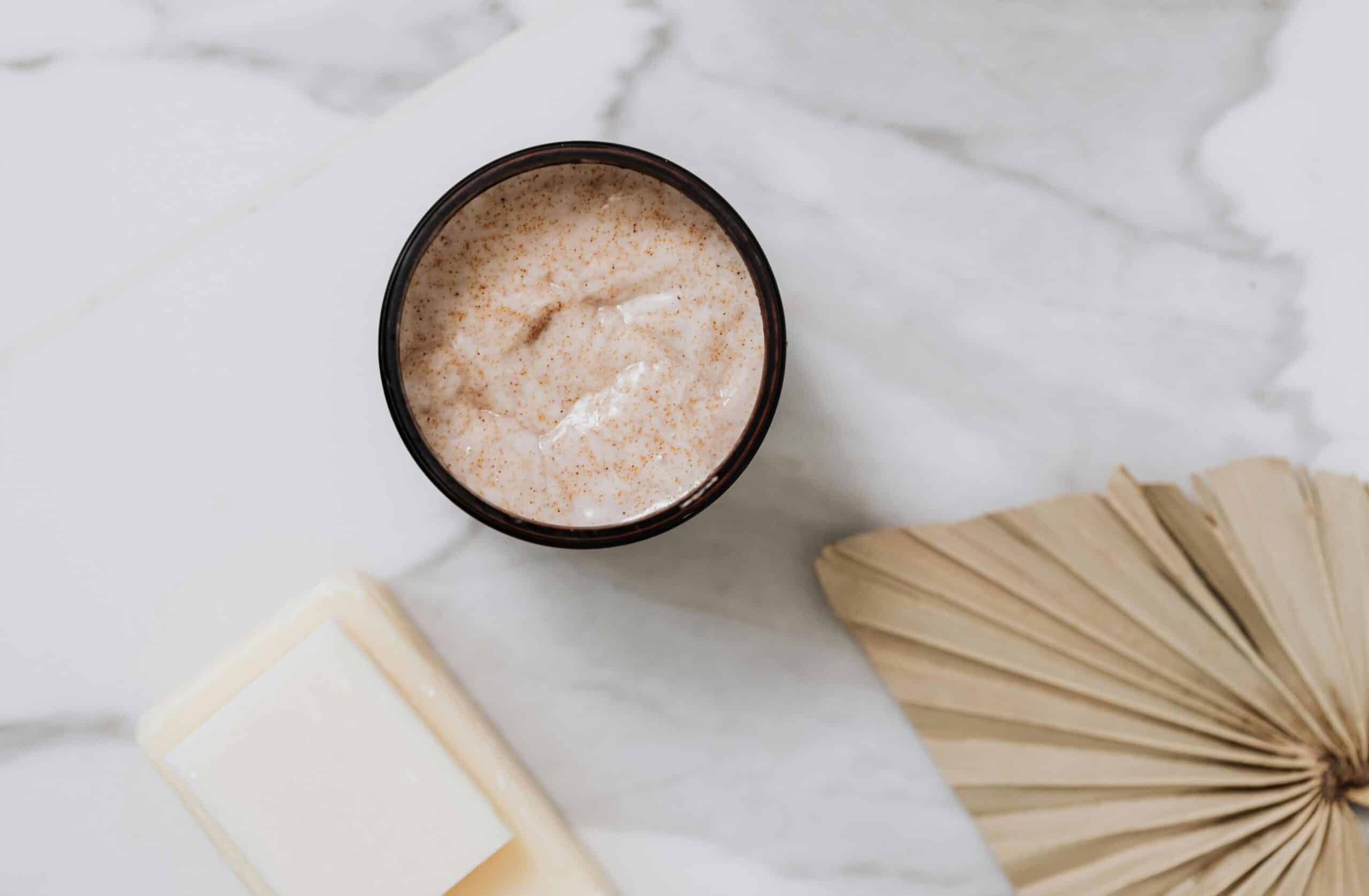
Body scrub is an exfoliating body-care product that suspends a physical abrasive – sugar, salt, ground seeds, or crushed shell – in an oil, butter, or emulsion base. This allows the granules to slough dead skin while the base conditions.
The primary formulation challenge is suspension: the scrub must hold its granules evenly throughout the jar. This prevents them from sinking into a hard layer at the bottom under a pool of separated oil. In the EU, body scrub is a cosmetic requiring a CPNP notification and safety assessment.
Sourcing and Formulation Decisions
Core sourcing decisions involve the abrasive, the base, and the wash-off behavior. Sugar dissolves and offers a gentler exfoliation. Salt is firmer and can be paired with detox positioning. Ground coffee, seeds, and shell powders are used for natural and textured scrubs.
Bases split into oil or butter scrubs, which leave a rich conditioning film, and emulsified scrubs that rinse cleaner and feel less greasy. Microplastic exfoliants are effectively excluded under EU rules, leading to a dominance of natural abrasives. Grit size is also important: a fine, facial-adjacent scrub differs from a coarse foot or body polish.
Manufacturing and Logistics
Manufacturing of body scrubs clusters in EU cosmetic blenders located in Germany, Italy, France, Poland, and the UK. The format is accessible to many mid-size houses, though suspension and emulsified variants require more skill than a plain oil scrub.
MOQs typically range from 1,000 to 3,000 units per SKU for a custom formula. These numbers can be lower when using a stock base. Lead times for a first custom run, including CPNP work, are generally 6 to 10 weeks. Jar filling of a thick granular product is slower than filling a thin liquid, which impacts cost at low volumes.
Cost Drivers and Differentiation
Cost is driven, in order, by the base oils and butters and any actives, the abrasive (specialty ground botanicals cost more than sugar or salt), the jar and closure, and blending and filling. Private-label buyers include D2C skincare and natural-beauty brands, spa and wellness brands, and retailer body-care ranges.
Differentiation rests on the abrasive and grit, the base feel, scent, and suspension quality in the jar. Qualifying a blender on suspension stability, grit consistency, and rinse-off feel is more critical than the unit price. This is because a scrub with sunken granules and separated oil appears damaged on the shelf, and an inappropriate grit fails the product's core function.
Frequently asked questions
Why do body scrubs separate, and how is it prevented?+
Should I use sugar, salt, or a botanical abrasive?+
What is the difference between an oil scrub and an emulsified scrub?+
What MOQ and lead time apply to private-label body scrub?+
Are there preservation concerns specific to body scrubs?+
What grit is right for a body scrub versus a foot scrub?+
Explore adjacent product types
Get a vetted shortlist of body scrub suppliers in 48 hours.
Post a brief on Wonnda. Free, no commitment. We match you with vetted manufacturers that fit your MOQ, format and market.