GLP-1 Companion: What It Is, Examples and Why It Matters for Brands
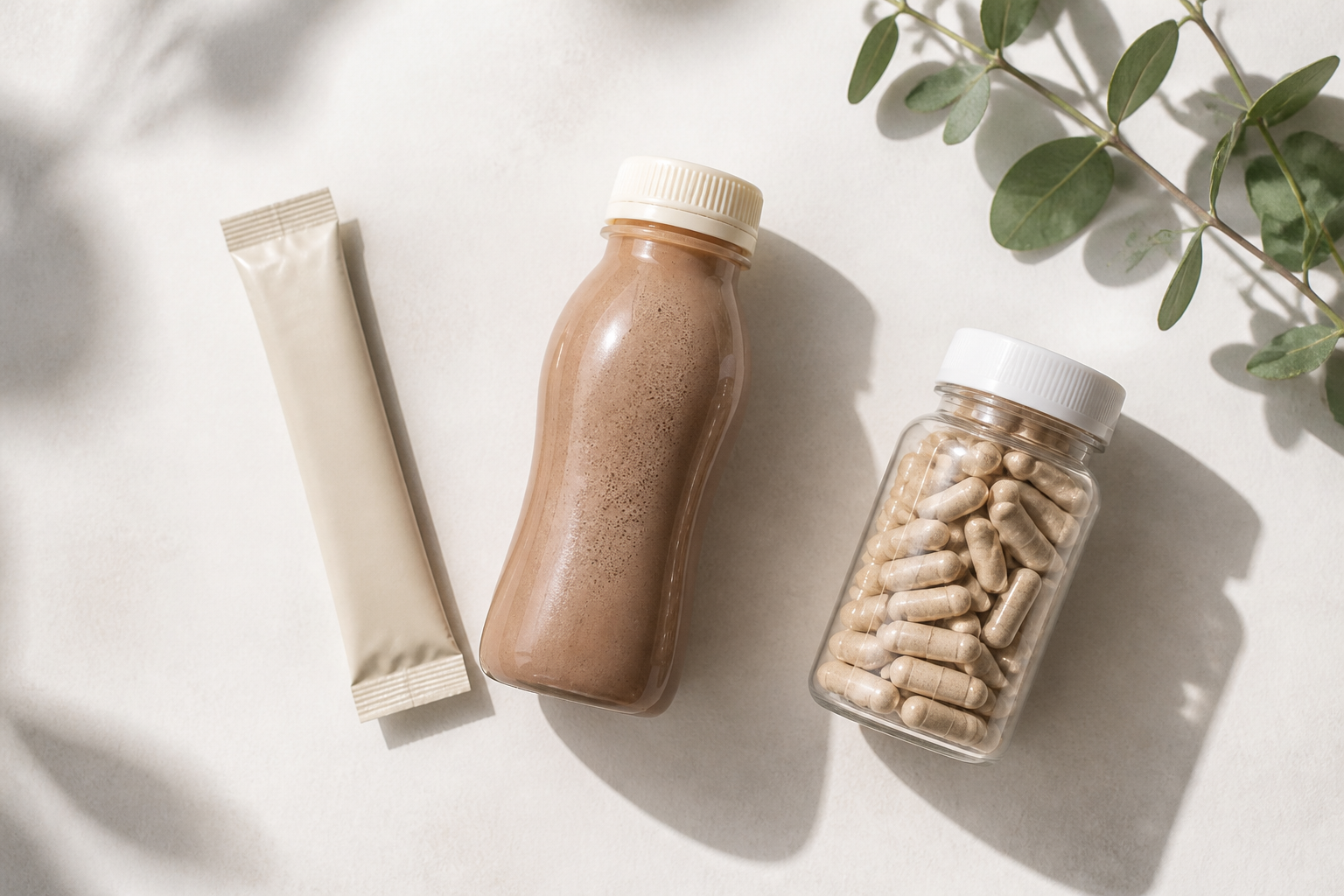
GLP-1 medications change how much people eat, and that changes what they need from every portion. Smaller meals, less appetite and new digestive routines leave gaps in protein, fiber, fluids and micronutrients. "GLP-1 companion" is the name the industry has settled on for products built to fill those gaps.
Key Takeaways
A GLP-1 companion is a food, drink or food supplement designed around the nutrition needs of people on GLP-1 medications, or anyone eating much smaller portions. It supports everyday nutrition. It does not replace, mimic or enhance the medication.
The core needs are well documented: enough protein to protect lean mass, gentle fiber, hydration and the micronutrients that fall short when people eat less.
Large players are already in the category, from Nestlé, Danone, Herbalife and Nature Made in the US to Morrisons, M&S, Co-op and Holland & Barrett in the UK.
The EU has no authorized "GLP-1 friendly" claim. Companion products win with approved nutrition and health claims, not with references to the drug.
Most GLP-1 companion products run on standard contract manufacturing formats: powders, stick packs, capsules, gummies, bars and compact drinks.
The audience is bigger than current users. In a large US study, most people without diabetes stopped their medication within a year, and life after GLP-1 is its own market.
Please note: This article is written for brands, product developers and sourcing teams. It is not medical, nutritional or legal advice. Anyone taking a GLP-1 medication should speak with their doctor before changing their diet or adding supplements.
What is a GLP-1 companion?
A GLP-1 companion is a nutrition product (a food, beverage or food supplement) positioned to help people on GLP-1 medications meet their everyday nutrition needs while they eat less. The term describes a market positioning, not a regulated product category. There is no legal definition of "GLP-1 companion" in the EU, the UK or the US.
What it is: protein, fiber, hydration and micronutrient products sized and formulated for people with a reduced appetite.
Why it matters: GLP-1 users eat noticeably less. Danone says its conversations with users point to roughly 1,000 fewer calories a day in the early phase of treatment, while nutrient needs stay the same.
How it works: the product concentrates the nutrients that matter into small, easy-to-tolerate portions and makes them part of a daily routine.
Some background on the medications themselves. GLP-1 receptor agonists such as semaglutide (sold as Ozempic and Wegovy) and dual agonists such as tirzepatide (sold as Mounjaro) mimic gut hormones that signal fullness and slow stomach emptying. They are prescription medicines. In the US, daily pills joined the injections: the FDA approved a Wegovy pill in December 2025 and Eli Lilly's orforglipron (Foundayo) in April 2026.
Companion, "GLP-1 friendly" and "natural GLP-1" are not the same thing
Brands use several labels for this space. They carry very different regulatory risk, so it pays to know which one you are building.
Positioning | What it promises | Typical products | Risk in the EU |
|---|---|---|---|
GLP-1 companion / nutrition support | Helps people on GLP-1 medication cover their nutrition needs | Protein shakes, fiber sachets, multivitamin packs, electrolytes | Lower, as long as claims stay within authorized nutrition and health claims |
"GLP-1 friendly" | The food fits the needs of GLP-1 users (high protein, smaller portion) | Ready meals, wraps, snacks, yogurt drinks | Medium to high. No authorized claim in the EU; untested in UK courts |
"Natural GLP-1", booster, "nature's Ozempic" | The product raises or mimics GLP-1, or replaces the drug | Botanical capsules, drops, patches | High. Implies a pharmacological or disease-related effect |
Post-GLP-1 / maintenance | Supports eating habits after stopping medication | Meal replacements, protein, fiber | Lower to medium, depending on the weight claims used |
This article focuses on the first and last rows. That is where brands can build something durable.
What GLP-1 users need nutritionally
In 2025, four US medical and nutrition societies (the American College of Lifestyle Medicine, the American Society for Nutrition, the Obesity Medicine Association and The Obesity Society) published a joint advisory on nutritional priorities during GLP-1 therapy. It is the most useful single document for product developers in this space, and it maps directly onto product opportunities.
Need | What the advisory says | What it means for product development |
|---|---|---|
Protein | Proposes 1.2-1.6 g of protein per kg body weight per day during active weight loss. An absolute target of 80-120 g per day may be easier to follow. | Protein-dense, small-volume formats: compact shakes, clear whey, high-protein dairy, protein snacks |
Lean mass | In a body-composition subgroup of the STEP 1 semaglutide trial, about 38% of the weight lost was lean mass. Protein alone is likely not enough without resistance training. | Protein products paired with strength-training messaging; creatine for active adults |
Digestive comfort | Reported frequencies: nausea 25-44%, diarrhea 19-30%, constipation 17-24%, vomiting 8-24%. | Gentle fibers, low-fat recipes, mild flavors, small single-serve portions |
Hydration | Stresses adequate fluids, since vomiting and diarrhea raise the risk of dehydration. | Low-sugar electrolyte stick packs and drinks |
Micronutrients | Intakes below about 1,200 kcal (women) or 1,800 kcal (men) raise the risk of shortfalls. Nutrients of concern include iron, calcium, magnesium, zinc and vitamins A, D, E, K, B1, B12 and C. | Daily vitamin packs, targeted multivitamins, fortified foods |
The advisory also says supplements "can be proactively considered for at-risk nutrients" and that protein shakes, bars and fortified products can help some people reach their protein targets. That is the opening for brands. It is not a license to claim that a product manages side effects. That remains the job of the prescribing doctor.
GLP-1 companion examples: who is already in the market
The category started in the US in 2024 and reached European shelves in 2026. These are documented launches from public sources.
Brand | Product | Format | Market | Launch |
|---|---|---|---|---|
Herbalife | GLP-1 Nutrition Companion (Classic and Vegan combos) | Bundle of existing shakes, protein drink mix, fiber and greens products | US, Puerto Rico | Feb 2024 |
Nestlé | Vital Pursuit; Boost Advanced (35 g protein) | Frozen meals; ready-to-drink shake | US | 2024-2025 |
Conagra | "On Track" badge, labeled "GLP-1 Friendly" | Badge on 26 existing Healthy Choice meals, recipes unchanged | US | Jan 2025 |
Danone | Oikos Fusion (23 g protein, 5 g prebiotic fiber in 7 fl oz) | Compact cultured dairy drink | US | 2025 |
Morrisons with Applied Nutrition | Small and Balanced | Ready meals about 30% smaller than standard, with a "GLP-1 friendly" logo | UK | Jan 2026 |
M&S | Nutrient Dense | 20 snacks, meals and salads, no GLP-1 reference on pack | UK | Jan 2026 |
Co-op | Good Fuel | Four mini meals designed for GLP-1 users | UK | Jan 2026 |
Applied Nutrition at Holland & Barrett | GLP-1 Support range | Protein, hydration stick packs, collagen gel, creatine stick packs, digestion capsules | UK, 400 stores | Jul 2026 |
Nature Made | GLP-1 Companion Health Pack | Daily packet with four supplements (multivitamin, magnesium, B12, calcium with D3) | US | 2026 |
Smidge | GLP-1 Companion Bundle | Five existing standalone supplements, sold as a bundle | US | Sep 2026 |
Ingredient suppliers are following. Kerry, ADM and Gnosis by Lesaffre pitch probiotics, fibers and vitamin K2 to brand owners with companion positioning.
What these launches have in common
They lead with nutrients, not the drug. Protein grams, fiber grams and vitamin content sit front and center.
Many are bundles, not new formulas. Herbalife and Smidge packaged existing SKUs. Smidge's founder called it "a curation, not a formulation". That keeps development cost and time low.
Portion size is part of the product. Morrisons cut portions by about 30%, Danone built a 7 fl oz drink, Co-op went for mini meals.
The big players hedge on the label. M&S avoids the term on pack. Conagra stresses that its recipes did not change. Nestlé reportedly added "GLP-1 Friendly" only after consumers asked for it.
Why GLP-1 companion matters for brands
The user base is large and still growing
In the US, 18% of adults say they have taken a GLP-1 drug and 12% say they are currently taking one (KFF Health Tracking Poll, November 2025). Europe is earlier on the curve, partly because in many countries people pay out of pocket. In Germany, statutory health insurance excludes weight-loss medications as lifestyle drugs. Still, a 2026 YouGov analysis counts more than four million German households that already use these medications or are considering them, and a Finnish survey published in 2026 found 3.5% of adults currently using one.
Access keeps widening. Pills lower the barrier for people who avoid injections, the EMA's committee gave a positive opinion on an oral Wegovy tablet in May 2026, and semaglutide patents expired in India in March 2026, with generics also arriving in Canada. Cheaper and easier access means more users, including in markets where Europe's brands export.
Baskets change, and the money moves
A Cornell University and Numerator study found that US households with a GLP-1 user cut grocery spending by about 6% within six months. Savory snacks fell 11%, while yogurt and fresh produce rose modestly. YouGov sees the same direction in Germany: active users shift toward portion-controlled, nutrient-rich and functional products and away from impulse buys. Calories leave the basket, but the remaining spend concentrates on products that deliver more nutrition per bite.
GLP-1 users already buy supplements
Kerry's consumer research found that 90% of GLP-1 users take vitamins, supplements or probiotics. The question for brands is not whether this audience buys supplements, but whose products they choose and whether those products are built for their situation.
Many people stop, and that is a second market
A 2025 study of a large US patient cohort in JAMA Network Open found that 64.8% of patients without type 2 diabetes stopped GLP-1 treatment within a year (46.5% of those with diabetes). In the STEP 1 trial extension, participants regained about two-thirds of their lost weight within a year of stopping semaglutide. People coming off medication look for routines that help them keep healthy habits, and that "off-ramp" audience may end up larger than the on-treatment one.
Market estimates are large but vary
Grand View Research sizes the broad GLP-1 companion products market at USD 204.8 billion in 2025, with Europe at a 22.1% share and hydration and recovery products as the largest segment. Other analysts use narrower definitions and land far lower. Treat any single number as directional. The consistent signal across sources is growth.
Use cases: GLP-1 companion product concepts
Each concept below runs on established contract manufacturing formats. The claim column shows the EU route that fits the concept. Wording must match the EU Register of nutrition and health claims exactly, and the product must meet the conditions of use for that claim.
Use case | Product concept | Typical formats | EU claim route (examples) |
|---|---|---|---|
Protein first | High-protein shake or drink in a small volume | Powder in tubs or stick packs, compact ready-to-drink, clear whey | "High protein" (at least 20% of energy from protein); "Protein contributes to the maintenance of muscle mass." |
Strength with training | Creatine for adults who do resistance training | Powder, stick packs, capsules, chews | "Daily creatine consumption can enhance the effect of resistance training on muscle strength in adults over the age of 55." (conditions of use: 3 g per day with regular resistance training) |
Fiber and regularity | Gentle, low-dose fiber that is easy to dose up slowly | Sachets, stick packs, capsules | "Source of fibre" or "high fibre"; fiber-specific health claims exist only for certain fibers, for example "Rye fibre contributes to normal bowel function." (only for foods that are high in this fibre) |
Hydration | Low-sugar electrolyte mix | Stick packs, effervescent tablets, ready-to-drink | "Magnesium contributes to electrolyte balance"; "Potassium contributes to normal muscle function." |
Micronutrient coverage | Daily vitamin and mineral pack | Daily packets, capsules, softgels, gummies | For example "Vitamin D contributes to the maintenance of normal bones"; "Vitamin B12 contributes to the reduction of tiredness and fatigue." |
Small-portion food | Mini meals, protein snacks, high-protein dairy | Ready meals, bars, yogurt drinks, puddings | Nutrition claims "high protein", "source of fibre", "high fibre" |
Hair, skin and nails | Beauty-from-within supplement for people losing weight | Gummies, capsules, collagen drinks | "Biotin contributes to the maintenance of normal hair"; "Zinc contributes to the maintenance of normal skin." |
After GLP-1 / maintenance | Meal replacement and routine products for people coming off medication | Shakes, bars, soups | "Substituting one daily meal of an energy restricted diet with a meal replacement contributes to the maintenance of weight after weight loss." |
Bundles and kits | Curated daily routine (protein, fiber, electrolytes, multivitamin) | Gift box, subscription, B2B kits for telehealth providers or pharmacies | Each product carries its own authorized claims; the bundle name must not imply a medical effect |
A note on hair, skin and nails: YouGov's German data shows active GLP-1 users buying more supplements in this category, so the demand is real. The same claims discipline applies.
Planning a GLP-1 companion product? Post your requirements on Wonnda and get matched with suitable supplement and functional food manufacturers within 48 hours.
EU rules: what you can and cannot say
Food supplements and foods in the EU are governed by food law, not medicines law. For GLP-1 companion products, five points matter most.
No disease claims. EU food information law (Regulation (EU) 1169/2011) prohibits attributing to a food the property of preventing, treating or curing a human disease. Claims about managing medication side effects fall into this territory.
Health claims only from the EU Register. Under Regulation (EC) 1924/2006, only authorized health claims may be used, with their conditions of use. No "GLP-1 friendly" claim has been applied for. Christofer Eggers of Squire Patton Boggs told FoodNavigator in April 2026 that it is "more than unlikely that any such claim will ever be approved for food or food supplements."
Do not lean on the drug. Advertising prescription medicines to the public is banned across the EU (in Germany under §10 HWG). Naming Ozempic, Wegovy or Mounjaro in your marketing creates avoidable risk. In the UK, the ASA has stated that claims containing the term "GLP-1" are not allowed in advertising. "GLP-1 friendly" food claims remain legally untested, and several UK retailers use the term anyway.
Consumer watchdogs are watching. Germany's Verbraucherzentrale found no evidence of effect for supplements advertised with GLP-1 references and called their advertising generally inadmissible because it is disease-related. It also flagged products with fake approval logos.
Check the ingredient, not just the claim. Confirm Novel Food status for trending ingredients, check national rules on terms such as "probiotic" (treated as a health claim in many member states), and notify food supplements where required before launch (in Germany with the BVL).
Safer direction | Risky direction |
|---|---|
"High in protein. Protein contributes to the maintenance of muscle mass." | "Prevents muscle loss on Ozempic" |
"Made for smaller appetites" / "designed for people eating smaller portions" | "Reduces GLP-1 side effects" |
"Source of fibre" plus an authorized fiber claim where one exists | "Relieves constipation from weight-loss injections" |
Nutrient amounts and authorized claims, consistent on pack, website and ads | "Natural GLP-1", "boosts your GLP-1", "nature's Ozempic" |
This is a summary for orientation, not legal advice. Have your claims reviewed by a food law specialist for every market you sell in.
Developing a GLP-1 companion product with a contract manufacturer
Your brief checklist
Manufacturers quote faster and more accurately when the brief answers these points up front:
Target user and moment: on medication, tapering off, or simply eating less. Each needs a different product story.
Portion and volume: small servings are the point. Define grams or milliliters per serving early.
Nutrient targets per serving: protein, fiber and micronutrients, set to meet the conditions of the claims you plan to use.
Tolerance: low fat, mild flavors, gentle fibers. Fermentable fibers and polyol sweeteners can cause bloating or a laxative effect, which is the opposite of what this audience wants.
Claims plan: agree the exact authorized claims before formulation, so doses match the conditions of use.
Format and packaging: single-serve stick packs, sachets and compact bottles suit routines and travel.
Certifications and documents: GMP for supplements; ISO 22000, FSSC 22000, IFS or BRC for food; HACCP; certificates of analysis, specifications and stability data.
Markets and labels: target countries, label languages and notification duties.
Formats and listed MOQs on Wonnda
The figures below are medians of minimum order quantities that manufacturers have listed on their Wonnda profiles (October 2026). They are listings, not quotes. Low medians often reflect white label or stock formulas; custom formulations usually start higher.
Format | Why it fits GLP-1 companion products | Listed MOQ on Wonnda (median) |
|---|---|---|
Supplement capsules and softgels | Micronutrients, digestive and hair, skin and nails formulas; easy to bundle | 500 units (44 listings) |
Protein powder | Flexible protein dosing; tubs or pouches | 500 units (11 listings) |
Supplement powder | Fiber, electrolyte and creatine blends | 800 units (22 listings) |
Supplement gummies | Low-dose vitamins and beauty formulas; pleasant to take with low appetite | 1,500 units (10 listings) |
Sachets and stick packs | Single-serve, portable, routine-friendly; ideal for fiber, electrolytes and protein | 25,000 units (sachets, 10 listings) |
Protein bars | Small-portion protein snack | 10,000 units (7 listings) |
Ready-to-drink protein | Compact, high-protein drinks | Too few listings for a reliable figure. Expect larger runs and specialist filling lines. |
White label, private label or custom formulation
White label is usually the fastest way to test the positioning: an existing protein powder, multivitamin or electrolyte formula, with your brand and packaging.
Private label with adjustments lets you tweak flavor, serving size or nutrient levels on a proven base formula.
Custom formulation is where real differentiation sits, for example a compact high-protein drink with a gentle fiber and a mild flavor profile. Budget for development, stability testing and a higher MOQ.
What we see in sourcing requests on Wonnda
Many GLP-1-related requests we receive ask for "GLP-1 support" or "natural GLP-1" capsules and powders. In the EU, that is the hardest positioning to defend. Briefs built on protein, fiber, hydration and micronutrients give manufacturers a clearer target and give the brand a product it can still sell when claim enforcement tightens.
Common mistakes to avoid
Building the brand on the drug. Drug names, syringe imagery and "GLP-1" in the brand name tie your product to medicines advertising rules and to a single treatment trend.
Copying US claims into Europe. US structure-function claims do not translate into EU authorized claims. Plan EU claims separately.
Designing for a normal appetite. A 500 ml shake or a 60 g bar can be too much for this audience. Portion size is a feature.
Choosing fibers and sweeteners users tolerate poorly. Test tolerance and start with lower doses.
Ignoring the off-ramp. Positioning only for people on medication leaves out everyone who stops, and that group grows every month.
Inconsistent claims across channels. Pack, website, ads and influencer content are read as one system by regulators and customers.
Relying on "clinically studied" ingredient stories. A study on an ingredient is not an authorized claim for your product.
The GLP-1 shift is not a short-lived diet trend. It changes portion sizes, nutrient priorities and shopping baskets for a growing share of consumers. Brands that build honest, well-formulated companion products now, with claims that hold up in Europe, will own a category the big players are still approaching carefully. If you want to test a concept, browse verified supplement manufacturers on Wonnda or post a sourcing request and compare offers.
Disclaimer: This article provides general industry information for businesses. It is not medical, nutritional or legal advice and does not recommend any product for treating or preventing disease. GLP-1 medications are prescription medicines and should only be used under medical supervision. Always seek qualified legal advice on product claims for each target market.
Sources
Mozaffarian D, et al. Nutritional priorities to support GLP-1 therapy for obesity: A joint Advisory. Obesity, 2025.
KFF Health Tracking Poll, November 2025.
Rodriguez PJ, et al. Discontinuation of GLP-1 receptor agonists, JAMA Network Open, 2025 (via HealthDay).
Wilding JPH, et al. Weight regain and cardiometabolic effects after withdrawal of semaglutide: The STEP 1 trial extension. Diabetes, Obesity and Metabolism, 2022.
Cornell and Numerator study on grocery spending (Food Dive, 2025).
YouGov study on GLP-1 and shopping behavior in Germany (Lebensmittel Praxis, January 2026).
GLP-1 medications: use and interest in a representative survey of Finns. International Journal of Obesity, 2026.
How "GLP-1 friendly" claims are regulated in the UK and EU (FoodNavigator, April 2026).
GLP-1-friendly foods are booming, but the label is still taboo (FoodNavigator, April 2026).
GLP-1-Werbung für Nahrungsergänzungsmittel (Verbraucherzentrale, 2025).
How GLP-1 is reshaping health on the shelf (IGD, January 2026).
Applied Nutrition launches GLP-1 support range with Holland & Barrett (Grocery Gazette, July 2026).
Herbalife launches GLP-1 Nutrition Companion product combos (Herbalife, February 2024).
Nature Made 2026 product innovations (Nature Made, 2026).
Smidge launches GLP-1 Companion Bundle (Nutrition Insight, September 2026).
GLP-1 companion supplements and post-medication nutrition (Nutrition Insight, June 2026).
Danone tackles the big question for GLP-1 users (FoodNavigator, December 2025).
Nestlé launches new protein drinks for GLP-1 users (New Food Magazine, April 2025).
GLP-1 Companion Products Market Report (Grand View Research).
Wegovy im Sommer 2026 (Münster Aktuell, July 2026).
Canada unveils generic Wegovy alternative (BioXconomy, May 2026).
Frequently asked
What is a GLP-1 companion?
A GLP-1 companion is a food, drink or food supplement positioned to help people on GLP-1 medications such as semaglutide or tirzepatide meet their everyday nutrition needs while they eat less. Typical products focus on protein, fiber, hydration and micronutrients. The term is a market positioning, not a regulated category.
Do GLP-1 companion supplements replace or boost GLP-1 medication?
No. A GLP-1 companion supports nutrition. It does not replace, mimic or enhance a prescription GLP-1 medication, and products that claim to do so face serious regulatory risk in the EU.
Can I put "GLP-1 friendly" on a product label in the EU?
There is no authorized "GLP-1 friendly" health claim in the EU, and food lawyers consider approval very unlikely. Brands use authorized nutrition claims such as "high protein" or "source of fibre" and authorized health claims instead. Get legal advice for each market.
Which ingredients are typical in GLP-1 companion products?
Protein (whey, milk or plant protein), gentle fibers, electrolytes such as magnesium and potassium, creatine, and vitamins and minerals that can fall short at low calorie intakes, including vitamin D, calcium, B12, iron and zinc.
Which formats work best for GLP-1 companion products?
Small, single-serve formats work best: stick packs and sachets, compact ready-to-drink protein drinks, capsules, gummies, protein bars and mini meals. Portion size matters because users have a reduced appetite.
How do I find a manufacturer for GLP-1 companion products?
On Wonnda you can browse 20,000+ vetted manufacturers and suppliers, filter by format and certification, and post a sourcing request to get matched with suitable supplement or functional food manufacturers within 48 hours. Wonnda is free for buyers and charges no commission.
Related articles
10+ Top Supplement Trends in 2026 (Exclusive Wonnda Data)
PPWR Regulation: What EU Brands Must Do by 2030
White Label Mushroom Coffee: The 2026 Sourcing Guide for Brands
Made in USA Cookware: Why More Brands Are Reshoring Production
10+ Best European Supplement Brands in 2026

10+ Best German Supplement Brands in 2026

Top 5 D2C Trends to Watch for in 2026

10 Best German Skincare Brands Everyone Should Know