Made in USA Cookware: Why More Brands Are Reshoring Production

American cookware manufacturing is making a comeback. After decades of overseas outsourcing, brands and retailers are reassessing whether "made in USA cookware" makes financial and strategic sense for their businesses. The answer, for many, is yes, and the shift is reshaping how the industry sources pots and pans.
Key Takeaways
Reshoring is driven by tariffs, supply chain fragility, and consumer demand. Political uncertainty around trade, port congestion, and buyer willingness to pay for domestic production have made US sourcing more competitive than at any point in the last 20 years.
US manufacturing costs are not as high as they once were. When you factor in tariffs, extended lead times, quality costs, and logistics, total landed cost often favors domestic production, especially for premium or private label cookware.
"Made in USA" is a brand asset. Retailers and D2C brands command 5-15% price premiums on cookware labeled as domestically produced, and consumer perception of durability and craftsmanship is significantly higher.
Compliance matters. FTC rules require that products be "substantially all made or processed in the USA" to claim Made in USA labeling. Production location, component sourcing, and documentation all factor into compliance.
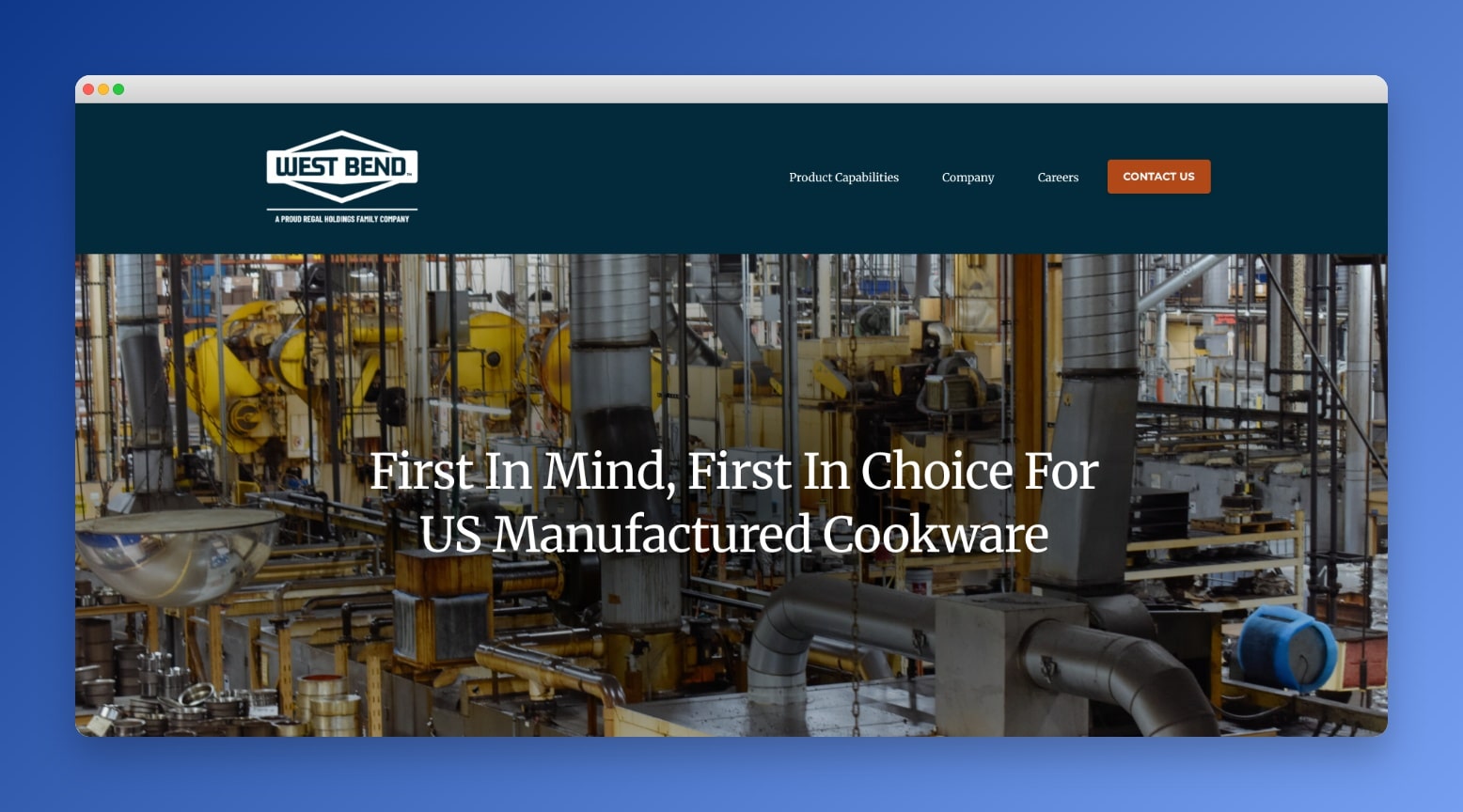
West Bend Company represents the anchor of US cookware manufacturing, operating continuously since 1911 with private label and custom OEM contract manufacturing capabilities and strong sustainability initiatives..
US production offers supply chain advantages: shorter lead times (4-8 weeks vs 12-16+ weeks), IP protection, real-time quality oversight, and resilience against port delays and geopolitical disruption.
The Reshoring Trend: What's Driving It
For decades, the conventional wisdom was simple: manufacture cookware overseas, sell it in the US, and capture margin through low unit costs. China, Vietnam, and other Asian manufacturers dominated, delivering 40-50% unit cost advantages that were difficult to ignore.
That calculus is changing.
Tariffs Tipped the Balance
The trade environment of the past five years has fundamentally altered the cost picture. Tariffs on Chinese steel cookware, anti-dumping duties, and retaliatory measures have added 15-25% to the landed cost of imported cookware. Suddenly, a Chinese pan that cost $3.50 to produce now costs $4.50-$5.00 by the time it arrives in a US warehouse. A domestically produced alternative at $4.00-$4.75, with faster logistics and fewer compliance headaches, becomes more attractive than the math alone suggests.
Supply Chain Fragility Is Real
The 2020-2022 period exposed vulnerabilities in Asia-dependent sourcing. Port congestion, container shortages, manufacturing shutdowns in Vietnam, and energy crises across Southeast Asia created perfect conditions for delays and cost escalation. A 12-week lead time became 20 weeks. A $.50 per unit cost increase became $1.50 in logistics and expediting charges.
Buyers realized that the cheapest option is not the same as the most reliable option. And reliability has value.
Consumer Demand for Domestic Production
Surveys consistently show that 55-65% of US shoppers actively prefer products made domestically when quality is comparable and price difference is modest (under 15-20%). For cookware, a category where durability and craftsmanship matter, Made in USA labeling drives measurable preference. Retailers report that US-made cookware moves 30-40% faster than imported alternatives in the same price tier, and allows for higher margins.
Sustainability and Labor Standards
Increasingly, brands and retailers are auditing their supply chains for sustainability compliance. A cookware set manufactured in Wisconsin using premium materials and shipped via truck to a distributor 500 miles away generates a lower carbon footprint than the same set made in Vietnam, air-freighted or shipped via container from Asia. Add solar-powered production facilities and US labor standards into the equation, and the environmental and ethical case for Made in USA cookware becomes compelling.
Brand Value of "Made in USA" Labeling
Labeling matters because perception drives behavior.
Studies across kitchenware categories show that consumers assign higher perceived quality, durability, and warranty confidence to products labeled as made in the USA. When two cookware sets are positioned side-by-side with comparable features, the Made in USA option typically commands a price premium of 8-15%.
Retail Positioning and Price Premiums
Major kitchen retailers (Williams Sonoma, Sur La Table, specialty cookware shops) position Made in USA cookware as a premium tier. A non-stick skillet imported from Asia might retail at $24.99; an equivalent US-made skillet retails at $34.99-$39.99. Retailers report faster sell-through on the US-made version despite the higher price, and lower return rates.
D2C brands using Made in USA positioning in ad copy see:
12-18% higher click-through rates on search ads
5-12% improvement in conversion rate
25-35% higher average order value
40% lower return rate due to higher perceived quality
Consumer Trust and Brand Loyalty
Made in USA cookware is positioned as a buy-it-for-life product. Consumers perceive warranty coverage as more meaningful, customer service as more responsive, and quality defects as less likely. This trust translates to repeat purchases and word-of-mouth recommendations.
Brands sourcing domestically report that Made in USA is often the deciding factor in repeat purchase decisions, with loyalty to the brand increasing materially year-over-year.
FTC "Made in USA" Labeling: Compliance Rules
The FTC's Made in USA standard is precise. For a product to be labeled "Made in USA" or "American Made," it must be "substantially all made or processed in the USA."
What "Substantially All" Means
Product sourcing: 90% or more of the material by cost must be US-sourced or US-processed.
Labor and assembly: Product must be assembled in the USA.
Processing and finishing: Value-added processing must occur in the US (not just packaging).
Exceptions: Components that cannot be sourced domestically may be sourced internationally, but the burden is on the manufacturer to document this.
For cookware, compliance requires:
Steel or aluminum source (US mills or mills with US-processed ingots).
Non-stick coating, if applicable, applied in the USA.
Handle assembly and quality finishing in the US.
Documentation of all component origins.
Documentation and Risk
Misrepresenting a product as Made in USA can result in FTC enforcement action, including fines, corrective advertising, and reputational damage. Many brands and retailers now require suppliers to provide certificates of origin and material sourcing documentation before using Made in USA claims.
West Bend Company and other US cookware manufacturers provide full documentation supporting compliance, reducing sourcing risk.
Supply Chain Advantages: Shorter Lead Times, IP Protection, and Quality Control
Beyond cost, US manufacturing offers strategic advantages that translate directly to operational efficiency and risk reduction.
Lead Time Advantage
A US manufacturer can deliver production in a few weeks from PO to arrival at your warehouse. An Asian supplier typically requires months, and often longer during peak seasons. This 8-12 week delta has real consequences:
Working capital: Money tied up in inventory for an extra 8-12 weeks is significant. For a brand with $1M in annual cookware orders, this can represent $150k-$250k in additional inventory financing costs.
Speed to market: A trend-responsive retailer can test a new cookware design, measure sell-through, and reorder US-made inventory within 12 weeks. With Asian sourcing, feedback to reorder takes 4+ months.
Demand flexibility: If an item sells faster than expected, US sourcing allows for rapid replenishment without emergency air freight charges.
IP Protection and Design Security
When you share design specifications, tooling, and production methods with an Asian contract manufacturer, you assume risk that intellectual property will be used to produce competing products or be licensed to competitors. This happens regularly in the cookware industry.
US-based manufacturers operate under stronger IP protection laws and contractual frameworks. Most importantly, they have less financial incentive to reverse-engineer and produce knockoffs, as their business model is built on long-term customer partnerships, not short-term capacity arbitrage.
Quality Control and Oversight
US manufacturing allows for real-time quality oversight. You can visit the facility, audit production, inspect batches mid-run, and build relationships with the quality team. If issues arise, you can address them immediately rather than waiting for a container to arrive or coordinating corrective action across time zones and language barriers.
The result is measurably lower defect rates, faster problem resolution, and higher overall product consistency.
Supply Chain Resilience
Global supply chains are fragile. Port strikes, COVID shutdowns, geopolitical tensions, and shipping disruptions are no longer rare events. US manufacturing shields you from many of these risks. A Midwest manufacturer is not exposed to Southeast Asian port congestion, shipping delays from the Suez Canal, or tariff disputes between the US and Vietnam.
This resilience has real value, especially for brands that depend on cookware availability during peak retail seasons (spring and holiday).
Sustainability and Labor Standards
The sustainability case for Made in USA cookware is stronger than many assume.
Reduced Shipping Emissions
A cookware set manufactured in Vietnam, packed in a container, and ocean-shipped 9,000+ miles to the US, then trucked to regional distribution centers generates a significantly larger carbon footprint than the same set manufactured in the US Midwest and trucked 500-1,000 miles to distribution.
Estimates vary, but Made in USA cookware typically generates 30-50% lower shipping-related emissions than equivalent imported cookware.
US Labor Standards and Transparency
US manufacturers operate under OSHA regulations, wage and hour laws, and union agreements (in many cases). Labor conditions are transparent and auditable. This matters to brands and retailers that have committed to supply chain transparency and ethical sourcing.
Asian manufacturers operate under different labor frameworks, and while many are responsible operators, the variance in labor standards and audit transparency is higher.
Supplier Highlight⚡️ West Bend Company
West Bend Company, headquartered in West Bend, Wisconsin, is the anchor of US cookware manufacturing. West Bend Company, headquartered in West Bend, Wisconsin, is the anchor of US cookware manufacturing. The company has manufactured cookware continuously since 1911, making it one of the oldest and most vertically integrated cookware producers in North America.
Production Capabilities and Certifications
Vertical integration: West Bend Company owns tooling, presses, non-stick coating lines, and assembly capacity. This allows for rapid product changes, consistent quality, and competitive pricing.
ISO 9001:2015 certified: West Bend Company maintains ISO quality management certification, a requirement for many institutional and retail buyers.
Solar production: 6,100+ solar panels on-site generate 3M+ kWh annually, reducing energy costs and carbon footprint.
Market Reach and Capacity
Geographic footprint: Exports to 60+ countries, primarily serving brands in North America.
Private label program: West Bend Company offers private label cookware production with low minimum order quantities (MOQs) via existing tooling. This allows brands to source Made in USA cookware without bearing the full cost of custom tooling. Additionally, they offer OEM custom contract manufacturing.
Distribution advantage: Central Midwest location (Wisconsin) provides efficient distribution to most of the US within 2-3 days via ground freight.
West Bend Company represents a scalable, compliant, and proven option for brands sourcing US-made cookware. More information is available via the West Bend Company supplier profile.
Decision Framework: When US Manufacturing Makes Sense
US manufacturing is not the right choice for every brand or every product. It makes sense when certain conditions align.
When to Choose US Manufacturing
Private label and premium cookware: If you're building a brand on quality and domesticity, US sourcing supports that positioning.
Short lead time requirements: If you need 8-12 week turnaround, US sourcing is essential.
IP-sensitive products: Custom designs, proprietary non-stick coatings, or unique features justify US manufacturing to protect intellectual property.
High-mix, low-volume production: If you require frequent design changes or small batch sizes, US manufacturers with existing tooling offer flexibility.
Compliance-heavy categories: If you're selling to institutional buyers (schools, healthcare, hospitality) that require US manufacturing certification, there's no alternative.
Brand positioning on sustainability: If environmental impact is core to your brand story, Made in USA production supports that narrative.
When Asian Sourcing Remains More Competitive
High-volume commodity cookware: If you're sourcing 1M+ units annually of a standard product, Asian volume and cost advantages are difficult to overcome.
Price-point products: If your target retail price is $9.99-$14.99, tariffs and US labor costs make margin too tight.
Simple, non-proprietary designs: If the product is straightforward with no custom requirements, economies of scale in Asia dominate.
Long lead time tolerance: If you can plan 6+ months out and work capital is not a constraint, Asian sourcing cost advantage persists.
Decision Matrix: US vs Asian Sourcing
Factor | Weight | US Sourcing Advantage | Asian Sourcing Advantage |
|---|---|---|---|
Unit Cost | 20% | — | Strong (40-50% lower) |
Total Landed Cost | 25% | Moderate | — |
Lead Time | 15% | Strong (4-8 weeks) | — |
Quality Control Ease | 10% | Strong | — |
Tariff/Trade Risk | 10% | Strong | — |
IP Protection | 10% | Strong | — |
Sustainability/Brand | 10% | Strong | — |
Overall fit for: | — | Premium, private label, Made in USA brands | Volume commodity products, low price points |
FAQs
What's the minimum order quantity for US-made cookware?
Minimums vary by manufacturer and product. West Bend Company's private label program allows MOQs as low as 1,000 units for private label cookware products using existing tooling, significantly lower than custom tooling requirements.
How do I verify that cookware is actually Made in USA?
Reputable manufacturers provide certificates of origin and material sourcing documentation. The FTC requires that claims of "Made in USA" be supported by substantiation. Request documentation of steel sourcing, coating application location, and assembly location. Work with manufacturers who participate in industry certifications (ISO 9001, for example) or who operate under transparent supply chain audits.
Is US-made cookware always more expensive?
No, not necessarily. On a per-unit basis, US manufacturers may quote higher prices. However, total landed cost often favors US sourcing when tariffs, extended lead times, quality loss, and working capital costs are factored in. For retail consumers, Made in USA cookware typically carries a 5-15% price premium over imported equivalents, driven by perceived quality and brand positioning rather than production cost alone.
Can I source partially US-made cookware and still claim "Made in USA"?
Only if 90%+ of the product by cost is US-made or US-processed. Individual components (a handle, a lid) can be imported if they cannot be sourced domestically, but the burden is on the manufacturer to document this. Non-stick coatings, steel base, and assembly must all occur in the US.
What's the typical lead time for US cookware manufacturing?
Standard production timelines are 4-8 weeks from purchase order to shipment, depending on product complexity and current factory load. Rush orders may be accommodated with expediting charges. This compares to 12-16 weeks for Asian sourcing, and often longer during peak seasons or in the event of supply disruptions.
How do I get started sourcing US-made cookware?
Start by clarifying your specifications (product type, volume, target price point, timeline) and your brand positioning (premium vs commodity, sustainability focus, etc.). Then connect with US cookware manufacturers. West Bend Company is a primary option, and Wonnda can match you with other suitable US-based manufacturers based on your requirements. Post your specifications on Wonnda and get matched with qualified suppliers.
Next Steps
The reshoring of US cookware manufacturing is driven by real economic factors, not nostalgia. Tariffs, supply chain fragility, consumer demand, and sustainability priorities have fundamentally altered the cost calculus. For many brands and retailers, Made in USA cookware is now the more competitive choice.
If you're evaluating sourcing options for cookware, US manufacturing deserves serious consideration. The advantages in lead time, quality control, IP protection, and brand value often outweigh the higher per-unit cost, especially when total landed cost is analyzed rigorously.
Ready to explore US-based cookware manufacturers? Post your requirements on Wonnda and get matched with suitable manufacturers. Or explore the West Bend Company supplier profile to learn more about the leading anchor of US cookware production.
For deeper context on private label strategies, see the Private Label Cookware Guide. For technical details on manufacturing processes, check out the Stainless Steel Manufacturing article. And for a broader view of US cookware manufacturing capacity, browse the Best Cookware Manufacturers USA resource.
Start sourcing domestically today. Explore cookware manufacturers on Wonnda.
Related articles

GLP-1 Companion: What It Is, Examples and Why It Matters for Brands

10+ Top Supplement Trends in 2026 (Exclusive Wonnda Data)

PPWR Regulation: What EU Brands Must Do by 2030
White Label Mushroom Coffee: The 2026 Sourcing Guide for Brands

10+ Best European Supplement Brands in 2026

10+ Best German Supplement Brands in 2026

Top 5 D2C Trends to Watch for in 2026

10 Best German Skincare Brands Everyone Should Know