European Suppliers: How to find the best EU suppliers in 2026

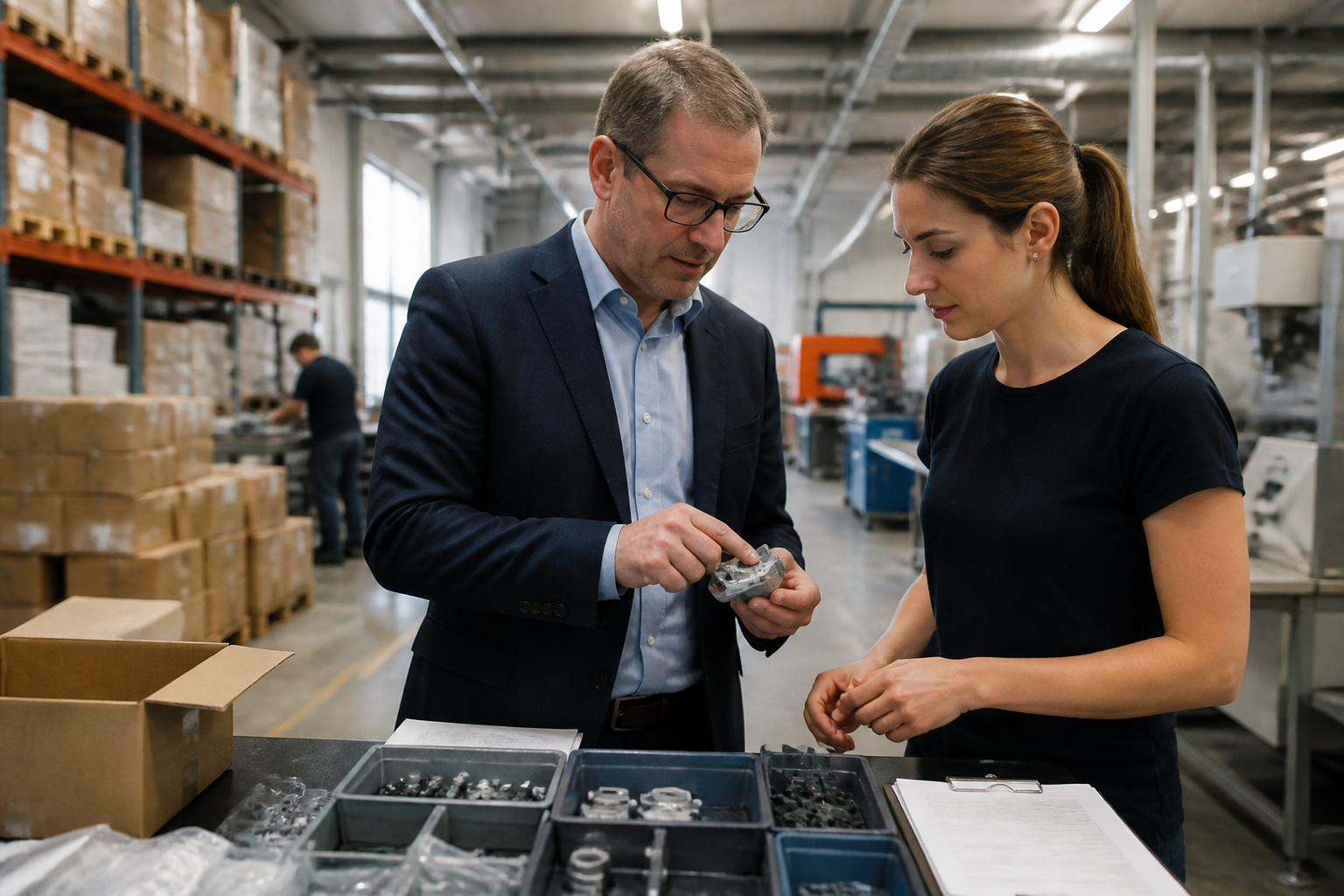
Europe is known for it’s long tail of small and medium sized businesses (SMBs). Many of those business are B2B companies. In recent years, many buyers have been proactively nearshored their suppliers towards Europe.
"European suppliers" covers four very different kinds of business, and picking the wrong one is the most common reasond a sourcing project stalls. A dropshipping supplier and a contract manufacturer both count, but they serve opposite ends of a brand's journey. This guide breaks down the four types, shows you how to choose, and explains how to vet a supplier before you commit.
Key takeaways
"European supplier" is an umbrella term. The four types are dropshipping suppliers, wholesalers and distributors, best private label manufacturers, and contract manufacturers.
Your choice depends on one thing first: do you want to sell someone else's product, or build your own brand?
Private label and contract manufacturing give you the highest margins and full brand control, but come with minimum order quantities (MOQs) and longer lead times.
Vetting matters more than price. Check certifications, MOQ fit, lead times, and EU compliance before you shortlist.
Europe is not one market. Country strengths, regulations, and lead times vary widely by category.
What counts as a European supplier
A supplier is any business that provides you with products or the capability to make them. In Europe, that ranges from a warehouse that ships single units to your customers, to a factory that develops a custom formulation to your specification. The label "supplier" tells you almost nothing on its own. What matters is the model behind it, because that model decides your margins, your MOQs, your branding, and your lead times.
There are four models worth knowing. Most sourcing confusion comes from treating them as interchangeable.
The four types of European suppliers, compared
Use this table to place any supplier you come across into the right category before you evaluate it further. The differences in MOQ, branding, and margin are what actually determine fit.
Supplier type | What they do | Typical MOQ | Your branding? | Margin potential | Lead time | Best for |
|---|---|---|---|---|---|---|
Dropshipping supplier | Ships individual orders directly to your customer. You hold no stock. | None (per order) | Minimal to none | Low | Immediate | Testing products with low upfront risk |
Sells existing products in bulk, usually under their own or a generic brand. | Moderate (cartons to pallets) | No (their brand) | Medium | Days | Retailers and resellers stocking known products | |
Private label manufacturer | Produces standard formulations that you sell under your own brand and packaging. | Medium (hundreds to thousands) | Yes (label and packaging) | High | Weeks | Building a brand quickly on proven products |
Contract manufacturer (OEM/ODM) | Develops and produces custom products to your specification. | Higher | Yes (fully yours) | Highest | Weeks to months (includes development) | Differentiated or bespoke products |
European Dropshipping suppliers
These suppliers ship products one order at a time, directly to your customer, so you never hold inventory. It is the lowest-risk way to test whether a product sells, but you compete with everyone else selling the same catalogue, and there is little room to build a distinctive brand. Margins are thin and you have limited control over packaging and delivery experience.
European Wholesalers and distributors
Wholesalers sell existing products in bulk. You buy stock at a discount and resell it, typically under the manufacturer's brand. This suits retailers and resellers who want to stock recognised products without a production commitment. You get faster availability than manufacturing allows, but no ownership of the product or brand.
European Private label manufacturers
A private label manufacturer produces a standard, proven formulation that you sell as your own. You choose from their existing product range, then add your branding, label, and packaging. This is the fastest route to a real product line with healthy margins, which is why it is the backbone of most consumer brands sourcing in Europe. Expect a minimum order quantity and a lead time measured in weeks.
European Contract manufacturers (OEM and ODM)
A contract manufacturer makes a product to your specification. With ODM you adapt one of their base products; with OEM you bring your own formula or design and they produce it. This gives you the most differentiated product and the highest margins, at the cost of higher MOQs, longer development, and more coordination. It is the right model once you know your product needs to stand apart from what private label can offer.
How to choose the right type for your business
Start with one question: are you selling someone else's product, or building your own? If you want a brand, you need private label or contract manufacturing. If you want to resell, you need wholesale or dropshipping.
From there, three constraints usually decide it:
Budget and volume. Dropshipping and wholesale need little or no upfront commitment. Private label and contract manufacturing require you to meet an MOQ, which ties up capital.
Speed. If you need product on shelves in days, manufacturing is not your route. If you can plan weeks ahead, the margin and branding gains are worth it.
Differentiation. If a standard product works, private label is faster and cheaper. If your positioning depends on a unique formula, format, or ingredient, you need a contract manufacturer.
Many brands move through these stages: test with dropshipping, validate with wholesale, scale with private label, then differentiate with contract manufacturing. There is no single right answer, only the right answer for your stage.
Where and how to find European suppliers
Once you know the type you need, there are four main channels to find one.
1. European B2B sourcing platforms & marketplaces
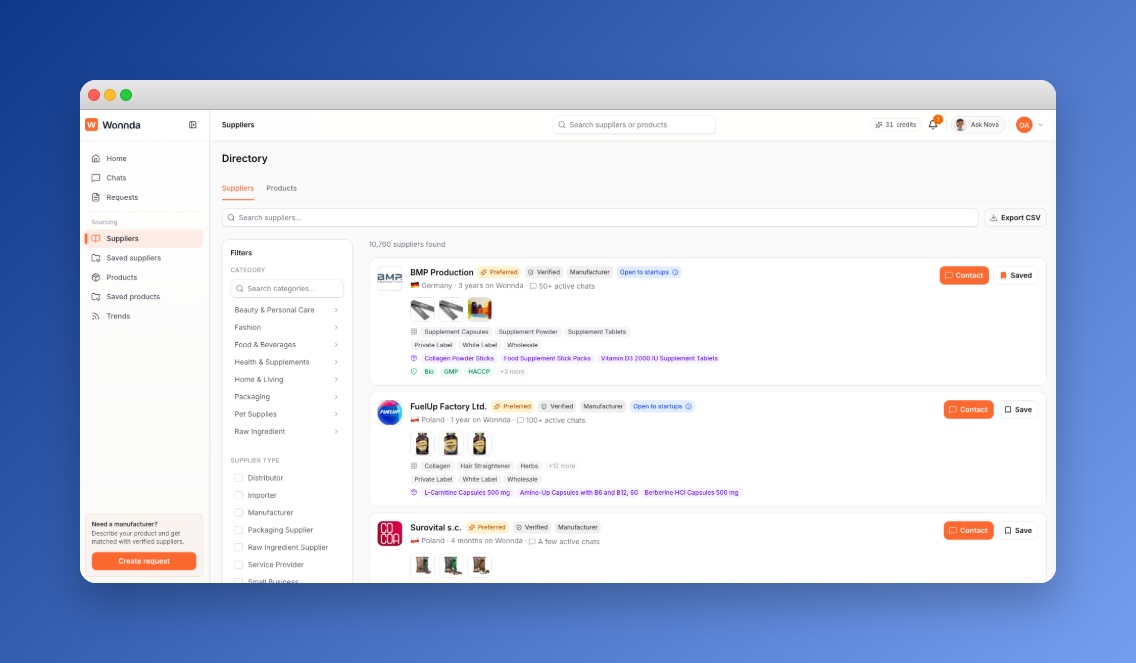
Purpose-built European B2B marketplaces like Wonnda let you search vetted private label manufacturers and contract manufacturers by category, certification, and MOQ, then message them directly. This is the fastest path from need to shortlist.
2. European Sourcing Agencies
Sourcing agencies do the work for you. They find suitable manufacturers, compare quotes, negotiate pricing, and manage quality and logistics, so you hand over a brief instead of running the search yourself. It is the fastest route when you lack the time or an in-house procurement team, in exchange for an agency fee.
Procfit, a Vienna and Munich based agency and Wonnda's certified sourcing partner, is a strong choice here: it has access to more than 70,000 European manufacturers, has completed 800+ projects across 100+ industries, and focuses on European production for shorter lead times and easier EU compliance.
If you are looking for a European manufacturer and want to have a white-glove service, Procfit is the right sourcing partner for you.
3. Business directories
General directories list large numbers of companies but rarely verify them, so you carry the vetting burden yourself.
4. Trade shows
In-person events are strong for building relationships in a specific vertical, but they are expensive, infrequent, and geographically limited.
5. Referrals and search
Recommendations and manual research work, but they are slow and hard to compare at scale.
How Wonnda helps you find European suppliers
Wonnda is a B2B sourcing platform built for the private label and contract manufacturing end of this spectrum. You can post what you need and get matched with suitable manufacturers within 48 hours, or browse verified suppliers by category yourself.
Post your requirements and get matched with suitable European manufacturers within 48 hours. Free for buyers, no commission.
How to vet a European supplier
Price is the last thing to check, not the first. A supplier that is cheap but misses certifications or lead times will cost you far more than the saving. Run every shortlist candidate through the same checks.
Certifications. Match the certification to the category. Food needs standards such as ISO 22000, HACCP, BRC, or IFS. Cosmetics look to GMP and COSMOS or NATRUE for natural claims. Textiles use OEKO-TEX or GOTS. Verify the certificate is current, not just claimed.
MOQ fit. Confirm the minimum order quantity works for your budget and demand. An MOQ that is too high is the most common reason a good supplier is still the wrong supplier.
Lead times. Ask for realistic production and shipping timelines, including development time for custom work. Build in buffer.
EU compliance. Confirm the supplier can meet the labelling, ingredient, and safety rules for the markets you sell in. Requirements differ across the EU and UK.
Samples. Always order and assess samples before a production run. This is non-negotiable for private label and contract manufacturing.
Communication and Incoterms. Clear, responsive communication predicts a smooth project. Agree Incoterms early so responsibility for shipping, duties, and insurance is unambiguous.
Best European suppliers by category - Curated by Wonnda’s network
The right European supplier is specific to your category. Below you can explore verified European suppliers across Wonnda's core verticals, with capability and certification detail on each profile.
1. Activ'Inside
Revolutionizing the Nutraceutical Industry
- Location
- France
- MOQ
- 1000 units
- Lead time
- 8 weeks
- Capabilities
- Private Label, Contract Manufacturing
- Trust score
- 4.7
Activ'Inside is a French health food-tech company specializing in nutraceutical development and production, offering both private label and contract manufacturing services for dietary supplements. Their focus on natural ingredients and scientifically backed formulations makes them a fitting European supplier option for brands looking to develop unique products.
Located in Beychac-et-Caillau, France, Activ'Inside operates a 24/7 manufacturing facility. They produce powder supplements, tablets, shots, drinks, gummies, and capsules, serving markets across Western Europe, Eastern Europe, and beyond.
Certifications: Featured Supplier
2. Biostile Global
European CDMO for food supplements, cosmetics, and pet food with patented BMT® microencapsulation technology and 30+ years of formulation expertise.
- Location
- Slovenia
- MOQ
- Contact for MOQs (project-dependent)
- Lead time
- 12 weeks
- Capabilities
- Private Label, Contract Manufacturing, Wholesale
- Trust score
- 5.0
Biostile Global is a European contract development and manufacturing organization (CDMO) and private label manufacturer based in Slovenia. They specialize in food supplements, cosmetics, and complementary animal feed, offering custom formulation and R&D services to brands seeking to develop their own products.
With four GMP-certified production facilities in Slovenia and over 30 years of expertise, Biostile Global dedicates approximately 75% of its capacity to white label and private label manufacturing. They provide end-to-end solutions, including production, packaging, and regulatory documentation for brands sourcing within Europe.
Certifications: Featured Supplier
3. BF-ESSE LTD.
Your Partner in Functional & Sports Supplements
- Location
- Latvia
- Capabilities
- Private Label, Contract Manufacturing
- Trust score
- 4.7
BF-ESSE LTD. is a European contract manufacturer specializing in functional and sports food supplements from their base in Riga, Latvia. They offer comprehensive private label and contract manufacturing services, providing a key option for brands looking to develop their own products within the EU.
As a European supplier, BF-ESSE LTD. provides custom supplement development, formulation services, and EU-compliant packaging. They produce capsules, tablets, powders, and liquid supplements, and hold ISO 9001 and HACCP certifications.
Certifications: Featured Supplier
4. Cita Lieta Ltd.
Elevating Private Label Gift and Bath Accessories
- Location
- Latvia
- Capabilities
- Private Label, Contract Manufacturing
- Trust score
- 4.7
Cita Lieta Ltd. is a European supplier based in Latvia, specializing in private-label bath and gift accessories, including bath bombs, candles, and other relaxing items. As both a contract manufacturer and private label producer, they offer full product lifecycle management from formulation to international shipping, making them a suitable partner for brands looking to develop their own cosmetic lines in Europe.
This Latvian supplier, established in 2005, focuses on private label production of cosmetics, skin care products, and natural bath and body care items. Cita Lieta handles products such as natural soaps, bath bombs, face and body skin care products, and hair care products, serving brands that want to create unique items for the European market.
Certifications: Featured Supplier
5. Cavex Holland BV
Innovators in Dental Solutions
- Location
- Netherlands
- Capabilities
- Private Label, Contract Manufacturing
- Trust score
- 4.7
Cavex Holland BV, a Dutch manufacturer, specializes in private label and contract manufacturing of dental products and solutions in the Netherlands. With over a century of experience, Cavex focuses on creating reliable materials such as impression materials and oral care solutions, making them a relevant European supplier for brands seeking established production partners.
Based in Haarlem, Netherlands, Cavex handles all operations in-house, including R&D and production. They manufacture dental materials, impression materials, tooth whitening solutions, and prophylactic pastes for dental professionals, suppliers, distributors, and consumers.
Certifications: Featured Supplier

6. Bio2you
Leading Skincare Manufacturer
- Location
- Latvia
- Capabilities
- Private Label, Contract Manufacturing
- Trust score
- 4.7
Bio2you is a skincare manufacturer based in Latvia, specializing in natural cosmetic products. As both a private label and contract manufacturer, they are an example of the types of European suppliers that offer custom formulations and full brand control, as discussed in this article.
Bio2you, founded in 2009, focuses on sea buckthorn oil-based formulations for skincare and body care. They are located in Riga, Latvia, manufacturing serums, masks, creams, and lotions.
Certifications: Featured Supplier
- Location
- Germany
- Capabilities
- Private Label, Contract Manufacturing
- Trust score
- 4.7
Azba Cosmetics is a Berlin-based private label cosmetics manufacturer and product developer, crafting naturally effective and hybrid formulations. As a European supplier, they offer end-to-end services, including product development, formulation optimization, and both white label and private label solutions, which are ideal for brands seeking controlled manufacturing within Europe.
With over 20 years of experience, Azba Cosmetics specializes in natural cosmetic products and dietary supplements from their facility in Berlin, Germany. They support brands from concept to market, focusing on products like natural and hybrid cosmetics, and also process natural raw materials.
Certifications: Featured Supplier
8. Cobeco Pharma
European Private Label Manufacturer For Personal Care Products, Lubricants, Supplements and more
- Location
- Netherlands
- Capabilities
- Private Label, Contract Manufacturing
- Trust score
- 4.7
Cobeco Pharma is a European private label supplier based in the Netherlands, specializing in personal care products, lubricants, and supplements. With over 25 years of experience, this Dutch producer offers end-to-end solutions, including formulation, packaging, and compliance for brands looking to source within Europe.
Cobeco Pharma serves a wide range of customers across Europe, North and South America, the Middle East, Asia, and Australia. Their product categories include health supplements, cosmetic products, erotic and sexual wellness products, medical devices, and lubricants and gels.
Certifications: Featured Supplier
9. Cosmacon GmbH
German cosmetic formulation experts specializing in custom development and certified natural cosmetics since 2013.
- Location
- Germany
- MOQ
- Contact for MOQs (project-dependent)
- Capabilities
- Private Label, Contract Manufacturing
- Trust score
- 4.0
Cosmacon GmbH is a German cosmetic product developer and private label manufacturer near Hamburg, specializing in custom formulation and certified natural cosmetics for European brands. Their expertise in developing unique cosmetic formulations helps brands differentiate their products within the competitive European market, which is crucial for successful sourcing projects.
Based in Schenefeld, Germany, Cosmacon GmbH has a production network that includes Germany, Austria, Bulgaria, Poland, and Switzerland, offering flexibility for brands seeking European suppliers. This network supports white label, private label, and custom development services for a range of cosmetic products including body creams, face serums, and certified natural cosmetics.
Common mistakes when sourcing from Europe
Treating Europe as one market. Country strengths, regulations, and lead times vary. Germany leads in supplements, France in cosmetics, Italy in food and packaging.
Ignoring MOQ mismatch. Falling for a supplier whose minimum order you cannot meet wastes everyone's time.
Skipping samples. A spec sheet is not a product. Test before you produce.
Underestimating lead times. Custom manufacturing in particular takes longer than founders expect. Plan backwards from your launch date.
Choosing on price alone. The cheapest quote rarely accounts for compliance, reliability, and rework.
Sourcing well in Europe is mostly about matching the right supplier type to your stage, then vetting rigorously. Get those two right and the rest follows.
Frequently asked questions
Are European suppliers more expensive than Asian suppliers?
Unit prices are often higher, but European suppliers frequently offer lower MOQs, shorter shipping times, easier communication, and stronger compliance with EU regulations. Total landed cost and reliability often close the gap, especially for smaller runs.
What is the difference between a wholesaler and a manufacturer?
A wholesaler sells existing products in bulk, usually under the manufacturer's brand. A manufacturer makes products, either standard formulations you brand as your own (private label) or custom products to your specification (contract manufacturing).
Do European suppliers work with small businesses and low MOQs?
Many do. MOQs vary widely by supplier and category, and plenty of European private label manufacturers accommodate smaller founding brands. Filtering by MOQ upfront is the fastest way to find a fit.
Which European countries are best for sourcing?
It depends on the category. Germany is strong in supplements and engineering, France in cosmetics and beauty, Italy in food and packaging, and Eastern Europe in cost-competitive manufacturing. Match the country's strength to your product.
How do I verify a European supplier is legitimate?
Confirm current certifications relevant to your category, order samples, check MOQ and lead times in writing, and agree Incoterms before ordering. Sourcing on a platform that vets suppliers removes much of this manual work.
Related articles
Best Clothing Manufacturers in Europe - 2026 Guide by Wonnda
10+ Best Beauty Manufacturers in the US (2026 List)

How to Find a Manufacturer for Your Product (2026 Guide)

10 Best European Sourcing Agencies To Find Suppliers & Launch Your Product
How to Start a Premium Private Label Cookware Brand: The Complete Guide
5+ Best Private Label Nonstick Cookware Manufacturers
5+ Best Private Label Cookware Manufacturers in the USA (2026)
Best Private Label Beef Tallow Manufacturers in Europe (2026 Guide)