
Best private label cleaning products manufacturers
Find vetted private label cleaning products manufacturers on Wonnda. Brands seek coordinated household cleaning ranges, including spray and wipe formats. Sourcing considerations involve the specific surfaces and rooms the products will clean, a shared formulation platform for consistency, and the detergent basis. These products often include all-purpose sprays, kitchen and bathroom cleaners, glass cleaner, and surface wipes. Lead times can vary depending on custom formulation complexity and packaging requirements.
- Vetted suppliers
- 20,000+
- Brands & buyers
- 25,000+
- EU-made
- 80%
Buyer criteria
- Multi-product capability under one roof
Confirm the manufacturer can formulate and fill the full range you want, from neutral sprays to acidic descalers and glass cleaners, rather than only part of it. Splitting a range across suppliers risks fragrance and quality mismatches and complicates ordering. A single capable partner keeps the line coherent and your supply chain simple.
- Fragrance and finish consistency
A coordinated range relies on a consistent scent and appearance across products. Verify the shared fragrance holds across different chemistries, since an acidic descaler and a neutral spray can carry scent differently. Ask for samples of the whole line together so you can confirm the brand identity reads consistently from product to product.
- Per-surface performance
Each formula must work on its job: the degreaser on kitchen grease, the descaler on limescale, the glass cleaner streak-free. Require performance evidence for each product, not just the all-purpose base. A range is only as strong as its weakest formula, so confirm every SKU performs before launching the line.
- Unified packaging system
A range benefits from a shared bottle and closure platform that signals one brand. Confirm the manufacturer can supply consistent HDPE packaging with the right triggers, pumps and any wipes format across SKUs. A coherent packaging system strengthens shelf presence and reduces tooling cost compared with bespoke packaging per product.
- Compliance for every SKU
Each product in the range needs its own EU Detergents Regulation declarations, fragrance allergen labeling and any CLP hazard labeling, since an acidic descaler and a neutral spray differ in classification. Confirm the manufacturer handles compliant labeling for every formula, since one non-compliant SKU can hold up the whole launch.
Red flags
- Can only make part of the range
If the manufacturer can produce sprays but not the descaler or glass cleaner, you will end up splitting the range across suppliers, risking fragrance and quality mismatches. A partner that cannot deliver the full line you planned forces compromises on coherence. Confirm full-range capability before committing to a multi-product launch.
- Inconsistent scent across products
If samples of the range carry the fragrance differently from one formula to the next, the brand identity breaks down on the shelf. This often happens when formulas are developed in isolation. Reject a range where the shared scent does not hold consistently, since a coordinated line is the whole point of building a range.
- Performance shown only for the base
A manufacturer that demonstrates only the all-purpose spray and waves away the specialised formulas may be relying on weak descaler or glass cleaner formulas. Require performance evidence for every product. A range with one underperforming SKU drags down the credibility of the entire line in the customer's eyes.
- Compliance handled for some SKUs only
If labeling and hazard classification are addressed for the simple formulas but not the acidic or specialised ones, the range cannot launch cleanly. Each SKU has its own requirements. A partner that does not handle compliance across every product is creating a bottleneck that delays the whole line.
Manufacturing process
- 01
Range planning and platform design
The manufacturer and brand define which products the range covers and design a shared surfactant and fragrance platform, then adjust each formula to its target: neutral all-purpose, alkaline kitchen degreaser, acidic bathroom descaler, low-residue glass cleaner. Planning the line together keeps the fragrance, look and performance consistent across SKUs.
- 02
Per-formula development
Each product in the range is formulated to its surface and soil, with pH, surfactant level and any solvent or acid set for the job, while keeping the shared fragrance and brand character. Specialised formulas such as the descaler or glass cleaner are developed and checked individually before the range is finalised.
- 03
Raw material weighing across SKUs
Surfactants, builders, acids, solvents, fragrance and additives for each formula are weighed to their batch records, with active matter of incoming materials verified. Shared ingredients like the common fragrance are managed across the range so the scent identity stays consistent from one product to the next.
- 04
Compounding and blending
Each formula is compounded in its mixing vessel in the correct ingredient order and blended to a stable, homogeneous liquid, then checked for appearance, pH and viscosity. Because the formulas differ in chemistry, each is handled to its own process while the line is scheduled to keep changeovers efficient.
- 05
Quality control across the range
QC checks active matter, pH, viscosity, colour, odour and microbiological limits per formula, confirms each product performs on its target surface, and verifies the fragrance and finish are consistent across the line. Stability samples are held so every SKU holds appearance and performance over shelf life.
- 06
Filling and unified packaging
Each formula is filled into its HDPE bottle with the right closure, trigger for sprays, pump or flip-top as needed, and labeled in the shared range design with mandatory ingredient and hazard data per product. Wipes, if part of the range, are saturated and packed on their own line. Lot codes are printed throughout.
Understanding cleaning products private-label manufacturing
Product Range Considerations
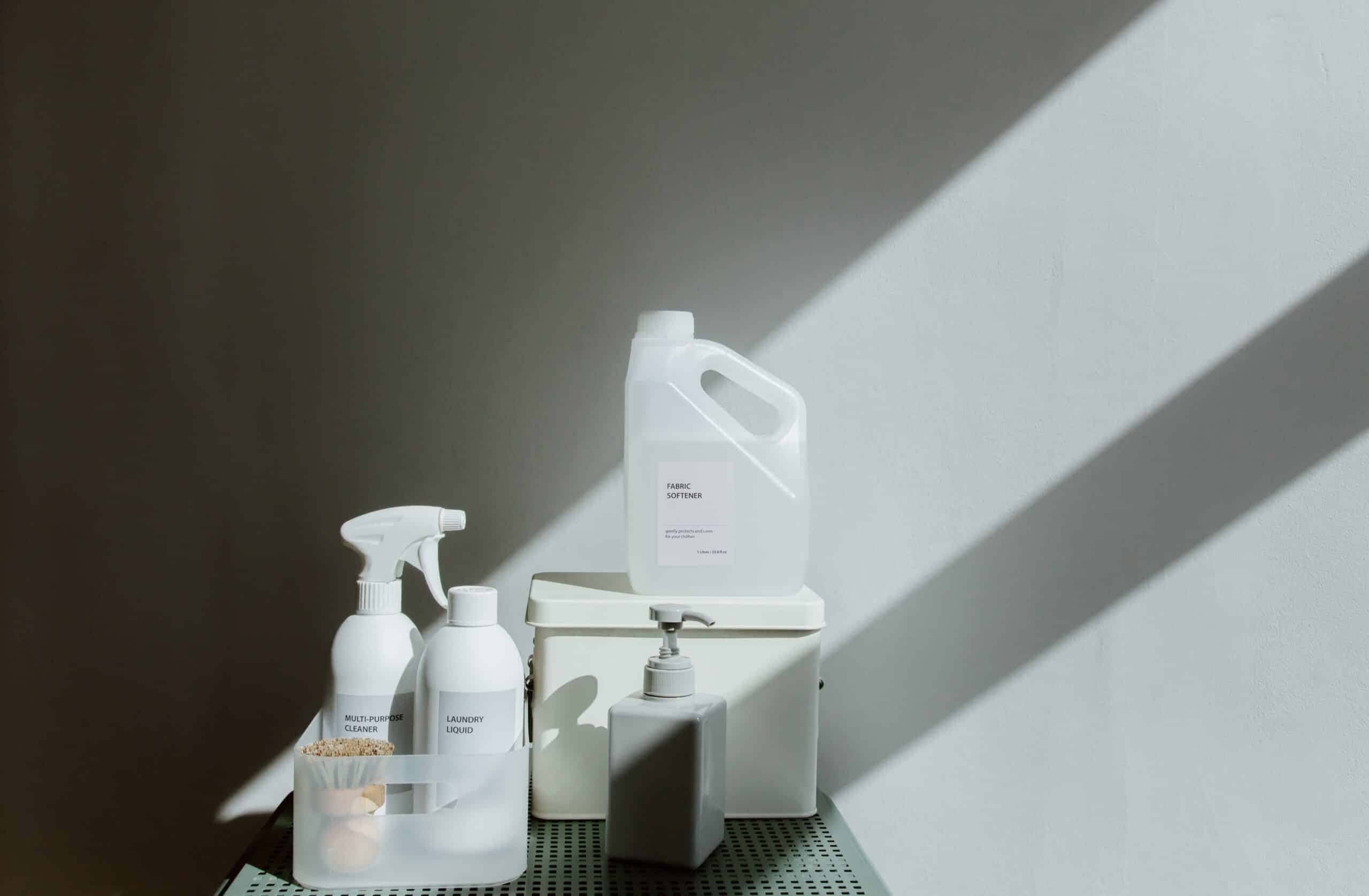
Cleaning products as a private label range cover the everyday household line a brand puts on the shelf together: all-purpose spray, kitchen and bathroom cleaners, glass cleaner, surface wipes and the supporting surfactant-based formulas that handle daily home care. For a brand, the appeal of building a coordinated range rather than a single product is shelf presence and basket size.
The decisions that shape the range are which surfaces and rooms to cover, the shared formulation platform, and the packaging system that ties the line together. A coherent household range usually shares a surfactant and fragrance backbone across products, with each formula adjusted to its job.
Formulation and Cost
Each formula is adjusted to its job: a near-neutral all-purpose spray for general surfaces, a more alkaline degreaser for the kitchen, an acidic or descaling formula for bathroom limescale, and a fast-drying, low-residue glass cleaner. Keeping a common fragrance and look across the line builds brand recognition.
Cost across a range is driven by the surfactant and functional actives per formula, the shared fragrance, the packaging system (HDPE bottles, triggers, pumps and any wipes substrate), and the fill across multiple SKUs. A shared fragrance and a common bottle platform reduce cost and reinforce branding.
Manufacturing and Logistics
Contract manufacturing for a household cleaning range in Europe is widely available. Many fillers can produce a multi-product line under one roof in a number of countries:
- Germany
- Poland
- Italy
- Spain
- Benelux region
MOQs are set per SKU, typically around 3,000 to 10,000 units each. A multi-product launch carries a higher combined minimum, though running the line together in one window improves pricing.
Lead times run 6 to 10 weeks for a first run. Lead times are longer with custom fragrance, bespoke bottles, or trigger and pump tooling shared across the range.
Target Market and Differentiation
Private label household cleaning buyers are predominantly retailer own-label home-care ranges, D2C cleaning brands launching a coordinated line, and lifestyle and home brands extending into cleaning. Channel mix is grocery, drugstore and online.
Brands differentiate on range coherence, fragrance identity, format mix, and packaging design rather than single-product performance. The value is in the complete line. Qualifying a manufacturer on multi-product capability, consistent fragrance and finish across the range, and EU Detergents Regulation compliance for every SKU matters more than the lowest per-bottle quote.
Frequently asked questions
Should I launch a single cleaning product or a full range?+
How do I keep a consistent fragrance across different cleaning formulas?+
What products typically make up a household cleaning range?+
Why do different cleaners in a range need different pH levels?+
Is it cheaper to source a whole range from one manufacturer?+
What MOQ applies when launching a multi-product cleaning range?+
Explore adjacent product types
Get a vetted shortlist of cleaning products suppliers in 48 hours.
Post a brief on Wonnda. Free, no commitment. We match you with vetted manufacturers that fit your MOQ, format and market.