
Best private label adaptogen pouches manufacturers
Wonnda connects brands with private label adaptogen pouches manufacturers. Sourcing considerations include the specific botanical extracts used, such as ashwagandha or rhodiola, and their standardization for active compounds. Compliance with regulatory guidelines for adaptogen-related claims and traditional use is crucial. Lead times can vary depending on the availability of highly purified botanical raw materials and the complexity of the formulation process.
- Vetted suppliers
- 20,000+
- Brands & buyers
- 25,000+
- EU-made
- 80%
7+ Top private label adaptogen pouches manufacturers
Wonnda works with the best private label adaptogen pouches manufacturers. Here is a list of trusted suppliers from our network.
Lithuania-based manufacturer producing nicotine pouches, caffeine pouches, cbd/cbn/cbg pouches, available to brands sourcing adaptogen pouches.
- Country
- Lithuania
- MOQ
- Lead time
Denmark-based manufacturer producing tobacco-free oral pouches, caffeine-containing oral pouches, cannabinoid-containing oral pouches, available to brands sourcing adaptogen pouches.
- Country
- Denmark
- MOQ
- Lead time
Poland-based manufacturer producing nicotine pouches, energy nicotine pouches, white label nicotine pouches, available to brands sourcing adaptogen pouches.
- Country
- Poland
- MOQ
- Lead time
Poland-based manufacturer producing nicotine pouches, energy pouches, coffee pouches, available to brands sourcing adaptogen pouches.
- Country
- Poland
- MOQ
- Lead time
Lithuania-based manufacturer producing nicotine pouches, all-white nicotine pouches, tobacco pouches, available to brands sourcing adaptogen pouches.
- Country
- Lithuania
- MOQ
- Lead time
USA-based manufacturer producing oral pouch products, caffeine pouch products, cbd pouch products, available to brands sourcing adaptogen pouches.
- Country
- USA
- MOQ
- Lead time
United Kingdom-based manufacturer producing tobacco-free nicotine pouches, mint nicotine pouches, mango nicotine pouches, available to brands sourcing adaptogen pouches.
- Country
- United Kingdom
- MOQ
- Lead time
Compare MOQs and lead times
Quick side-by-side of the shortlist. Missing values shown as a dash.
| Supplier | Location | Types | MOQ | Lead time |
|---|---|---|---|---|
| Global Snus | Lithuania | - | ||
| House of Pouches | Denmark | - | ||
| Kylmakorpi | Poland | - | ||
| Luna Corporate | Poland | - | ||
| MB IP Factory (brand: FLIQ) | Lithuania | - | ||
| JD Quality Pouches LLC | USA | - | ||
| hiit Pouches | United Kingdom | - |
Buyer criteria
- Standardized, documented extracts
The product's credibility rests on genuine standardized botanical extracts, so confirm each adaptogen is supplied at a stated standardization level with documented specs, not a cheap unstandardized powder. Ask for the standardized compound percentage and a certificate of analysis. An adaptogen pouch built on commodity powder cannot deliver the effect its positioning promises.
- Honest, defensible dosing
Adaptogens only work at meaningful doses, so confirm the per-pouch extract amount is defensible against studied levels rather than a trace for the label. The pouch format limits load, which tempts under-dosing. Ask how much standardized extract each pouch delivers, since a fairy-dusted adaptogen produces no benefit and undermines repeat purchase in a results-sensitive category.
- Botanical sourcing and contaminant testing
Botanical extracts carry heavy-metal and adulteration risk, so require per-batch testing for the standardized compound, heavy metals and microbiology with certificates of analysis. Confirm the manufacturer tests incoming extract, not just trusts supplier paperwork, since botanical quality and contaminant levels vary by source and growing conditions.
- Flavor masking of bitter botanicals
Many adaptogens are bitter or earthy, so the flavor system must mask the botanical note while staying clean. Evaluate the manufacturer's experience masking botanicals and taste production-representative samples. A pouch where the adaptogen taste breaks through is unpleasant, and in a buccal product the user holds that taste in the mouth for several minutes.
- Novel Food and claim compliance
Botanical adaptogens face food-supplement rules, some carry market-specific restrictions, newer ones raise Novel Food questions, and most stress-related health claims are unauthorized in the EU. Confirm the manufacturer can keep claims within traditional-use framing and handle Novel Food checks. A partner that allows unauthorized stress claims exposes finished stock to enforcement.
Red flags
- Unstandardized commodity powder
An adaptogen pouch built on cheap unstandardized botanical powder rather than a standardized extract cannot reliably deliver the active compounds the positioning depends on. If the manufacturer cannot state a standardization level and provide a certificate of analysis, treat the adaptogen claim as unsubstantiated, since the standardized compound is what makes the extract worth using.
- Trace dosing behind a botanical name
Listing ashwagandha or rhodiola on the can while including only a token amount too low to matter inflates the label without delivering function. Ask for the per-pouch standardized extract dose against studied levels. An under-dosed adaptogen produces no effect, and the category lives on customers feeling a benefit and reordering.
- No contaminant testing on botanicals
Botanical extracts carry real heavy-metal and adulteration risk, so a manufacturer that does not test each batch for the standardized compound, heavy metals and microbiology is exposing your brand to contaminant and authenticity failures. In a product held in the mouth and used regularly, missing botanical testing is disqualifying regardless of price.
- Unauthorized stress or health claims
Most stress, anxiety and health claims for adaptogens are not authorized in the EU, so a manufacturer that lets you print them is exposing finished stock to enforcement. Compliant adaptogen pouches use traditional-use and wellness framing. A partner that waves through stress-treatment claims either does not know the rules or disregards them.
Manufacturing process
- 01
Adaptogen and standardization selection
The brand selects the adaptogens (ashwagandha, rhodiola, ginseng and others) and the standardization level, such as a stated withanolide percentage, at a defensible dose. The extract grade and any branded standardized extract are specified here, since extract quality, not the pouch, defines the product's credibility.
- 02
Extract sourcing and verification
Standardized botanical extracts are sourced to specification and tested on receipt for identity, the standardized compound, heavy metals and microbiology, since botanicals carry contaminant and adulteration risk. Any newer botanical is checked for Novel Food status. Branded extracts arrive with documented specs that are verified.
- 03
Base and buccal formulation
A cellulose or plant-fiber fleece base is formulated with moisture and pH to carry the botanical extracts and support buccal availability. The format limits how much extract can be loaded, so concentration is balanced against pouch size and mouthfeel, and the base is designed to hold the actives evenly.
- 04
Flavor masking and blending
Many adaptogens are bitter or earthy, so a flavor system is developed specifically to mask the botanical note while keeping a clean taste. Extracts and flavors are blended evenly so each pouch delivers the intended dose, with blend uniformity verified, since botanical extracts can be low-inclusion and prone to uneven distribution.
- 05
Filling, portioning and dose checks
The filling is dosed into fleece pouches and sealed, with fill weight and extract content checked so each pouch delivers the labeled adaptogen dose across the can. Consistent portioning ensures the standardized extract is present at the claimed level in every pouch, not just on average.
- 06
QC, canning and claim-compliant labeling
QC verifies the standardized compound against label claim, runs heavy-metal and microbiological tests and checks moisture and pH. Pouches are canned and labeled with ingredients, extract standardization, supplement information and traditional-use framing, keeping claims within authorized wording and Novel Food rules per market.
Understanding adaptogen pouches private-label manufacturing
Product Overview
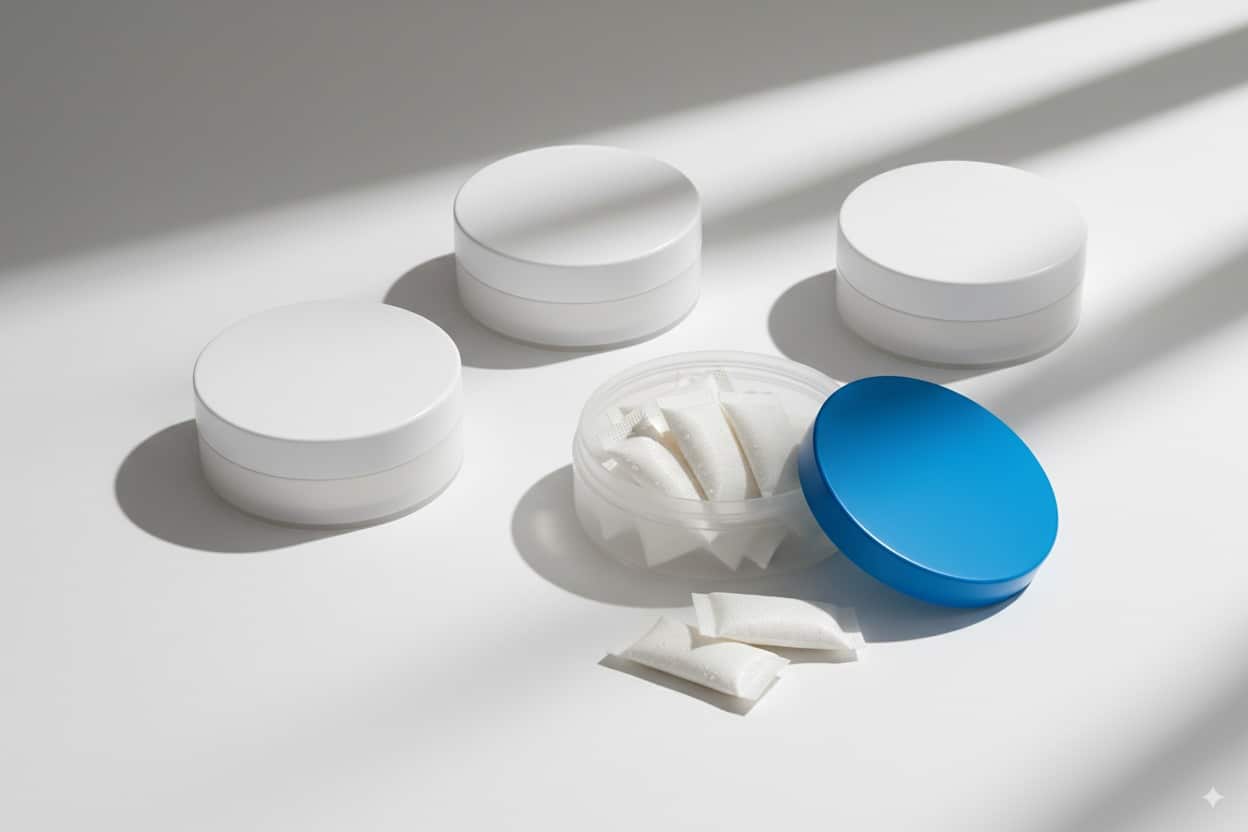
Adaptogen pouches are oral fleece pouches containing botanical adaptogens such as ashwagandha, rhodiola, or ginseng. They are positioned for stress resilience and balance, rather than stimulation, and are held under the lip for buccal delivery.
For private label brands, the defining feature is that the actives are botanical extracts with their own sourcing, standardization, and regulatory complexity. The brief therefore emphasizes extract quality and claim compliance over simple dosing.
Extract Quality and Formulation
Extract quality is a core decision. Adaptogens like ashwagandha are sold at varying standardization levels - for example, a stated withanolide percentage. A credible product specifies a standardized extract at a defensible dose, rather than an unstandardized powder.
Branded standardized extracts exist, command a premium, and provide documented specifications. The buccal pouch format limits the amount of extract that can be loaded and influences how botanicals taste, as many adaptogens are bitter or earthy. Flavor masking and extract concentration are significant formulation challenges.
Regulatory Landscape
Botanical adaptogens fall under food-supplement rules. Several have restrictions or require specific labeling in some EU markets. Newer or less-established botanicals can raise Novel Food questions.
Health claims for adaptogens are largely unauthorized in the EU. Positioning therefore relies on traditional-use and wellness framing, rather than stress-treatment claims. Production is typically handled by functional-pouch contract manufacturers in the Nordics and wider EU that can source and handle botanical extracts.
Production, MOQs, and Lead Times
Custom adaptogen pouch runs typically start around 5,000 to 25,000 cans. Stock-recipe relabels are accessible, though sourcing standardized botanical extracts can increase the minimum order quantity and lead time.
Lead times range from 8 to 14 weeks, extending further when Novel Food or specific extract sourcing is involved. The primary cost drivers, in order, are:
- Botanical extracts (standardized and branded extracts are the dominant cost)
- Flavor masking system
- Can and components
- Compliance work
The extract quality and the claim position are where both cost and credibility are established.
Target Market and Differentiation
Buyers include wellness and adaptogen-focused D2C brands, stress and balance lifestyle brands, and functional-pouch brands seeking to add a botanical line. Differentiation is achieved through authentic standardized extracts, honest dosing, effective flavor masking of bitter botanicals, and a compliant traditional-use claim position.
Qualifying a manufacturer on its botanical-extract sourcing and testing, whether adaptogens are standardized and meaningfully dosed, and its understanding of Novel Food and claim rules is more critical than the headline can price. An adaptogen pouch built on cheap, unstandardized powder and unauthorized claims will fail in both efficacy and compliance.
Frequently asked questions
What are adaptogens and what goes in an adaptogen pouch?+
Why does extract standardization matter for adaptogens?+
Can I make stress or anxiety claims on an adaptogen pouch?+
How do you stop adaptogen pouches from tasting bitter?+
What MOQ and lead time should I expect for adaptogen pouches?+
How is an adaptogen pouch different from a mushroom or focus pouch?+
Explore adjacent product types
Get a vetted shortlist of adaptogen pouches suppliers in 48 hours.
Post a brief on Wonnda. Free, no commitment. We match you with vetted manufacturers that fit your MOQ, format and market.