
Best private label linen bedding manufacturers
Wonnda is where brands find private label linen bedding manufacturers. Sourcing involves choosing between various flax origins and blends, which significantly impact the fabric's feel and performance. Key considerations include the weaving technique, whether the linen is stonewashed for softness, and the construction details of items like duvet covers and pillowcases. Brands often prioritize certifications that attest to sustainable cultivation and processing, and lead times can vary based on custom color dyeing or specialized finishing treatments.
- Vetted suppliers
- 20,000+
- Brands & buyers
- 25,000+
- EU-made
- 80%
5+ Top private label linen bedding manufacturers
Wonnda works with the best private label linen bedding manufacturers. Here is a list of trusted suppliers from our network.
 Private LabelContract Manufacturing
Lithuania-based manufacturer producing flax linen bed linen, linen curtains, wool throws and blankets, available to brands sourcing linen bedding.
- Country
- Lithuania
- MOQ
- Lead time
 Private LabelContract Manufacturing
Lithuania-based manufacturer producing linen pants (men's classic), stonewashed linen bedding sets, gauze linen fabric, available to brands sourcing linen bedding.
- Country
- Lithuania
- MOQ
- Lead time
 Private LabelContract Manufacturing
Lithuania-based manufacturer producing linen bedding sets, linen tablecloths, linen towels, available to brands sourcing linen bedding.
- Country
- Lithuania
- MOQ
- Lead time
 Private LabelContract Manufacturing
Austria-based manufacturer producing tablecloths, napkins, kitchen towels, available to brands sourcing linen bedding.
- Country
- Austria
- MOQ
- Lead time
 Private LabelContract Manufacturing
Estonia-based manufacturer producing quilts and duvets, pillows (synthetic, feather, down, hybrid), spring mattresses, available to brands sourcing linen bedding.
- Country
- Estonia
- MOQ
- Lead time
Compare MOQs and lead times
Quick side-by-side of the shortlist. Missing values shown as a dash.
| Supplier | Location | Types | MOQ | Lead time |
|---|---|---|---|---|
| Baltpro Textile | Lithuania | PL · CM | ||
| Epic Linen | Lithuania | PL · CM | ||
| Linomeda | Lithuania | PL · CM | ||
| Leitner Leinen | Austria | PL · CM | ||
| Wendre | Estonia | PL · CM |
Buyer criteria
- Genuine flax content
The premium positioning of linen bedding rests entirely on real flax and its breathability and softening properties, so verify whether the fabric is 100 percent linen, a linen-cotton blend, or a linen-look substitute. A blend or imitation sold as pure linen misrepresents the product customers pay a multiple of cotton for. Confirm fiber content with documentation and judge the texture and hand on samples.
- Washing and softness quality
Raw linen is stiff, so the washed softness is what customers feel and pay for. Verify the stonewashing or garment-washing achieves a genuinely soft, broken-in hand on samples rather than a crisp fabric with a marketing claim. The quality of the washing is central to a sellable linen bedding product, since stiff bedding fails the first and most important test customers apply.
- Duvet-cover closure and corner ties
The duvet cover is the most complex and stress-prone piece, so verify the closure, buttons, ties, or hidden zip, is durable and the interior corner ties hold the duvet in place. Inspect closures and corner ties on samples. A flimsy closure or missing corner ties make the cover impractical, and these are common failure points in a product inserted and removed and washed repeatedly.
- Sizing and duvet fit
Confirm the duvet cover and pieces are sized accurately and generously for standard duvet dimensions in your target markets, since duvet sizes differ across regions. A cover that does not fit the duvet, too tight or too loose, fails at its basic job. Verify sizing against the relevant market standards and confirm the linen is pre-shrunk so the fit holds after washing.
- Pre-shrinking and colorfastness
Bedding is washed regularly, so confirm the linen is pre-shrunk through the washing process and the dyes are colorfast. Unshrunk linen loses size and a fading set looks tired. Verify dimensional stability and colorfastness on washed samples, since a premium bedding set must hold its size, fit, and color across its life to justify the considered purchase it represents.
- Seam and stitching quality
Linen bedding is premium, so visible stitching quality matters and seams must withstand frequent washing and the stresses of duvet insertion and removal. Inspect seam strength and finish on samples, especially around closures and corner ties where stress concentrates. Weak seams on a premium set fail under normal use and are immediately at odds with the quality the price point promises.
Red flags
- Blend or linen-look sold as pure linen
Because linen bedding commands a multiple of cotton's price on the strength of genuine flax, a linen-cotton blend or a linen-look fabric presented as 100 percent linen is a serious misrepresentation. The breathability and softening that justify the premium come from real flax. Demand fiber content documentation and judge the hand and texture on samples, since the whole price point depends on authenticity.
- Stiff, crisp fabric
If samples feel stiff and crisp rather than soft and broken-in, the washing is inadequate and the bedding will disappoint, since washed softness is the main quality customers feel. Raw linen must be properly stonewashed to be sellable as premium bedding. A manufacturer delivering crisp fabric with a softness claim has not done the washing the product depends on.
- Flimsy or missing duvet-cover closures
A duvet cover with a weak closure or no interior corner ties is impractical, since the duvet shifts inside and the cover is hard to keep in place, and weak closures fail under repeated insertion and washing. The duvet cover is the most stress-prone piece. Poor closure and corner-tie quality on samples signals a cover that will frustrate customers and fail in normal use.
- Sizing that does not fit standard duvets
If the duvet cover does not match standard duvet dimensions for the target market, or shrinks out of fit because the linen is not pre-shrunk, the product fails at its basic job. Duvet sizes vary by region, so a cover sized for the wrong market or that loses fit after washing leaves customers with bedding that does not work, a fundamental and avoidable failure.
Manufacturing process
- 01
Flax linen and weight specification
The brand fixes the material, 100 percent flax linen versus a blend, and the fabric weight for the bedding feel, since the premium positioning rests on genuine linen and its properties. Mid-weight linen is common as it drapes well without feeling flimsy. Content and weight are locked first because they determine breathability, hand, and the price point the whole product supports.
- 02
Weaving
Flax yarn is woven into linen fabric at the chosen weight, with the weave judged for the right texture, evenness, and the natural slubs that give linen its character. The fabric must have enough substance to drape properly on a bed. Weave quality affects how the bedding feels and wears, so it is specified rather than left to the mill's standard cloth.
- 03
Stonewashing and softening
Raw linen is crisp and stiff, so the fabric or finished pieces are stonewashed or garment-washed to achieve the soft, pre-broken-in hand and gentle wrinkle that define washed linen bedding. This washing also pre-shrinks the set so it holds size. The washing quality is central, since the soft hand is the main thing customers feel and pay the premium for.
- 04
Dyeing
Linen is dyed to the brand palette with colorfast dyes suited to repeated laundering, or natural undyed linen is used. The color palette is a key differentiator in premium linen bedding, and linen takes dye with a subtle, lived-in variation that suits the material. Colorfastness matters because bedding is washed regularly and must hold color across its life.
- 05
Cutting and duvet-cover construction
Pieces are cut to size and the duvet cover is constructed with its closure, buttons, ties, or a hidden zip, interior corner ties to hold the duvet in place, and accurate sizing for standard duvets. Pillowcases get envelope or buttoned closures. The duvet-cover construction is the most complex part, and closure and corner-tie quality determine the cover's practicality and durability.
- 06
Sewing and finishing
Pieces are sewn with durable seams and finished hems suited to repeated laundering. Linen bedding is a premium product so stitching quality is visible and matters. Seams must withstand the stresses of duvet insertion and removal and frequent washing, so seam strength and finish are checked, particularly around closures and corner ties where stress concentrates.
- 07
Quality control, pressing, and set packing
Finished sets are inspected for sizing accuracy, washed softness, colorfastness, seam and closure quality, and duvet-cover fit, then pressed and packed as coordinated sets with care labeling. Sizing is verified against standard duvet dimensions for the target markets. Care guidance covers washing and the relaxed wrinkle, since customers should understand how to maintain the linen's look and softness.
Understanding linen bedding private-label manufacturing
Materials and Construction
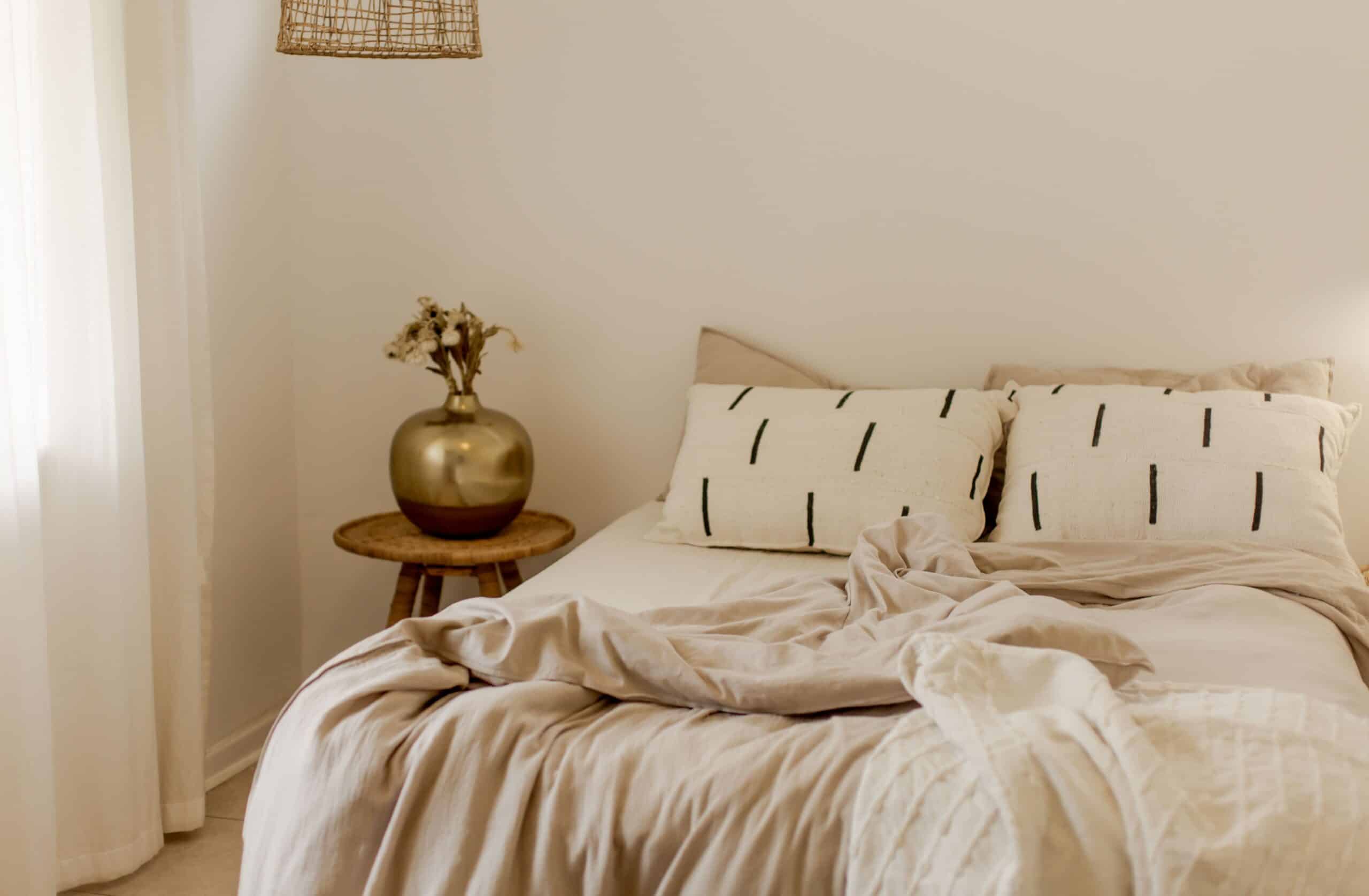
Linen bedding is a full bed set woven from flax, including duvet covers, pillowcases, and accompanying sheets. It is sold on the promise of breathability, temperature regulation, and a relaxed, lived-in look.
For a private label brand, linen bedding is a higher-investment, higher-margin product than cotton bedding. Its premium is justified by fabric authenticity, softness achieved through washing, and the construction of the duvet cover and its closure.
The core material decision is genuine flax linen and its weight. Linen bedding is bought for properties only real flax delivers: breathability, moisture-wicking, and the way it softens with every wash.
Confirming 100 percent linen versus a linen-cotton blend or a linen-look fabric is the foundational sourcing decision, as the entire premium positioning rests on it.
Fabric weight, in GSM, is chosen for the bedding feel. Lighter linen offers a soft, airy drape, while mid-weight linen provides the balance most bedding brands target, ensuring enough substance to drape well without feeling flimsy.
Finishing and Certifications
Stonewashing and finishing make linen bedding sellable. Raw linen is crisp and stiff, so it is almost always stonewashed or garment-washed to achieve the soft, pre-broken-in hand and gentle wrinkle that customers expect. This washing also pre-shrinks the set to hold its size.
Duvet cover construction matters, including the closure (buttons, ties, or a hidden zip), interior corner ties to hold the duvet in place, and generous, accurate sizing for standard duvets.
OEKO-TEX certification underpins safe-textile and often organic positioning.
MOQs and Lead Times
MOQs for custom linen bedding typically start around 300 to 1,000 sets per color. Lead times are 8 to 14 weeks due to the washing and multi-piece construction.
Cost drivers, in order, are linen grade and pure-versus-blend status, fabric weight, washing and duvet-cover construction, and order volume.
Manufacturing Locations and Market
Linen bedding manufacturing for the European market centers on the Baltic flax region, with Lithuania being prominent. Portugal, Poland, and India also produce linen bedding.
Linen bedding buyers include:
- Premium home and bedroom D2C brands
- Boutique hotels and design-led short-stay operators
- Retailer premium bedding ranges
Differentiation relies on linen authenticity, washed softness, color palette, and the quality of the duvet-cover closure and fit. Qualifying a manufacturer on genuine flax content, washing quality, and duvet-cover construction matters more than the headline price. Linen bedding is a considered, premium purchase where a stiff fabric, a flimsy closure, or a cover that does not fit the duvet undermines a price point built entirely on quality and feel.
Frequently asked questions
Why is linen bedding so much more expensive than cotton?+
Why does linen bedding need to be stonewashed?+
What should I look for in a linen duvet cover's construction?+
Does duvet sizing differ between markets?+
What MOQ and lead time should I expect for linen bedding?+
Is linen bedding actually better for sleep than cotton?+
Explore adjacent product types
Get a vetted shortlist of linen bedding suppliers in 48 hours.
Post a brief on Wonnda. Free, no commitment. We match you with vetted manufacturers that fit your MOQ, format and market.