5+ Best Private Label Nonstick Cookware Manufacturers

Finding the right nonstick cookware manufacturer shapes your brand's product quality, margins, and regulatory risk. A poor choice in coating durability or compliance costs you returns, reputation damage, and legal exposure.
We've reviewed the top nonstick cookware manufacturers and suppliers across the US, Europe, and Asia to help you source the right partner.
Key Takeaways
- West Bend Company (Wisconsin, USA) leads US-made nonstick cookware with vertically integrated coating and curing facilities, ISO 9001:2015 certification, and flexible MOQs via existing tooling.
- PTFE and ceramic nonstick coatings dominate the market, each with distinct durability, heat resistance, and regulatory profiles suitable for different price points and audiences.
- PFAS regulations tightening in the EU and US drive demand for PFOA/PFAS-free formulations, making regulatory compliance a critical supplier evaluation criterion.
- Most capable manufacturers offer private label options, custom coating specifications, and quality certifications (ISO 9001, SGS, etc.) required for major retail channels.
- Supplier location, coating durability testing standards, and MOQ flexibility determine feasibility for brands at different scale stages.
Understanding Nonstick Coating Types
Nonstick cookware relies on surface coatings that reduce friction and prevent food adhesion. Understanding coating chemistry helps you align supplier capabilities with your brand positioning and regulatory requirements.
PTFE (Polytetrafluoroethylene) Nonstick
PTFE is the most common nonstick coating, commonly called Teflon (a DuPont trademark). It performs reliably across a wide temperature range, typically safe up to 260-300°C (500-575°F), depending on formulation. PTFE requires a primer layer on the base metal for adhesion, then multiple topcoat layers for durability. Cost per unit is lower than ceramic coatings, making PTFE the standard for mass-market cookware.
PTFE formulations have evolved significantly. Legacy PTFE contained PFOA (perfluorooctanoic acid) as a processing aid, which created regulatory and environmental concerns. Modern PFOA-free PTFE formulations are standard among compliant manufacturers. However, some PTFE coatings still contain other PFAS compounds, which are under increasing regulatory scrutiny.
Durability: PTFE wears faster than ceramic under abrasive utensil contact. Most PTFE cookware loses nonstick performance within 2-5 years of regular home use. Reinforced PTFE (with hard particles added) extends durability to 5-7 years but increases cost.
Ceramic Nonstick Coatings
Ceramic nonstick uses silica or silicon-based compounds applied as sol-gel coatings. These coatings are harder and more durable than standard PTFE, resisting scratches and maintaining nonstick performance longer (often 5-10+ years with normal use). Ceramic coatings naturally shed no harmful compounds and require no PFOA or PFAS, making them attractive for premium and health-conscious segments.
Ceramic coatings typically have lower heat tolerance than PTFE, with maximum safe temperatures around 175-200°C (350-400°F) in many formulations. This limits their use in high-heat cooking methods. Some advanced ceramic coatings, like those from Scanpan, reach 240°C (465°F), bridging the gap.
Cost and positioning: Ceramic coatings command a 15-40% price premium over traditional PTFE. Brands often position ceramic cookware as premium, eco-conscious, or health-focused.
Sol-Gel and Hybrid Coatings
Sol-gel technology involves applying a liquid ceramic precursor that cures into a solid coating on the cookware surface. Sol-gel allows for precise coating control and can bond directly to the base metal, eliminating the need for a primer layer. This reduces total coating thickness, improving heat conductivity.
Hybrid coatings combine PTFE and ceramic properties, using a ceramic topcoat over a PTFE primer. These aim to balance the durability of ceramic with the heat tolerance of PTFE. Results vary widely depending on the formulation and application process.
Comparison Table: Nonstick Coating Types
| Coating Type | Max Temperature | Durability | PFAS-Free | Cost Index | Best For |
|---|---|---|---|---|---|
| Standard PTFE | 260–300°C | 2–5 years | No (legacy) / Yes (modern) | 1.0x | Mass-market cookware, everyday cooking |
| Reinforced PTFE | 260–300°C | 5–7 years | Yes | 1.3x | Mid-market cookware with durability claims |
| Ceramic (Standard) | 175–200°C | 5–10 years | Yes | 1.4x | Premium, health-focused brands |
| Ceramic (Advanced) | 240°C | 7–10 years | Yes | 1.6x | Premium cookware with high-heat versatility |
| Sol-Gel | 200–250°C | 6–10 years | Yes (varies) | 1.5x | High-end cookware, direct-to-consumer |
| Hybrid (PTFE/Ceramic) | 240–280°C | 4–8 years | Yes (depends) | 1.25x | Mid-market cookware seeking balance |
5 Best Nonstick Cookware Manufacturers and Suppliers
1. West Bend Company (USA)
- Location: West Bend, Wisconsin, USA
- Specialization: Traditional nonstick and ceramic nonstick cookware on cladded steel
- Key Capabilities: Vertically integrated in-house coating and curing facility
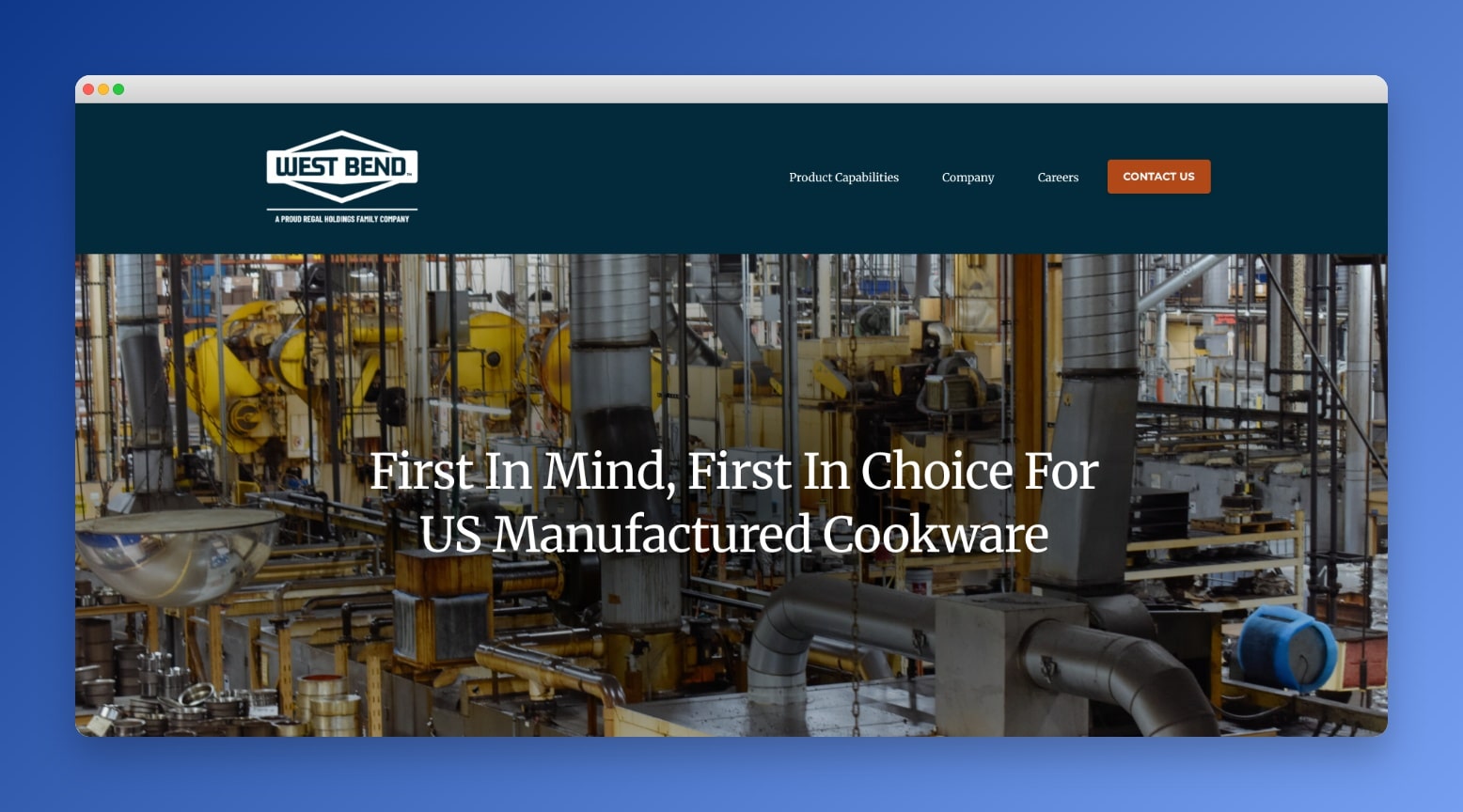
West Bend Company is a US-based manufacturer with 110+ years of cookware experience. The company uses stainless steel as its primary base material , which offers superior durability and heat conductivity. West Bend's facility includes high-temperature ovens for curing coatings to precise specifications. The company maintains ISO 9001:2015 certification and features several sustainability initiatives.
West Bend offers flexible MOQs for brands via existing tooling and design libraries, and can also provide custom OEM services with new tooling capabilities. The company works with brands of various scales, from small D2C launches to major retail accounts. Lead times are competitive for North American sourcing due to domestic production and inventory availability.Coating types offered: Traditional PTFE nonstick, and ceramic nonstick
- Base materials: Cladded steels
- Certifications: ISO 9001:2015, Made in USA
- MOQ: Low
- Notable strengths: US-made quality, flexible MOQs, broad product portfolio
2. Papilla (Tekirdağ, Turkey)
Papilla is one of Turkey's larger aluminium cookware manufacturers and has been producing non-stick cookware since 1999. The company is set up explicitly for private label and white label production, which makes it a practical regional supplier for brands serving European, UK, and MENA markets.
What They Make: Non-stick aluminium cookware, including frying pans, sauce pots, casseroles, woks, and full cookware sets. Private label and white label both supported as core production lines.
Key Differentiators: Over 25 years of non-stick specialisation. Turkish manufacturing base offers shorter logistics into Europe than Asian sourcing without paying full EU manufacturing prices. Private label and white label business is a primary revenue line, not an afterthought, so the supplier-side workflows (custom branding, packaging, OEM tooling) are mature. Strong fit for buyers who need volume aluminium non-stick at a mid-tier price point.
3. Illa S.p.A. (Bergamo, Italy)
Illa is an Italian cookware manufacturer that produces non-stick pots and pans in a highly automated facility in northern Italy. The company positions itself as a premium European option, with EU-certified raw material sourcing relevant for retailers and brands operating under strict supply chain rules.
What They Make: Non-stick pots, pans, and full cookware sets manufactured in Italy. The company states it can produce nearly any cookware format with a non-stick coating.
Key Differentiators: Italian production with high automation, helpful for consistency at volume. EU-certified raw materials, useful for retailers with strict provenance and compliance requirements. Strong "Made in Italy" story carries clear retail value, especially in cookware where Italian provenance is associated with quality. Premium positioning rather than commodity supply.
Capabilities Snapshot: Non-stick coatings applied to Italian-manufactured cookware bodies. Wide product range across pots, pans, and complete sets. EU-sourced raw material inputs. Suited to OEM-style relationships with brands and retailers.
4. Steel Crafts Europa (Vinovo, Italy)
Steel Crafts Europa is an Italian OEM and ODM cookware manufacturer focused on premium cookware rather than mass-market production. It is most relevant for brands that want European manufacturing combined with full brand customisation.
What They Make: OEM and ODM cookware including multi-ply stainless cookware lines and non-stick options. Brand customisation across product, finish, and packaging.
Key Differentiators: Italian manufacturing base with full design support. OEM and ODM both supported, useful for buyers who want either spec-driven (OEM) or design-led (ODM) production. Multi-ply stainless capability adds versatility for brands that want both stainless and non-stick lines under one supplier. Premium positioning aligned with European retail expectations.
Capabilities Snapshot: Multi-ply stainless cookware with optional non-stick coatings. OEM and ODM development support. Custom finishes, handles, and packaging. Suited to integrated cookware ranges rather than single-SKU programs.
5. Titanium Cookware Inc. (United States, with German-made product lines)
Titanium Cookware Inc. markets non-stick cookware in North America and emphasises its "Made in Germany" product lines. Important caveat: based on public information, the company looks more like a distributor and commercial partner than a true OEM factory, so it is best treated as a route to German-manufactured cookware rather than as a manufacturing source itself.
What They Make: Distributes and markets non-stick cookware in North America, with German-manufactured product lines forming the centre of its catalogue. Actual production sits with partner factories in Germany.
Key Differentiators: US-based commercial presence with German-manufactured product. Useful for buyers who want a US counterpart rather than dealing directly with a European factory. Best understood as a sourcing channel into Germany-made non-stick cookware, not as a flexible OEM manufacturer in its own right.
Manufacturer Comparison Table
| Manufacturer | Location | Specialty | Production Model | MOQ | Best For |
|---|---|---|---|---|---|
| West Bend Company | West Bend, WI, USA | PTFE and ceramic nonstick on cladded steel | OEM with existing tooling library, plus full custom OEM | Low (flexible via existing tooling) | Brands wanting US-made nonstick cookware with flexible MOQs and a broad product portfolio. |
| Papilla | Tekirdağ, Turkey | Aluminium nonstick cookware (pans, pots, sets) | Private label and white label | Not publicly disclosed | Mid-tier nonstick aluminium for European, UK, and MENA private label buyers. |
| Illa S.p.A. | Bergamo, Italy | Italian nonstick pots, pans, and sets with EU-certified raw materials | OEM-style relationships | Not publicly disclosed | Premium retail private label where "Made in Italy" provenance carries pricing power. |
| Steel Crafts Europa | Vinovo, Italy | Multi-ply stainless cookware with optional nonstick | OEM and ODM | Not publicly disclosed | Brands building integrated stainless and nonstick lines under one Italian supplier with design support. |
| Titanium Cookware Inc. | USA (German-made product lines) | German-manufactured nonstick cookware, marketed in North America | Distributor and commercial partner (not OEM) | N/A (channel, not factory) | US buyers wanting access to German-made nonstick cookware without managing a direct EU factory relationship. |
Supplier Highlight: West Bend Company's Coating and Curing Capabilities
West Bend Company stands out among nonstick cookware manufacturers for its vertically integrated coating and curing operation. Rather than outsourcing nonstick application to third-party coaters, West Bend manages the entire process in-house.
In-house coating process:
West Bend's facility applies multiple layers of PTFE or ceramic nonstick coating, starting with a primer layer for adhesion, followed by intermediate layers for coverage and topcoats for durability. The company uses high-temperature industrial ovens to cure coatings to precise temperatures and durations, ensuring consistent coating thickness and adhesion.
Vertical integration offers several advantages. West Bend can rapidly adjust coating specifications based on customer requirements, maintain tighter quality control over application and curing, reduce lead times compared to external coating services, and manage supply chain risk by owning a critical step in the manufacturing process.
Quality control and ISO certification:
West Bend maintains ISO 9001:2015 certification, covering design, production, and inspection processes. The company conducts adhesion testing, scouring resistance testing, and heat cycling checks to verify coating durability before products ship.
Sustainability and facility operations:
West Bend's manufacturing facility is partially solar-powered, reducing energy consumption and operational costs. The company's US location enables fast turnaround and eliminates long-distance shipping delays, beneficial for brands with time-sensitive launches.
The combination of in-house coating, ISO certification, flexible MOQs via existing tooling, and US manufacturing positions West Bend as a preferred partner for brands seeking reliable domestic nonstick cookware sourcing.
PFAS Regulations and Compliance Landscape
PFAS (per- and polyfluoroalkyl substances) are synthetic chemicals used in many industrial applications, including nonstick coatings. They are highly persistent in the environment and human bodies, raising health and regulatory concerns.
Current EU Regulations
The EU has implemented REACH restrictions on certain PFAS compounds and is actively evaluating broader class-wide restrictions. The ECHA (European Chemicals Agency) is assessing a ban on all PFAS except those considered essential, which could significantly restrict nonstick coating formulations available in Europe.
Brands selling nonstick cookware in the EU should confirm their manufacturer's PFAS status and review compliance documentation. Ceramic and PTFE formulations specifically formulated to be PFAS-free are increasingly standard among EU-compliant manufacturers.
US Regulatory Trends
The EPA is evaluating class-wide PFAS restrictions but has not finalized rules as of 2026. However, individual states are moving faster. California has implemented Prop 65 requirements for certain PFAS in consumer products. Michigan and Vermont have enacted stricter PFAS limits in drinking water and surface water.
The EPA's regulations are expected to evolve in 2026 and beyond. Brands targeting the US market should source from manufacturers offering PFOA-free and ideally broader PFAS-free formulations to reduce regulatory risk.
Compliance Verification
When evaluating manufacturers, request:
- Safety Data Sheets (SDS) for all coating components
- Third-party lab testing confirming PFOAS/PFAS status
- Written compliance guarantees for target markets (EU, US, California, etc.)
- Documentation of coating reformulation history (indicating the manufacturer has proactively addressed PFAS concerns)
Manufacturers cannot claim "PFAS-free" based solely on marketing language. Insist on lab-verified test data from accredited third parties.
Common Mistakes When Sourcing Nonstick Cookware
1. Prioritizing Price Over Coating Quality
Nonstick durability directly impacts customer satisfaction and return rates. Sourcing from the cheapest manufacturer often results in cookware that loses nonstick performance within months, triggering negative reviews and customer churn. Invest in coating quality testing (scouring resistance, adhesion) rather than competing purely on unit cost.
2. Neglecting Regulatory Compliance Documentation
PFAS regulations are tightening rapidly. Brands that source from manufacturers unable to provide compliance documentation face the risk of products being pulled from shelves or facing legal liability. Confirm your manufacturer's regulatory status before committing to large orders.
3. Overlooking Lead Time and MOQ Constraints
Misalignment between your sales projections and a manufacturer's MOQ can result in excess inventory or stockouts. Evaluate whether a manufacturer's MOQ structure matches your volume roadmap. Lower MOQs via existing tooling (like West Bend's approach) offer flexibility for growing brands.
4. Failing to Evaluate Quality Certifications and Testing Data
Marketing claims about durability are meaningless without third-party verification. Request scouring resistance test reports (ASTM F735 or ISO 9252) and adhesion testing data before finalizing partnerships. ISO 9001 certification indicates systematic quality control, though it does not guarantee product performance.
5. Ignoring Base Material and Heat Conductivity
The nonstick coating is only one component. Aluminum base materials distribute heat more evenly than steel, but steel offers superior durability and toxin-free construction. Understand whether your target market prioritizes heat distribution (professional cooks, fast cooking) or durability (everyday home use). Discuss base material options and the trade-offs with your manufacturer.
6. Insufficient Communication of Custom Requirements
If you have specific coating specifications, heat tolerance targets, or design constraints, communicate these clearly upfront. Vague specifications lead to products that miss your positioning or fail to meet customer expectations. Provide detailed technical briefs and request prototypes before committing to large production runs.
7. Assuming All Ceramic Coatings Are Created Equal
Ceramic nonstick coating quality varies significantly. Some formulations scratch easily or lose nonstick performance quickly. Request durability testing data and compare specific coating technologies (Scanpan's Stratanium vs. Neoflam's Ecolon, etc.) rather than assuming all ceramic coatings perform the same.
FAQs
What is the difference between PTFE and ceramic nonstick coatings?
PTFE nonstick is synthetic polytetrafluoroethylene, the most common nonstick coating. It performs reliably up to 260-300°C but wears faster than ceramic under abrasive use. Ceramic nonstick uses silica or silicon-based compounds and is harder and more durable (lasting 5-10+ years) but has lower heat tolerance (typically 175-200°C, though advanced formulations reach 240°C). PTFE is cost-effective for mass-market cookware. Ceramic commands a premium and appeals to health-conscious and premium segments.
Are all PTFE nonstick coatings PFOA-free?
Modern PTFE formulations are PFOA-free. However, some PTFE and other nonstick coatings may contain other PFAS compounds, which are under increasing regulatory scrutiny. Request Safety Data Sheets and third-party lab confirmation of PFAS status. Ceramic nonstick naturally avoids PFAS compounds, making it attractive for compliance-focused brands.
What MOQ should I expect from nonstick cookware manufacturers?
MOQs typically range from 1,000 to 10,000 units, depending on whether you're using existing tooling or custom designs. Manufacturers like West Bend offer lower MOQs (1,000–2,000) via existing tooling libraries. Custom designs or new molds from most manufacturers require higher MOQs (5,000–10,000+). Discuss your volume roadmap and launch timeline with potential manufacturers to find alignment.
How do I verify that a nonstick cookware manufacturer meets my regulatory requirements?
Request Safety Data Sheets (SDS) for all coating components, third-party lab testing results (from SGS, TUV, or similar accredited labs) confirming PFOAS/PFAS status, written compliance guarantees for your target markets, and documentation of any coating reformulation history. Do not rely on verbal assurances or marketing language. Confirm compliance for each specific market (EU, US, California) as requirements differ.
Which manufacturer is best for a small brand just starting out?
West Bend Company and Rena Ware (both US-based) offer the most flexible MOQs and shortest lead times for small brands. Both support starting volumes of 1,500–2,000 units via existing tooling and provide Made in USA positioning. European manufacturers like Scanpan and Berndes also support smaller initial orders (2,000–2,500 units) if you're comfortable with longer lead times and European sourcing.
What should I ask a nonstick cookware manufacturer during the first conversation?
Ask about coating types offered, base materials and sourcing, MOQ and lead times, quality certifications and testing data availability, PFAS/compliance documentation, customization options and costs, production capacity, and references from other brands they've worked with. Request detailed quotes that break down per-unit costs by volume and any tooling or setup fees. Request samples or prototype before committing to large orders.
Finding Your Next Nonstick Cookware Manufacturer
Sourcing the right nonstick cookware manufacturer depends on your brand positioning, target market, regulatory requirements, and production volume. West Bend Company excels for US-made cookware with flexible MOQs and in-house coating control. Scanpan leads in premium ceramic nonstick positioning. TVS Group and Meyer Corporation specialize in private label production at scale.
Post your nonstick cookware requirements on Wonnda to get matched with verified manufacturers. Share your volume projections, coating preferences, regulatory requirements, and timeline. Wonnda's supplier network includes established manufacturers and emerging producers, helping you find the right fit for your brand stage.
Ready to source nonstick cookware for your brand? Post your requirements on Wonnda and start your supplier matching process today.
Related articles
Best Clothing Manufacturers in Europe - 2026 Guide by Wonnda
10+ Best Beauty Manufacturers in the US (2026 List)

How to Find a Manufacturer for Your Product (2026 Guide)
European Suppliers: How to find the best EU suppliers in 2026

10 Best European Sourcing Agencies To Find Suppliers & Launch Your Product
How to Start a Premium Private Label Cookware Brand: The Complete Guide
5+ Best Private Label Cookware Manufacturers in the USA (2026)
Best Private Label Beef Tallow Manufacturers in Europe (2026 Guide)