5+ Best Private Label Cookware Manufacturers in the USA (2026)

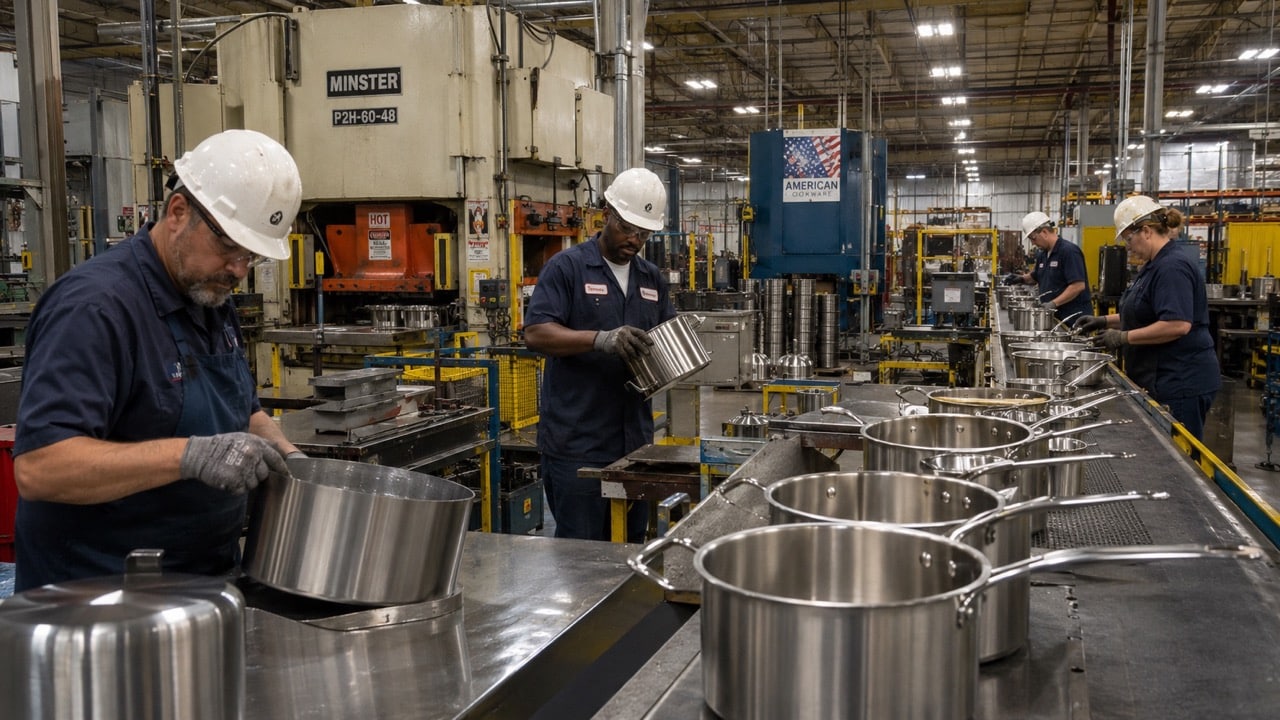
If you're sourcing cookware for your brand or retail business, finding the right US manufacturer can cut lead times by months and give you a competitive edge. We researched the best cookware manufacturers in the USA and broke down what actually matters when you're evaluating them.
Key Takeaways
- West Bend Company dominates the scale play with 110+ years of experience, ISO 9001:2015 certification, and a 6,100-panel solar facility. They work with cladded steel, nonstick, and soon carbon steel across multiple shapes and volumes.
- Lodge and Finex deliver authentic cast iron. Lodge is the largest cast iron maker in the US and has been since 1896. Finex pioneered octagonal cast iron design and premium finishes.
- US manufacturing adds 3-8 weeks to your timeline versus offshore but eliminates port delays, tariff exposure, container-load quantities, and communication friction. Total landed cost often breaks even when you factor in operational risk.
- Minimum order quantities range from 1,000 units (existing tooling libraries) to 10,000+ units (custom molds). Lead times from 6-16 weeks depending on complexity and tooling needs.
What Makes a Great US Cookware Manufacturer
Before we profile individual makers, here's how to evaluate any cookware manufacturer:
Manufacturing Capability
You need to understand what they actually make in-house versus outsource. True vertical integration (tooling, stamping, assembly, packaging) means faster iteration and better quality control. Ask about bottlenecks. Most manufacturers can handle standard shapes and sizes quickly, but custom designs or unusual gauges add weeks and tooling cost.
Materials and Technical Specs
Stainless steel cookware comes in layers: 3-ply (stainless steel/aluminum/stainless steel) offers solid heat distribution at a lower cost. Gauge (thickness) matters for durability, cheaper products you find in low-end stores can warp. Nonstick coatings range from PTFE-based (traditional, durable) to ceramic (healthier perception, less durable). Cast iron is forged or sand-cast, and the finish (smooth, textured, enameled) affects both production cost and cooking performance.
Certifications and Compliance
ISO 9001:2015 signals consistent quality control. Many additional certifications are linked to the material supplier the factory works with - ask them for their suppliers' certificates.
Minimum Order Quantities and Tooling
MOQs typically start at 1,000-2,000 units per SKU if you're using existing molds. Custom tooling might not bump the minimums, but would make economically only sense if you increase the quantities to 5,000-10,000 units. You need to factor in the mold development and custom manufacturing costs, which can be anything between $10,000-$50,000 in upfront cost. Ask about their tooling library before you assume you need custom designs.
Lead Times and Production Timeline
The standard manufacturing process can move in 8-12 weeks for private label and white label products. Custom molds may add 12-24 weeks. However, this highly depends on the complexity of the product - which is dependent on the material sourcing, getting handles molded and produced, etc. Factor in quality control inspections, packaging customization, and freight to your warehouse.
The 10 Best Private Label Cookware Manufacturers in the US
1. West Bend Company (West Bend, Wisconsin)
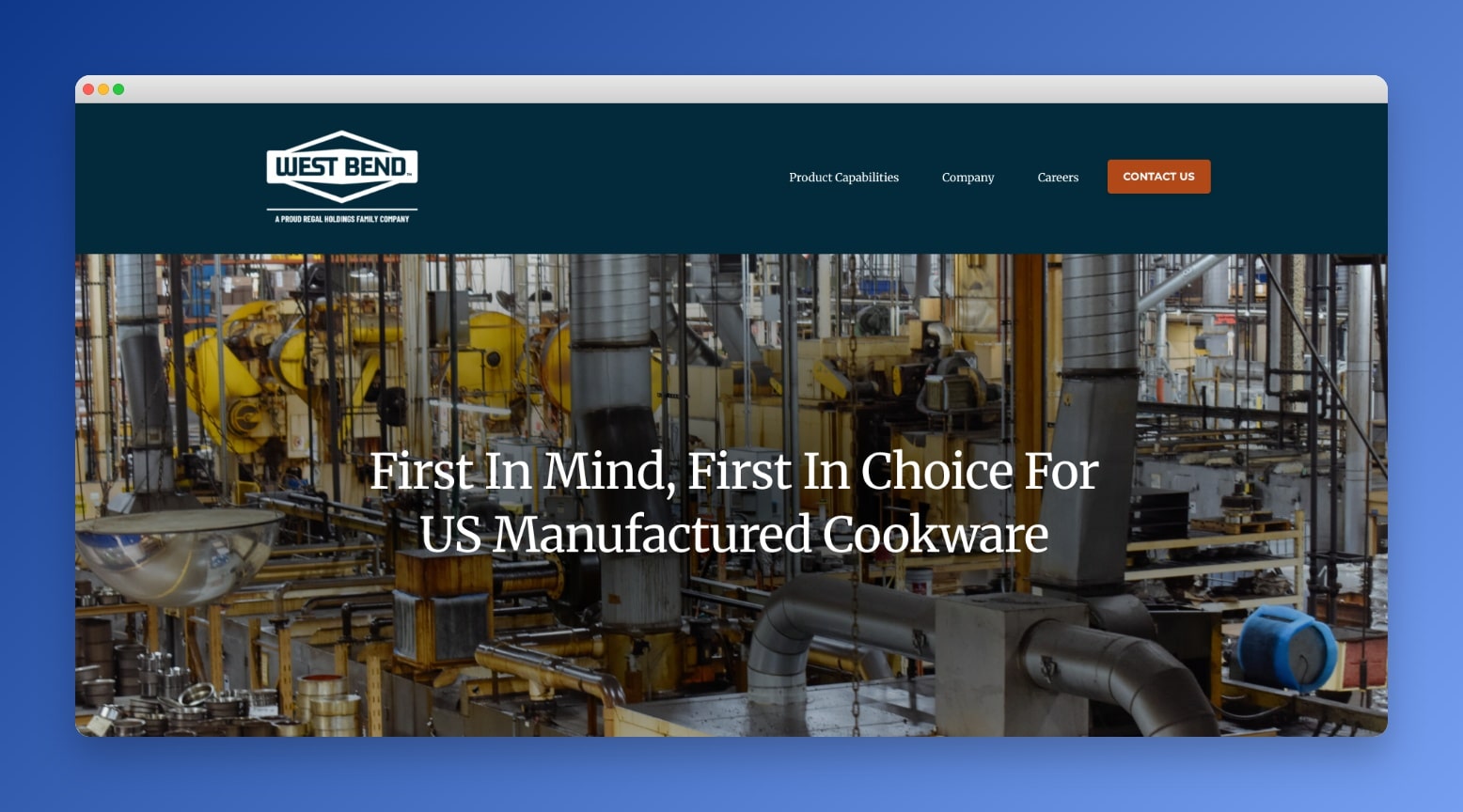
West Bend Company is the backbone of US private label cookware manufacturing. Founded in 1911, they've built a vertically integrated operation that handles everything from tooling and stamping to assembly and packaging. Regal Ware (now Regal Holdings) acquired West Bend's assets in 2002.
West Bend Company serves everyone from major retailers to private label startups.
What They Make: Multi-ply cladded steel cookware, including fry pans, sauce pots, sauciers, and stock pots. Offering private label manufacturing and custom contract OEM services.
Key Differentiators: ISO 9001:2015 certified. Strong enviromental initiatives, like solar energy generation, water recycling and materials recycling. Fourth-generation family owned. . Exports to 60+ countries. Union workforce with institutional knowledge. Existing tooling library allows private label customers to start with MOQs as low as 1,000-2,000 units per SKU. New automated manufacturing line being installed 2027 will quadruple capacity.
Capabilities Snapshot: Multi-ply cladded steel. Traditional nonstick (PTFE) and ceramic nonstick options. Custom handles, knobs, and packaging. Production runs as small as 1,000 units using existing tooling.
Lead Times: Generally 8-12 weeks for standard orders. Custom design or custom tooling adds 12-24weeks. Strict quality process built into timeline.
Certifications: ISO 9001:2015, FDA food contact surface approval, PFOA-free nonstick options.
Why They're #1: Scale plus flexibility. West Bend combines 110+ years of manufacturing heritage, modern facilities, and a willingness to work with emerging brands. Their sustainability initiatives can be part of brands’ stories and resonate with retailers and consumers focused on domestic sourcing and sustainability. The existing tooling library is a game-changer if you're launching with a tight timeline or limited capital.
2. Lodge Cast Iron (South Pittsburg, Tennessee)
Lodge is the oldest continuously operating cast iron cookware manufacturer in the USA, founded in 1896. They're the largest domestic producer of cast iron by volume.
What They Make: Seasoned and unseasoned cast iron cookware. Skillets, Dutch ovens, bakeware, griddles. Both smooth and textured finishes. Enameled options available.
Key Differentiators: Longest heritage of any US cast iron maker. Fully American-made and family-owned. 100% sand-cast process in South Pittsburg. Vertically integrated from casting to finishing.
Capabilities Snapshot: Sand casting for durability and aesthetic. Machined smooth finishes or textured vintage-style finishes. Enameled cast iron in multiple colors. Custom engraving available.
Lead Times: 10-12 weeks for standard orders. Enameled finishes add 2-3 weeks. Custom designs or high-volume custom orders add 4-8 weeks.
Certifications: FDA approved, lead and cadmium-free enamel.
Why Consider Lodge: If you're building a legacy-focused cookware brand or retail line emphasizing American heritage, Lodge's 130-year track record and full US manufacturing are compelling. They're also approachable for mid-volume orders (2,000-5,000 units).
3. Finex Cast Iron (Portland, Oregon)
Finex is a craft manufacturer focused on octagonal cast iron design and high-end finishes. They've carved a niche in the premium cast iron segment.
What They Make: Octagonal cast iron skillets and cookware. Polished finishes, enameled options. Small batch, artisanal approach.
Key Differentiators: Unique octagonal design (patented). Polished cooking surface for better searing. Made in Portland with attention to craft. Strong brand identity with cooking enthusiasts.
Capabilities Snapshot: Sand-cast octagonal cookware. Machined polished cooking surfaces. Enameled finishes in multiple colors. Custom orders available.
Lead Times: 12-16 weeks due to small-batch, hand-finishing approach.
Why Consider Finex: If you're targeting premium home cooks and culinary professionals willing to pay $200-$400+ per skillet, Finex's design and quality justify the price. MOQs are lower (500-2,000 units) due to their production model.
4. Borough Furnace (Syracuse, New York)
Borough Furnace manufactures cast iron cookware using sand casting and hand-finishing techniques rooted in traditional metalworking.
What They Make: Cast iron skillets, griddles, and cookware. Smooth vintage finishes. Limited edition designs and custom orders.
Key Differentiators: Small-batch, heritage-focused approach. Smooth polished finishes that rival vintage cast iron. Each piece carries maker information.
Capabilities Snapshot: Sand casting with hand-finishing. Smooth polished cooking surfaces. Custom designs for bulk orders. Engraving available.
Lead Times: Ca. 20 weeks (according to our researcH) for custom designs or specialty finishes due to hand-work.
Why Consider Borough Furnace: For ultra-premium, artisanal positioning. MOQs are low (500-1,000 units), making them ideal for boutique brands or limited-edition offerings.
5. Smithey Ironware (Charleston, South Carolina)
Smithey is a Charleston-based cast iron brand that manufactures heirloom-quality cookware with modern design sensibilities.
What They Make: Cast iron skillets, Dutch ovens, griddles, and cookware accessories. Hand-finished, precision-ground cooking surfaces.
Key Differentiators: Modern design applied to traditional sand casting. Precision grinding for superior cooking performance. Strong heritage and storytelling around Charleston craftsmanship.
Capabilities Snapshot: Sand-cast iron with precision-ground cooking surfaces. Matte enamel finishes. Custom designs available.
Lead Times: Ca. 16 weeks for custom or bulk orders.
Cookware Manufacturers Comparison Table
| Manufacturer | Location | Specialty | MOQ | Lead Time | Best For |
|---|---|---|---|---|---|
| West Bend Company | West Bend, WI | Multi-ply cladded steel (fry pans, sauce pots, stock pots) | 1,000–2,000 units | 8–12 weeks standard, +12–24 weeks for custom tooling | Scale plus flexibility. Brands needing premium manufacturing services with a domestic sourcing and sustainability story. |
| Lodge Cast Iron | South Pittsburg, TN | Sand-cast iron (skillets, Dutch ovens, bakeware), enameled options | 2,000–5,000 units | 10–12 weeks standard, +2–3 weeks for enamel | Heritage-led brands and retail lines emphasizing American manufacturing. |
| Finex Cast Iron | Portland, OR | Octagonal cast iron with polished cooking surfaces | 500–2,000 units | 12–16 weeks (small-batch, hand-finished) | Premium positioning, $200–$400+ retail price points, design-forward kitchenware brands. |
| Borough Furnace | Syracuse, NY | Hand-finished sand-cast iron, vintage-style smooth finishes | 500–1,000 units | ~20 weeks for custom or specialty finishes | Ultra-premium, artisanal positioning. Boutique brands and limited-edition runs. |
| Smithey Ironware | Charleston, SC | Precision-ground cast iron with matte enamel options | Contact for MOQ | ~16 weeks for custom or bulk | Heirloom-quality cookware with modern design sensibilities and Southern-craft storytelling. |
Made in USA vs. Offshore: Cost and Value Analysis
US manufacturing typically costs 15-40% more than offshore production, depending on product complexity and volume. But the total cost calculation includes more than unit price.
Timeline Advantage
US manufacturers can turn custom designs in 14-16 weeks start-to-finish. Offshore, add 4-8 weeks for shipping, port clearing, and customs. If you're launching a seasonal product or responding to market demand, shaving 8-12 weeks off your timeline has real value. You can launch earlier, gather customer feedback, and iterate faster.
Supply Chain Risk
Tariffs on imported goods have been volatile. Port delays in 2024-2025 have added weeks to offshore timelines. Quality control is harder when your manufacturer is 8,000 miles away. US-based manufacturers allow you to visit the facility, inspect molds before production, and resolve issues in real-time.
Brand Positioning
"Made in USA" resonates with retailers and consumers, especially in the cookware category where heritage and quality matter. You can charge 10-20% more for the same product if it's domestically made. This premium often covers the production cost difference.
Minimum Order Quantities
US manufacturers with tooling libraries (West Bend, Made In) let you start at 1,000-2,000 units. Offshore, minimums are often 5,000-10,000 units. Lower MOQs mean lower risk when you're validating a new product or brand.
Total Landed Cost Calculation
A stainless steel 3-ply skillet costs roughly $12-18 to manufacture in the USA, versus $8-12 offshore. Freight, tariffs, and Landed Cost add $2-5 offshore. By the time you account for quality issues, redesigns, and timing risk, US manufacturing often breaks even or comes out ahead, especially for orders under 10,000 units per SKU.
Real Example: A D2C brand launching a 10-piece cookware set might spend $20,000 in tooling with West Bend, then $15 per unit in production for 3,000 units (total $65,000). Offshore, they avoid tooling but spend $12 per unit landed cost for the same 3,000 units ($36,000). The West Bend route costs $29,000 more upfront. But West Bend delivers in 12 weeks versus 20 weeks offshore, and the "Made in USA" positioning justifies a 15-20% retail premium, often recovering the cost difference within the first sales cycle.
Private label cookware guide
Common Mistakes When Sourcing US Cookware
1. Confusing "Assembled in USA" with "Manufactured in USA"
Some manufacturers import components (stainless steel blanks, handles, hardware) and assemble them in the USA. That's not full domestic manufacturing. Ask specifically: where is the metal cut, stamped, or cast? Where are the components sourced? True domestic manufacturing sources materials and performs all major operations in the USA.
2. Underestimating Lead Times
Many founders expect 6-8 week turnarounds for custom cookware. Reality is 12-16 weeks for custom tooling, plus 2-3 weeks for quality control and packaging. Build in buffer. A 14-week lead time plus 3-week buffer means you need to order 17 weeks before you want inventory in hand.
3. Setting MOQs Too High
First-time founders often negotiate 5,000-10,000 unit minimums to lower per-unit cost. But if you're validating a new product, start at 1,000-2,000 units. Validate demand, gather feedback, then scale. Many US manufacturers have tooling libraries that allow lower MOQs on standard shapes.
4. Not Visiting the Facility
You can learn more in one facility visit than five conference calls. You'll see production bottlenecks, quality control processes, workforce stability, and equipment firsthand. For manufacturers you're betting your brand on, especially for custom tooling, a facility visit is non-negotiable.
5. Forgetting About Certifications and Compliance
FDA food contact surface approval, PFOA-free nonstick, and lead-free finishes sound like checkboxes, but they're legally required or strongly expected depending on your market. Confirm certifications upfront, or you'll face delays and redesigns later.
6. Ignoring Packaging and Logistics
Cookware is bulky and heavy. Packaging design affects both freight cost and unboxing experience. Discuss packaging customization, freight consolidation, and distribution strategy with your manufacturer. Cookware sourced in Wisconsin costs less to ship to Chicago than cookware from a West Coast facility.
7. Overlooking the Tooling Question
Custom tooling is a one-time cost ($15,000-$50,000+) but locks you into that manufacturer for future runs. If you're unsure about product-market fit, ask about using existing tooling first. West Bend's tooling library is specifically designed for this scenario.
Frequently Asked Questions
What's the minimum order quantity for US cookware?
For standard products using existing tooling, MOQs start at 1,000-2,000 units per SKU. Custom molds typically require 5,000-10,000 units. West Bend Company and Finex Cast Iron are the most flexible on MOQs due to their tooling libraries and craft production model.
How long does it take to manufacture cookware in the USA?
Standard products: 8-12 weeks from order to delivery. Custom designs or custom tooling: add 4-8 weeks. Quality inspections and packaging customization are built in. Always add 2-3 weeks of buffer for contingencies.
Is US-made cookware more expensive than imported cookware?
Per-unit manufacturing cost is 15-40% higher in the USA. However, "Made in USA" positioning justifies 10-20% retail premium in most cookware categories. When you factor in tariff exposure, supply chain risk, and faster time-to-market, US manufacturing often breaks even or comes out ahead, especially for brands under 10,000 units annually.
Which US manufacturer is best for nonstick cookware?
West Bend Company offers both traditional PTFE nonstick and ceramic nonstick options, with ISO 9001:2015 certification and PFOA-free finishes. They're the most established for nonstick production at scale.
Can I do a small private label run with a US manufacturer?
Yes, several manufacturers accommodate smaller runs. West Bend (1,000+ units), Made In Cookware (2,000+ units), and Finex Cast Iron (500+ units) all work with emerging brands. Expect higher per-unit costs on small runs, but it's the most capital-efficient way to validate product-market fit.
What certifications should I require from a cookware manufacturer?
Minimum: FDA food contact surface approval. Standard: ISO 9001:2015 quality management. Recommended if marketing health benefits: PFOA-free certification, lead-free paint/enamel, or chemical-free nonstick. Ask about certifications upfront, and verify with documentation.
Stainless steel manufacturing guide
Start Your US Cookware Sourcing Project
Post your requirements on Wonnda and get matched with verified manufacturers ready to quote your cookware project. Whether you're launching a private label line, building a D2C brand, or sourcing for retail, these US manufacturers can deliver quality, consistency, and the competitive advantages that domestic production offers.
Browse verified cookware suppliers on Wonnda and start your sourcing project today.
Related articles
Best Clothing Manufacturers in Europe - 2026 Guide by Wonnda
10+ Best Beauty Manufacturers in the US (2026 List)

How to Find a Manufacturer for Your Product (2026 Guide)
European Suppliers: How to find the best EU suppliers in 2026

10 Best European Sourcing Agencies To Find Suppliers & Launch Your Product
How to Start a Premium Private Label Cookware Brand: The Complete Guide
5+ Best Private Label Nonstick Cookware Manufacturers
Best Private Label Beef Tallow Manufacturers in Europe (2026 Guide)