Stainless Steel Cookware Manufacturing: Materials, Processes, and What Buyers Should Know

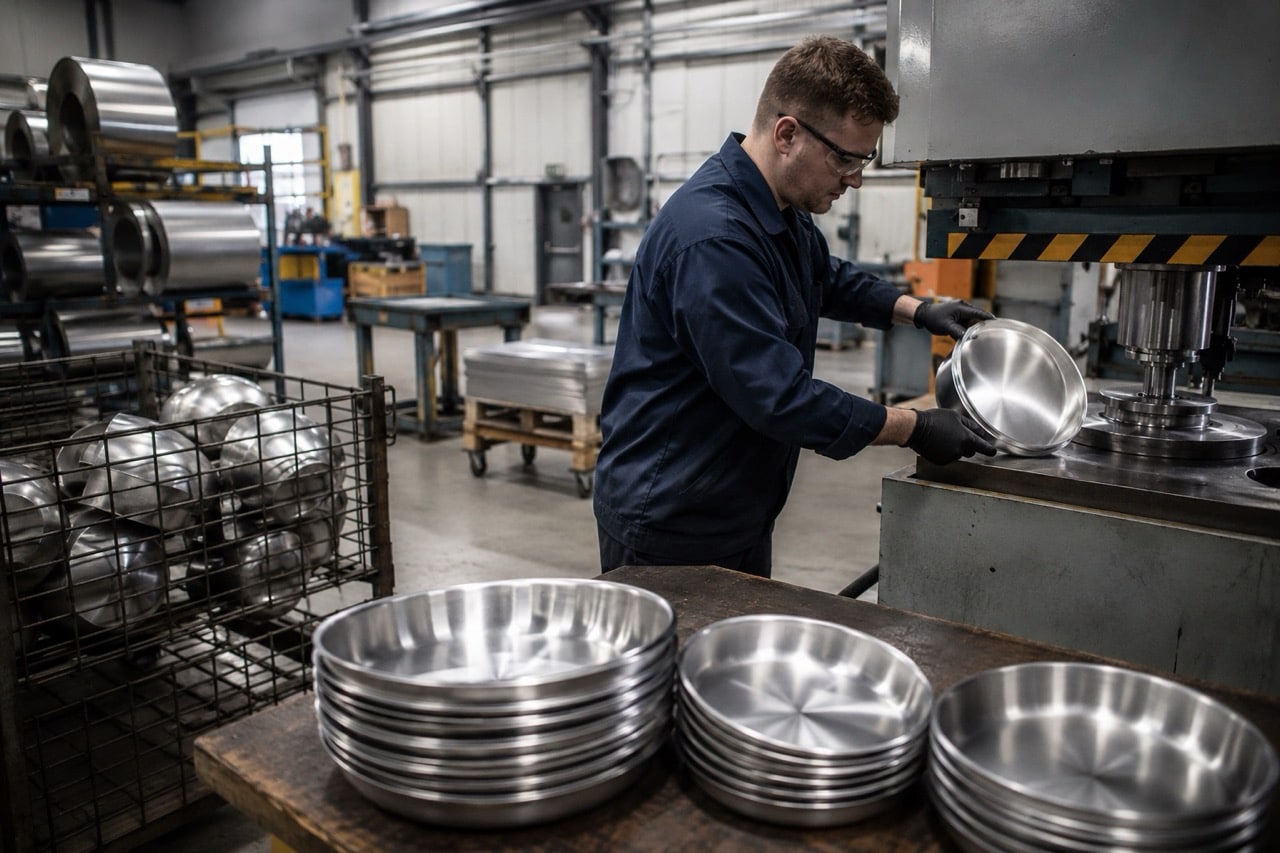
Stainless steel cookware dominates the premium cookware market for good reason. It's durable, versatile, and responsive to heat when engineered correctly. But what separates a well-made pan from one that performs poorly starts in the factory, not the kitchen.
Key Takeaways
- Stainless steel cookware requires multiple production steps including deep drawing, forming, welding, and precision finishing that separate quality manufacturers from volume producers
- Material composition matters: 18/10 and 18/8 stainless are the industry standards, but cost and durability trade-offs exist at lower grades like 13/0
- Ply construction (3-ply vs 5-ply vs fully clad) directly impacts heat distribution and manufacturing complexity; there's no single "best" construction for all use cases
- Coating selection influences product positioning: traditional nonstick coatings are proven but require higher temperatures; ceramic options appeal to health-conscious segments but wear faster
- Vertically integrated manufacturers control quality at every step; outsourced coating, stamping, or assembly introduces variability
- ISO 9001 certification is a baseline indicator, not a guarantee of product quality
What is Stainless Steel Cookware and Why It Dominates the Premium Segment
Stainless steel cookware is engineered metal cookware constructed from iron-chromium-nickel alloys bonded to conductive metal layers (typically aluminum or copper) to improve heat distribution. Unlike carbon steel or cast iron, stainless steel resists rust and corrosion without seasoning, making it suitable for dishwashers and acidic foods.
The premium segment demands stainless steel because it balances performance with minimal maintenance. A well-made stainless pan heats evenly, responds to temperature changes, cleans easily, and lasts decades. The material itself is neutral, so it doesn't impart flavors or require special care. This simplicity appeals to consumers who want performance without the learning curve of cast iron or the expense of non-stick alternatives.
Manufacturing-grade stainless steel comes in several compositions, but the industry standardized on austenitic grades, primarily 18/10 and 18/8 (indicating 18% chromium and 10% or 8% nickel). These grades are nonmagnetic, heat-resistant to 500°F and beyond, and formable into complex shapes. The nickel content provides corrosion resistance in the presence of moisture and salt. Reduce the nickel (like 13/0 stainless), and you reduce corrosion resistance and formability, which is why budget cookware often uses lower-grade stainless and fails faster.
The cookware itself is a laminate. A thin stainless steel surface layer sits bonded to a thicker aluminum or copper core, which sits bonded to another stainless steel layer on the bottom. This sandwich construction is the entire point: stainless steel doesn't conduct heat well on its own (conductivity of around 16 W/m·K), but aluminum (160 W/m·K) does. The core distributes heat evenly; the stainless surfaces provide durability and corrosion resistance.
The Stainless Steel Cookware Manufacturing Process
Building a stainless steel pot or pan requires precision at every stage. Variances in timing, temperature, or pressure compound through production, affecting final performance.
1. Material Sourcing and Blanking
Cookware manufacturers source raw stainless steel sheet in rolls or coils, typically 0.5mm to 1.5mm thick depending on the ply construction. Aluminum sheet (for cores) and sometimes copper foil (for premium cladding) arrive in rolls as well. Some companies also buy blanks.
Blanking is the first forming step. Manufacturers unroll the stainless sheet and feed it into a progressive die press that stamps out circular discs or rectangular blanks sized roughly to the final pan diameter. These blanks are slightly oversized to account for metal movement during drawing.
This step determines initial material waste. Efficient nesting of blanks on the sheet reduces scrap; poor planning wastes 10% to 20% of raw material, directly impacting cost per unit.
2. Annealing (Softening)
Stainless steel work-hardens as it's formed. If not softened between forming operations, the metal becomes brittle and will crack during deep drawing.
Annealing is a controlled heating and cooling cycle. Sheet blanks move through a furnace on a conveyor, reaching 1100°C to 1150°C depending on the stainless grade and alloy composition. At this temperature, the crystal structure resets and the material softens. The furnace then cools the sheet slowly to room temperature in a controlled atmosphere (often nitrogen or inert gas) to prevent oxidation.
Temperature and dwell time are critical. Too hot or too long, and the grain structure becomes coarse, weakening the final product. Too short, and the material doesn't fully soften, leading to splitting during drawing.
3. Deep Drawing and Forming
Deep drawing transforms a flat blank into a cup-shaped or bowl-shaped body. The blank sits over a die cavity, and a punch descends, forcing the metal to flow into the die shape.
Multiple draw operations may be required for tall pots. A first draw creates a shallow cup. The blank is annealed again to reset work-hardening, then moved to a second die for a deeper draw, and so on.
Speed and lubrication are essential. The blank slides across the punch and die surface; inadequate lubrication causes friction, heat, and premature material failure. Manufacturers use oil-based or synthetic lubricants optimized for stainless steel. Draw speed is typically 10 to 50 strokes per minute, depending on the depth of the draw and the thickness of the material.
At this stage, wall thickness remains roughly uniform across the pan. A 0.5mm blank pressed in a deep draw might emerge as a 0.45mm to 0.55mm wall after accounting for material flow.
4. Forming the Base and Rim
Once the pan body is drawn, secondary operations shape the base and rim.
The base, which sits on a stovetop, requires flat consistency and robustness to support the pan's weight and contents without flexing. Manufacturers use a base-forming die to flatten and slightly expand the bottom, ensuring good contact with burners.
The rim is rolled or beaded on an edge-forming machine. This operation compresses the thin upper edge of the pan into a rounded, reinforced shape. This serves two purposes: safety (no sharp edges) and strength (the compacted metal resists bending and denting).
5. Cladding
For stainless cookware, metal layers are bonded together using high-temperature welding or explosive cladding.
In the case of 3-ply construction, a stainless steel body sits between an aluminum core sheet. These three layers are stacked and fed through a furnace at 600°C to 800°C under pressure, welding them metallurgically into a single unit. The pressure is often applied by hydraulic press or roller press.
Explosive cladding is used for thicker clads and premium constructions. Sheets are stacked, and a measured explosive charge detonates above them, forcing the layers together at high pressure. This method bonds even dissimilar metals reliably but requires specialized equipment and expertise.
5-ply construction adds copper layers between the aluminum and stainless. Copper is an excellent heat conductor (380 W/m·K) and adds cost but significantly improves responsiveness. The laminate becomes: stainless, copper, aluminum, copper, stainless.
6. Welding and Handle Attachment
Handles and rims are typically welded to the pan body using spot welding or continuous welding.
For spot welding, electrodes press the handle material (often stainless steel or aluminum) against the pan wall, and an electrical current creates a localized weld. Multiple spot welds around the attachment point create a secure joint.
Riveted handles are older technology and less common in premium cookware. Spot welding is faster, creates no external fasteners, and looks cleaner.
Handle weld quality is a major quality indicator. Welds that are too shallow fail under stress. Welds that are too deep or uneven create material defects or stress concentrations. Modern manufacturers use robotic welding stations with controlled current, pressure, and dwell time to ensure consistency.
7. Trimming and Deburring
After forming and welding, the pan body has rough edges where material was severed or formed. Trimming removes excess metal and ensures the rim is even.
Deburring removes sharp edges left by cutting or stamping. This is done mechanically (abrasive wheels, files) or chemically (acid baths). Chemical deburring is faster and cleaner but adds process steps and cost.
8. Sanding and Buffing
Surface finish is both aesthetic and functional. A rough surface collects debris; a smooth surface cleans easily and looks premium.
Robotic or manual sanding with progressively finer abrasive grits (starting at 80-grit, finishing at 320-grit or higher) smooths the stainless surface. Buffing with cotton wheels and polishing compounds brings out the reflective luster.
This step determines whether the pan will have a brushed finish (linear sanding marks) or a polished finish (reflective, smooth). Brushed finishes hide fingerprints and minor defects; polished finishes show every spot but look more premium.
9. Cleaning and Preparation for Coating
Before coating, the pan must be clean at a molecular level. Oil, oxides, and dust prevent adhesion of the nonstick coating.
Pans are usually dipped in an alkaline cleaning bath, rinsed, and sometimes treated with a primer coat that enhances adhesion. For ceramic coatings, the pan may be roughened slightly to improve mechanical bonding.
10. Nonstick Coating Application
Nonstick coatings are applied by spray, dip, or roll coating.
Traditional PTFE-based nonstick (like Teflon) is sprayed as a liquid suspension. The pan rotates or moves through a spray booth, and multiple thin coats are applied, each dried at low temperature (100°C to 150°C) before the next coat. Typically 3 to 5 coats create the final nonstick layer, which is 20 to 40 micrometers thick.
Ceramic nonstick coatings are water-based and sprayed similarly but in fewer coats (often 2 to 3). Ceramic coatings are thinner and bond more mechanically than chemically, which is why they wear faster with abrasive utensils.
Some cookware is left uncoated (bare stainless) for professional or carbon-steel-like use. Uncoated stainless requires oil or butter for cooking and is more prone to sticking, but it performs well on high heat and appeals to culinary professionals.
11. Curing (Heat Treatment of Coating)
After coating, the pan undergoes high-temperature curing to cross-link the coating molecules and bond them to the stainless surface.
Traditional PTFE nonstick is cured at 350°C to 400°C for 10 to 30 minutes. At this temperature, the coating molecules link together, creating a durable, non-stick surface. Insufficient curing leaves the coating soft and easily damaged. Over-curing can cause coating degradation or embrittlement.
Ceramic coatings cure at lower temperatures (200°C to 250°C) because they're less chemically stable at high heat. This is one reason ceramic nonstick wears faster: the lower curing temperature creates a less durable bond and molecular structure.
12. Final Polishing and Quality Inspection
After curing, some manufacturers apply a final polish or protective layer. This is also when visual inspection occurs: checking for coating defects, uneven color, warping, or weld imperfections.
Modern quality control uses both visual inspection (often by trained human eyes) and automated optical systems that scan for surface defects, coating coverage, and color consistency.
Quality is typically measured using adhesion tests (ISO 2409 tape test), thickness gauges for coating uniformity, and thermal imaging to verify even heat distribution.
13. Packaging and Shipping
Finished cookware is cleaned once more to remove dust or debris from the manufacturing process, wrapped in protective materials (often plastic film or kraft paper), and packaged in corrugated boxes for shipment.
For branded cookware, packaging often includes instruction manuals, care cards, and customer service information. For white-label or OEM cookware, packaging may be minimal.
Storage conditions matter: high humidity or temperature fluctuations can affect coatings, so warehouses are climate-controlled.
Stainless Steel Grades: Material Composition and Trade-offs
The numbers in stainless steel grades indicate percentages of chromium and nickel (or other alloys).
18/10 Stainless Steel
18% chromium, 10% nickel. This is the premium standard for cookware. The high chromium content provides excellent corrosion resistance; the 10% nickel ensures formability and nonmagnetic properties. 18/10 is resistant to rust, pitting, and staining from salt, citrus, or tomato acids. Cost is higher, but longevity justifies it for premium brands.
18/8 Stainless Steel
18% chromium, 8% nickel. Slightly lower nickel than 18/10, so formability is somewhat reduced and corrosion resistance is marginally lower. Still excellent for cookware. Many manufacturers use 18/8 as a cost compromise that delivers 95% of the performance at 80% of the cost. Consumer distinction between 18/10 and 18/8 is negligible in real-world use.
13/0 Stainless Steel (Ferritic)
13% chromium, no nickel. This is budget stainless steel. It's magnetic (unlike 18/10 and 18/8), less formable, and vulnerable to pitting in acidic or salty conditions. It's sometimes used in the base layers of budget cookware to reduce cost, but the friction between budget and premium cookware often hinges on the use of 13/0 versus 18/8 or 18/10 bodies.
Comparison Table: Stainless Steel Grades
| Property | 18/10 | 18/8 | 13/0 |
|---|---|---|---|
| Chromium (%) | 18 | 18 | 13 |
| Nickel (%) | 10 | 8 | 0 |
| Corrosion Resistance | Excellent | Excellent | Good |
| Formability | Excellent | Excellent | Fair |
| Magnetic | No | No | Yes |
| Cost per kg | High | Medium-High | Low |
| Typical Use | Premium cookware | Mid-range cookware | Budget cookware, bases |
The choice of stainless grade is one of the first decisions in product design. It affects material cost, manufacturing complexity, and perceived quality. Brands targeting the premium segment specify 18/10 or 18/8; budget brands cut corners with 13/0 or even lower-grade ferritic stainless.
Ply Construction: 3-ply vs 5-ply vs Fully Clad
Ply construction describes how many layers of metal are bonded together to form the pan walls.
3-Ply Construction
Three layers: stainless steel bottom, aluminum core, stainless steel top (cooking surface).
The stainless bottom makes contact with the stovetop. Aluminum in the middle conducts heat efficiently. Stainless on top provides durability and corrosion resistance on the cooking surface.
This construction is the standard for mid-range to premium cookware. It balances heat distribution with cost and weight. A 3-ply pan typically weighs 1.2 to 1.8 kg per quart of capacity.
Manufacturing 3-ply involves cladding the stainless and aluminum sheets together (as described earlier), then stamping and forming the bonded layers as a single unit.
5-Ply Construction
Five layers: stainless bottom, copper layer, aluminum core, copper layer, stainless top. In some cases, both cores are aluminium.
Copper has thermal conductivity twice that of aluminum (380 W/m·K vs 160 W/m·K), so 5-ply pans heat faster and more evenly. The symmetry of copper on both sides of the aluminum ensures even expansion during heating, reducing warping.
This construction is premium and commands a price premium of 20% to 40% over comparable 3-ply cookware. It's used in professional-grade cookware and by brands marketing to serious home cooks.
5-ply manufacturing is more complex. Bonding five separate layers requires either multiple cladding runs or explosive cladding, both of which increase cost and require tighter process control.
Fully Clad vs Disc-Clad
Fully clad construction extends the layered metal all the way to the rim of the pan, so heat distribution is uniform across the entire surface.
Disc-clad construction (sometimes called encapsulated bottom) bonds the layered metals only to the bottom 1 to 2 inches of the sides. The upper sides and rim are single-layer stainless. This reduces cost and weight but also reduces heat distribution efficiency.
Most mid-range cookware is disc-clad; professional and premium cookware is fully clad.
Comparison Table: Ply Construction
| Property | 3-Ply | 5-Ply | Fully Clad (5-ply) |
|---|---|---|---|
| Layers | 3 | 5 (with copper) | 5 all the way up |
| Core Material | Aluminum | Aluminum + Copper | Aluminum + Copper |
| Heat Conductivity | Good | Excellent | Excellent |
| Heat Distribution | Even | Very Even | Very Even |
| Weight per Qt | 1.2-1.8 kg | 1.8-2.5 kg | 2.0-2.8 kg |
| Manufacturing Complexity | Medium | High | Very High |
| Cost per Pan | $$ | $$$-$$$$ | $$$$ |
| Typical Cooktop Use | All | Induction, Gas | Induction, Gas, Pro |
The choice of ply construction is driven by target market positioning. Budget brands use 3-ply with thick aluminum, no copper. Mid-market brands use quality 3-ply or 5-ply disc-clad. Premium brands use fully clad 5-ply.
Nonstick Coatings: Durability, Safety, and Trade-offs
Nonstick coatings determine how easy a pan is to clean, how long it lasts, and perceived safety.
Traditional PTFE-Based Nonstick
PTFE (polytetrafluoroethylene), commonly known as Teflon, is a synthetic fluoropolymer that has been used in cookware since the 1960s. It's applied in multiple thin layers and cured at high temperature, creating a durable, low-friction surface.
Advantages: Proven track record, durable (if not abused), excellent nonstick properties at moderate heat, inexpensive to apply.
Disadvantages: Requires care (avoid metal utensils, don't preheat above 400°C), concerns about PFOA (perfluorooctanoic acid) legacy products (though modern products have been PFOA-free since 2013 in the US), and if overheated significantly above 500°C, the coating can degrade.
Suitable for home cooking at moderate to high heat. Most professional kitchens avoid PTFE nonstick because it's not suitable for high-heat cooking or heavy scrubbing.
Ceramic Nonstick
Ceramic nonstick coatings are water-based, inorganic, and marketed as a "healthier" alternative to PTFE. The coating is usually 1 to 3 micrometers of ceramic particles (typically silicon dioxide or aluminum oxide) suspended in a polymer binder.
Advantages: PFOA-free, marketed as safer, oven-safe to higher temperatures (400°C to 500°C), and appeals to health-conscious consumers.
Disadvantages: Less durable than PTFE (wears visibly after 200 to 300 uses if metal utensils are used), lower nonstick performance at lower temperatures, and often requires re-seasoning after a year or two of regular use.
Ceramic coatings are formable into decorative colors and patterns, which is a marketing advantage. But the underlying durability issue means ceramic cookware often must be replaced sooner than PTFE-coated cookware.
Uncoated (Bare Stainless Steel)
No nonstick coating. The bare stainless steel surface requires oil or butter to prevent sticking but conducts heat evenly and performs well on high heat.
Advantages: Professional-grade performance, indestructible, suitable for high-heat cooking and all utensils, can be seasoned (though stainless doesn't retain seasoning like cast iron).
Disadvantages: Steeper learning curve, requires more oil or fat, and less appealing to consumers expecting nonstick convenience.
Uncoated stainless cookware is niche, used by culinary professionals and serious home cooks who prefer control and durability over convenience.
Coating Durability and Consumer Expectations
Regardless of coating type, consumer satisfaction hinges on how long the nonstick surface lasts. Budget cookware often has thin coatings (10 to 20 micrometers) that wear noticeably within a year. Premium cookware uses thicker coatings (30 to 50 micrometers) and multiple layers, extending life to 3 to 5 years with normal use.
The manufacturing difference is minimal: a few extra spray passes and longer curing time. But the perceived quality difference is enormous. A consumer who buys a $40 nonstick pan and sees the coating wear after a year is far less satisfied than one who buys a $100 pan that lasts five years, even though the cost per year of use is similar.
Quality Indicators Buyers Should Check
When sourcing stainless steel cookware from manufacturers, these indicators separate quality producers from volume cutters.
1. Material Thickness and Consistency
Measure the stainless steel and core material thickness using a micrometer or thickness gauge. Consistency across the pan (walls, bottom, rim) indicates good dies and process control.
Specifications should state stainless thickness (typically 0.6mm to 1.0mm) and core material thickness. A quality pan has uniform thickness, variation of no more than 5% to 10%.
2. Cladding Uniformity and Bond Integrity
Visual inspection under magnification should show even bonding between layers with no visible separation, delamination, or gaps. A cross-section of a sample pan (destructively tested) should show parallel layers with no voids.
Adhesion testing (ISO 2409 tape test) involves applying adhesive tape to the coating, then peeling it off. Coating loss indicates poor adhesion. A quality manufacturer will show tape test results.
3. Handle Attachment Quality
Welds should be smooth, uniform, and completely penetrating. No visible surface defects, porosity, or uneven bead patterns. A tugging test (pulling the handle firmly) should show no movement or flexibility.
4. Finish Consistency and Surface Quality
Run your hand (gently) across the interior and exterior. It should feel smooth and uniform with no rough spots, deep scratches, or inconsistent finishes. No visible pits, indentations, or metal debris.
5. Heat Distribution Testing
A quick way to assess heat distribution is to pour boiling water into the pan and observe how quickly the exterior bottom heats. Place your hand near the bottom exterior; it should warm evenly, not in spots.
More rigorous testing uses thermal imaging to map temperature distribution. Quality pans show even heat distribution across the bottom within 5°C to 10°C variance.
6. Coating Thickness Measurement
Coating thickness should be measured using an electromagnetic thickness gauge (for PTFE) or a calibrated micrometer (for ceramic). Specifications should state thickness in micrometers. Typical targets: PTFE 30-50µm, ceramic 15-25µm.
Thin coatings indicate cost-cutting; thick, multi-layer coatings indicate quality focus.
7. Distortion and Flatness
Place the pan on a flat surface and check for rocking or tilting. The base should sit flush. Tilt the pan and look along the bottom edge; it should be flat, not warped. Warping indicates poor base forming or quality control issues.
8. Rim Straightness and Bead Quality
The rim (top edge) should be uniformly rounded and even in height. Inconsistent rims indicate poor edge-forming dies or worn tooling.
Supplier Highlight ⚡️ West Bend Company - Private Label Cookware Manufacturer
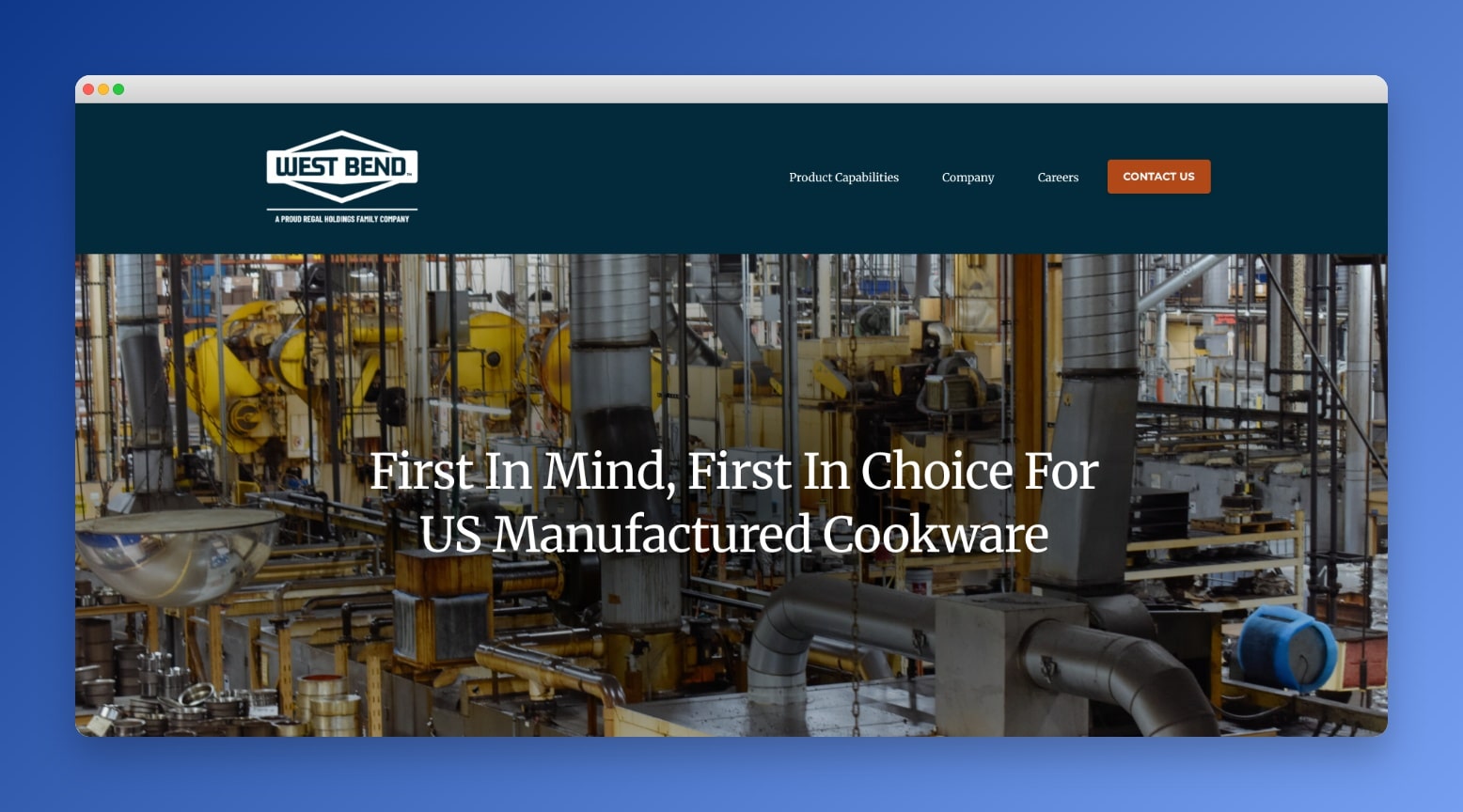
West Bend Company, headquartered in West Bend, Wisconsin, operates one of the few fully vertically integrated stainless steel cookware facilities in North America. The company handles every step of manufacturing under one roof: custom tooling, die design, metal forming, deep drawing, welding, trimming, robotic sanding and buffing, nonstick coating application, curing, polishing, and packaging.
This vertical integration is a competitive advantage that many manufacturers lack. When forming is outsourced to one supplier, coating to another, and packaging to a third, quality and cost control become difficult. Variability compounds at each handoff.
West Bend Company's integrated approach means any quality issue is immediately visible and correctable. If a batch of coated pans shows inconsistent finish, the team can adjust the spray parameters, curing temperature, or material prep without waiting for a supplier to respond. This responsiveness is reflected in quality consistency.
The company works with multi-ply cladded stainless steel constructions and offers both traditional nonstick and ceramic coating capabilities. This flexibility lets OEM partners and brands choose configurations based on their market positioning.
West Bend Company is ISO 9001:2015 certified, a certification achieved in 2024, which indicates a documented quality management system. The certification covers design control, material sourcing, manufacturing processes, and customer feedback loops.
The facility also features a robust sustainability program. This sustainability positioning appeals to environmentally conscious brands and end consumers.
With 110+ years of manufacturing experience, West Bend Company carries institutional knowledge about die design, process optimization, and troubleshooting that newer manufacturers lack. West Bend Company supplier profile
ISO 9001 Certification: What It Means and What It Doesn't
ISO 9001:2015 is an international quality management system standard. When a manufacturer is certified, it means an external auditor has verified that the company has documented processes for design control, manufacturing, material sourcing, testing, and customer feedback.
Certification is valuable because it indicates systematic thinking about quality. A certified manufacturer has written procedures, staff training records, and documented corrective actions for problems.
However, ISO 9001 is not a guarantee of product quality. It's an indicator that the manufacturer is organized and disciplined, not that the cookware is superior. A company could be ISO 9001 certified and still cut corners on material sourcing or coating application if those corners aren't explicitly tested in the audit.
The audit examines the system, not random finished products. Auditors check if the company follows its stated processes, not whether the processes themselves are optimal.
For buyers, ISO 9001 certification is a minimum expectation for serious manufacturers, especially for OEM relationships. But it should be paired with other quality indicators: material certifications, sample testing, and process-specific audits (e.g., coating thickness, heat distribution testing).
Many smaller or newer cookware manufacturers are not ISO 9001 certified but produce quality cookware. Certification is helpful for scale, credibility, and institutional discipline but not a prerequisite for quality.
Post Your Requirements and Get Matched with Suitable Manufacturers
If you're developing a cookware brand or sourcing products for private label, defining your specifications is the first step. What ply construction? What material grades? What coating type? What aesthetic finish (brushed or polished)? These choices have cost and performance implications.
Post your requirements on Wonnda and get matched with manufacturers who have relevant experience and capacity. Many manufacturers specialize in certain configurations, so matching is more effective than blind outreach.
FAQs
What's the difference between cooking surface temperature and stovetop heat?
A pan's nonstick coating can degrade if exposed to sustained high heat. PTFE nonstick is rated safe to about 500°C, but regular preheating above 400°C shortens the coating's life. When cooking, the stovetop temperature might be 300°C, but the pan surface can quickly reach 400°C or higher if heating empty. This is why manufacturers recommend never preheating an empty nonstick pan.
Why does some cookware warp, and can it be prevented in manufacturing?
Warping usually results from uneven heating or thermal shock (rapid cooling). In manufacturing, it can result from poor base forming, uneven cladding, or material residual stress. Quality manufacturers stress-relieve the finished pans using controlled cooling cycles. Some also use thicker bases (disc-clad over fully-clad for enhanced rigidity), reducing the likelihood of warping under normal use.
Is copper or aluminum better for the heat-conducting core?
Copper is superior in thermal conductivity and speed, so copper-clad (5-ply) pans heat faster and more evenly. But copper is three times more expensive and adds weight. For most home cooking, aluminum-core (3-ply) cookware is adequate and more economical. Copper is preferred for induction cooktops and professional kitchens where precision heat control is critical.
How long does nonstick coating typically last?
With normal use (wood or silicone utensils, hand washing), PTFE nonstick lasts 3 to 5 years. Ceramic nonstick typically lasts 1 to 2 years before visible wear appears. Budget cookware with thin coatings may show wear after 6 to 12 months. Premium cookware with thick, multi-layer coatings extends the lifespan to 5 to 10 years.
Can damaged nonstick coating be repaired or reapplied?
Damaged nonstick coating cannot be easily repaired at home. Some manufacturers offer recoating services, but the process is expensive (often 40% to 60% of the original pan cost) and requires shipping. It's usually more economical to replace the pan. For bare stainless or uncoated pans, there's nothing to damage, making them more economical over very long lifespans.
What's the benefit of ply construction versus single-layer stainless?
Single-layer stainless steel, without a conductive core, heats unevenly and slowly. Spots directly over the burner get much hotter than areas between burner coils. Ply construction (3-ply or higher) uses the core to distribute heat evenly, so the cooking surface heats uniformly. For stovetop cooking, this is critical for consistent results. Ply construction is standard for all premium cookware.
Find Verified Stainless Steel Cookware Manufacturers on Wonnda
Whether you're a brand founder developing your first product line, a product manager sourcing for a major retailer, or a sourcing agent hunting for contract manufacturers, locating the right cookware supplier is decisive.
Wonnda connects buyers with verified manufacturers who have experience, capacity, and quality systems. Browse profiles of stainless steel cookware manufacturers, review their capabilities (ply construction, material grades, coating options, certifications), and get matched based on your specifications.
Related articles
10+ Best Doypack Suppliers in Europe (2026 List)
10+ Best European Packaging Suppliers in 2026
Best Care Label Manufacturers and Wash Label Suppliers (2026)
10+ Best Woven Label Manufacturers in Europe and Turkey (2026)
The Complete Guide to Sustainable Textile Labels and Certifications (2026)
Clothing Label Requirements in Europe: What Fashion Brands Must Include (2026)
Best Sustainable Label Manufacturers for Eco-Conscious Brands (2026)
10+ Best Sustainable Packaging Suppliers in Europe (2026 Update)