
Clothing Label Requirements in Europe: What Fashion Brands Must Include (2026)

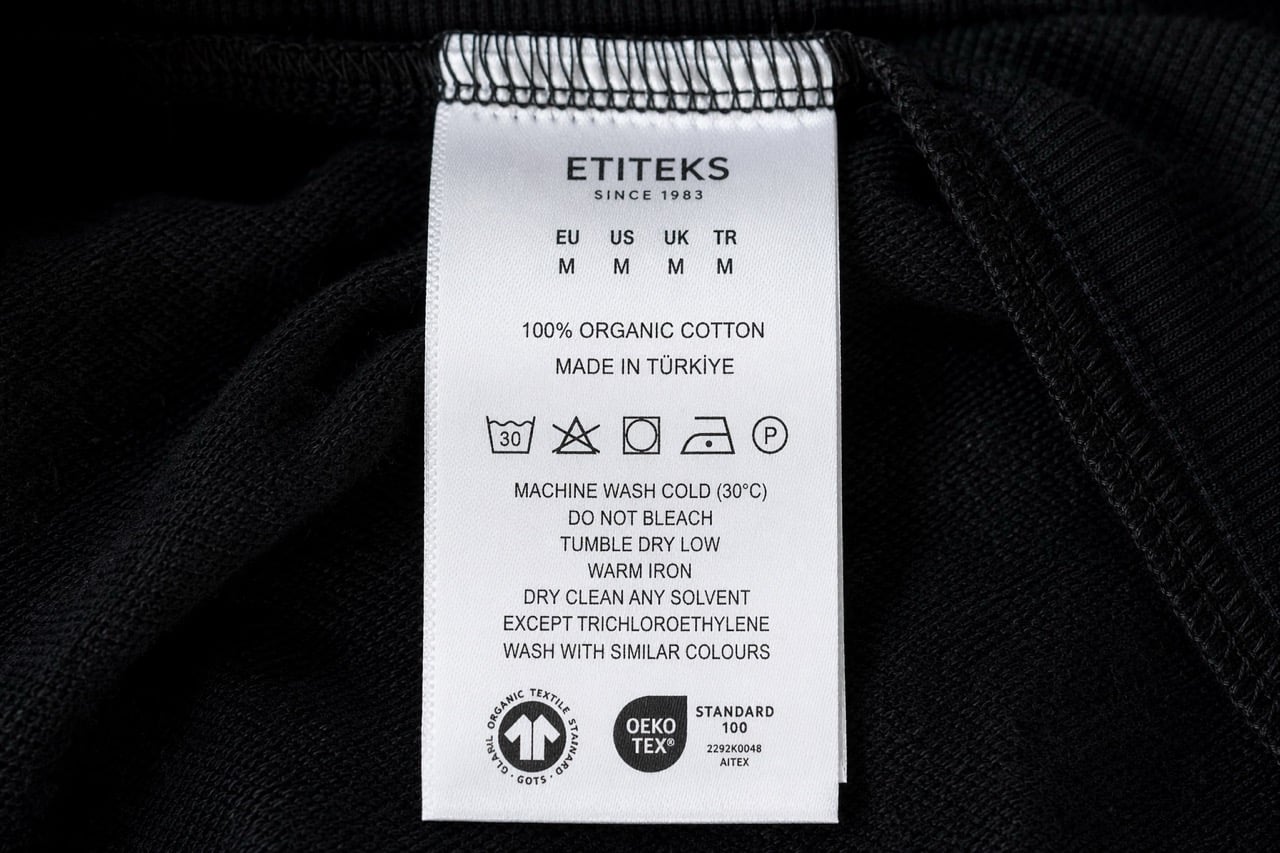
Selling clothing in Europe means complying with a clearly defined set of textile labeling requirements. These are legal obligations under EU and national regulations. Non-compliance leads to products being removed from retail shelves, rejected at customs, or flagged during market surveillance checks. Online sellers also face listing removals from marketplaces enforcing compliance policies.
This guide breaks down what must appear on your labels, how to structure that information correctly, and how to work with a label manufacturer to get it right from the start.
Key Takeaways
- EU Regulation 1007/2011 mandates fiber composition labeling for all textile products sold in the EU
- Care instructions are not legally required in the EU but are expected by retailers and strongly recommended
- The UK has its own post-Brexit textile labeling framework with some differences
- Country of origin is not mandatory in the EU for most textiles, but required in the US and commonly used across markets
- The EU Digital Product Passport (DPP) will introduce additional data requirements from around 2027
- Working with a label manufacturer experienced in multi-market compliance reduces costly errors
EU Textile Labeling: The Core Regulation about Clothing Labels
EU Regulation 1007/2011
This is the primary regulation governing textile labeling in the European Union. It applies to all textile products placed on the EU market, whether produced locally or imported.
What it requires
| Requirement | Details |
|---|---|
| Fiber composition | Must state the fiber name and percentage by weight of each fiber using harmonized names from Annex I |
| Presentation | Must be durable, legible, visible, and accessible |
| Language | Must be in the official language(s) of the country where the product is sold |
| Multi-fiber products | Fibers listed in descending order by weight; under 5% can be “other fibers” |
| “100%” claims | Only allowed if the product is entirely one fiber (2% tolerance; 5% for carded fibers) |
| Animal-origin parts | Must state “Contains non-textile parts of animal origin” where applicable |
How to Write Fiber Composition Correctly
The EU requires standardized fiber names. Brand or marketing terms are not accepted.
| Common Name | Correct EU Name | Example Label |
|---|---|---|
| Polyester | Polyester | 100% Polyester |
| Cotton | Cotton | 80% Cotton, 20% Polyester |
| Nylon | Polyamide | 100% Polyamide |
| Lycra/Spandex | Elastane | 95% Cotton, 5% Elastane |
| Rayon | Viscose | 100% Viscose |
| Cashmere | Cashmere | 70% Wool, 30% Cashmere |
Multi-component garments
If different parts have different compositions, each must be listed separately:
**Example:**Body: 80% Wool, 20% Polyamide
Lining: 100% Polyester
Trimmings and accessories
Small elements like buttons, zippers, or decorative trims under 7% of total weight are excluded from composition calculations.
What Is NOT Required by EU Regulation
Some elements are commonly assumed to be mandatory but are not:
| Information | Required in EU? | Notes |
|---|---|---|
| Care instructions | No | Strongly recommended and expected by retailers |
| Country of origin | No | Required in US; optional in EU but must be accurate if used |
| Manufacturer/importer | No (on label) | Required in documentation |
| Size | No | Industry convention only |
| Brand name | No | Commercial decision |
Care Labeling: Standards and Best Practice
ISO 3758: The Global Standard
Care symbols are not legally required in the EU but are universally expected across retail and e-commerce.
Five symbol categories:
| Symbol | Meaning |
|---|---|
| Washtub | Washing instructions |
| Triangle | Bleaching |
| Square with circle | Drying |
| Iron | Ironing |
| Circle | Professional cleaning |
Getting care instructions right
- Instructions must reflect real product performance
- They should be based on actual testing, not assumptions
- Incorrect instructions create liability and customer complaints
A practical rule: if a label says “wash at 40°C,” the product must withstand repeated washing at that temperature without damage.
UK Textile Labeling (Post-Brexit)
The UK uses the Textile Products (Labelling and Fibre Composition) Regulations 2012, closely aligned with EU rules.
Key differences
| Area | EU | UK |
|---|---|---|
| Language | Local EU language | English required |
| Responsible party | EU-based | UK-based |
| Fiber names | EU list | UK list (similar) |
| Country of origin | Not required | Recommended |
For brands selling in both markets, one well-designed label can typically cover both.
Country of Origin Labeling
EU
No general requirement, but if included it must be accurate under origin rules.
US
Mandatory for all textile products.
UK
Not strictly required, but misleading claims are prohibited.
Practical approach
Including country of origin on labels simplifies international compliance and aligns with consumer expectations.
Digital Product Passport (DPP): What’s Coming
The EU Digital Product Passport will introduce digital data requirements for textile products, expected around 2027–2028.
Expected data categories
| Category | Examples |
|---|---|
| Materials | Fiber composition, recycled content |
| Manufacturing | Production location, processes |
| Sustainability | Environmental metrics, certifications from suppliers |
| Durability | Care instructions, lifespan |
| End-of-life | Recycling and disposal guidance |
| Supply chain | Supplier information |
Impact on labels
- Physical labels remain mandatory
- QR codes or similar data carriers will link to digital data
- Label design will need to integrate digital identifiers
Working with Your Label Manufacturer
A capable manufacturer goes beyond printing and actively supports compliance.
What to expect
| Service | Description |
|---|---|
| Regulatory review | Checks label content against target market rules |
| Symbol validation | Ensures ISO 3758 accuracy |
| Fiber verification | Confirms correct terminology |
| Multi-market design | Creates labels for EU, US, UK simultaneously |
| Language guidance | Advises on required translations |
| Layout optimization | Ensures readability within size constraints |
Red flags
- No compliance review
- No knowledge of ISO 3758
- No multi-market experience
- No language guidance
Supplier Highlight: Etiteks
Meeting labeling requirements across multiple markets requires both production scale and regulatory expertise. Etiteks, based in Istanbul, is an example of a manufacturer integrating compliance into its workflow.
Experience
- Established in 1983
- Exports to over 60 countries
- Works across fashion, sportswear, and home textiles
Compliance capabilities
| Area | Capability |
|---|---|
| EU fiber composition | Verifies correct terminology before production |
| Care symbols | Ensures correct ISO 3758 usage |
| US requirements | Advises on origin labeling and identification rules |
| UK labeling | Supports post-Brexit requirements |
| Multi-language | Designs labels for multiple markets |
| Complex garments | Handles multi-component declarations |
Production capabilities
| Capability | Details |
|---|---|
| Capacity | Up to 15 million care labels per month |
| Durability | Designed for 50+ wash cycles |
| Materials | Satin, recycled satin, organic cotton, taffeta |
| Product lines | Care labels, woven labels, swing tags |
Sub-contractors and material suppliers within the production network hold relevant certifications such as GOTS, GRS, OCS, RCS, OEKO-TEX Standard 100, Sedex, and FSC, supporting material safety, traceability, and responsible sourcing practices.
Common Compliance Mistakes
- Using brand names instead of official fiber names
- Incorrect fiber percentages
- Care instructions not based on testing
- Missing multi-component breakdowns
- Not adapting labels for different markets
- Forgetting animal-origin disclosure
Frequently Asked Questions
Are care labels required in the EU?
No, but they are expected by retailers and consumers. In practice, they are essential.
Can one label cover EU and US?
Yes, if it includes fiber composition, care symbols, country of origin, and company identification.
What happens if labels are non-compliant?
Products can be rejected by retailers, blocked at customs, fined, or removed from marketplaces.
Do trims need to be listed?
No, small trims under 7% of total textile weight are excluded.
When will the Digital Product Passport apply?
Expected around 2027–2028.
What languages are required?
Labels must use the official language of each market where the product is sold. Multi-language labels are common.
Related articles

10+ Best Doypack Suppliers in Europe (2026 List)

10+ Best European Packaging Suppliers in 2026
Stainless Steel Cookware Manufacturing: Materials, Processes, and What Buyers Should Know
Best Care Label Manufacturers and Wash Label Suppliers (2026)
10+ Best Woven Label Manufacturers in Europe and Turkey (2026)
The Complete Guide to Sustainable Textile Labels and Certifications (2026)
Best Sustainable Label Manufacturers for Eco-Conscious Brands (2026)

10+ Best Sustainable Packaging Suppliers in Europe (2026 Update)